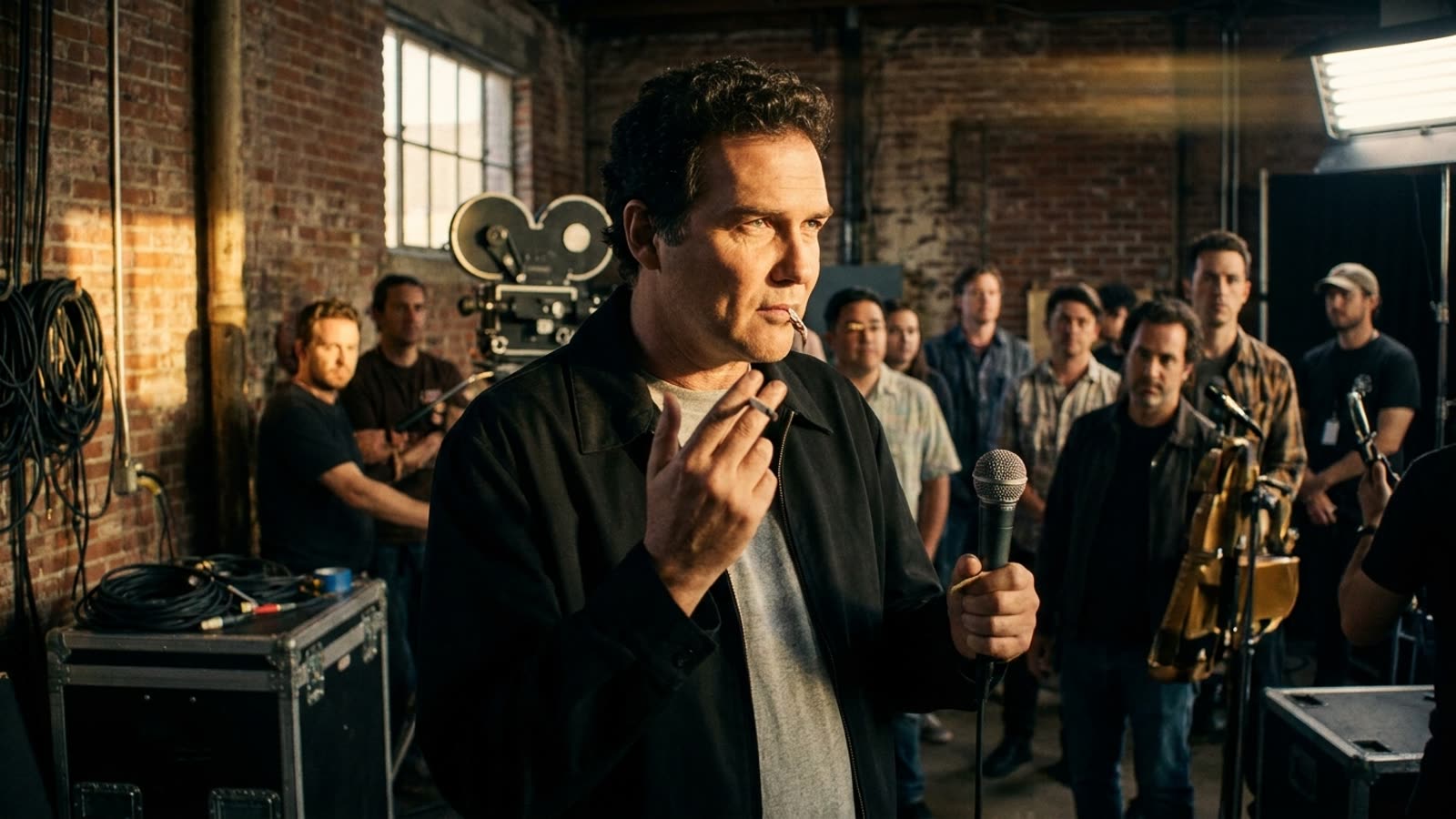
Four years after Norm Macdonald died quietly of cancer he'd hidden from nearly everyone, Judd Apatow has delivered a documentary that refuses the usual beatification. "Norm: The Tale of Norm Macdonald" is not a celebration of a beloved comedian; it is an autopsy of a man who weaponized humor against intimacy, audience, and self—and somehow remained impossible to look away from.
The film arrives at a moment when comedy documentaries have calcified into a predictable genre: archival clips, tearful colleagues, redemption arc, standing ovation. Apatow, who has made his share of sentimental work, seems to have recognized that Macdonald would have despised that treatment. Instead, the director leans into the discomfort, letting the portrait stay jagged.
The Andy Kaufman problem
Macdonald's comedy operated in a register that alienated as often as it delighted. His infamous "Weekend Update" tenure at Saturday Night Live ended not because he wasn't funny, but because he was funny in ways that made powerful people uncomfortable—most notably his relentless O.J. Simpson jokes, which reportedly irritated NBC executive Don Ohlmeyer. The documentary treats this firing not as martyrdom but as the logical consequence of Macdonald's inability, or refusal, to read a room.
Apatow draws an explicit line to Kaufman, another comic who seemed to be conducting psychological experiments on audiences rather than entertaining them. But where Kaufman's provocations often felt conceptual, Macdonald's had a wounded quality—as if he was testing whether anyone would still be there when the bit ended.
The secret illness
The film's most haunting material concerns Macdonald's nine-year battle with cancer, which he disclosed to almost no one. Colleagues describe learning of his death and his diagnosis simultaneously. The secrecy wasn't stoicism; it was consistent with a life spent keeping people at a calculated distance. Apatow doesn't psychoanalyze this choice, but he doesn't need to. The pattern is evident in every interview clip, every deflection, every joke that landed like a door closing.
What emerges is a portrait of comedy as armor—and armor that eventually becomes indistinguishable from the person wearing it. Macdonald's late-career work, including his Netflix talk show and his memoir "Based on a True Story" (which was almost entirely fabricated), takes on new meaning in this light. He was a man who told lies for a living and found the habit impossible to break even when the stakes were mortal.
Our take
The documentary's achievement is refusing to resolve its subject into coherence. Macdonald was brilliant, difficult, possibly cruel, certainly lonely, and very funny—all at once, without apology. Apatow has made a film that honors that complexity by declining to flatten it. In an era when celebrity memorials tend toward hagiography, this is the rare tribute that treats its subject as an adult who made choices and lived with consequences. Macdonald would probably have hated it, which is the highest compliment available.