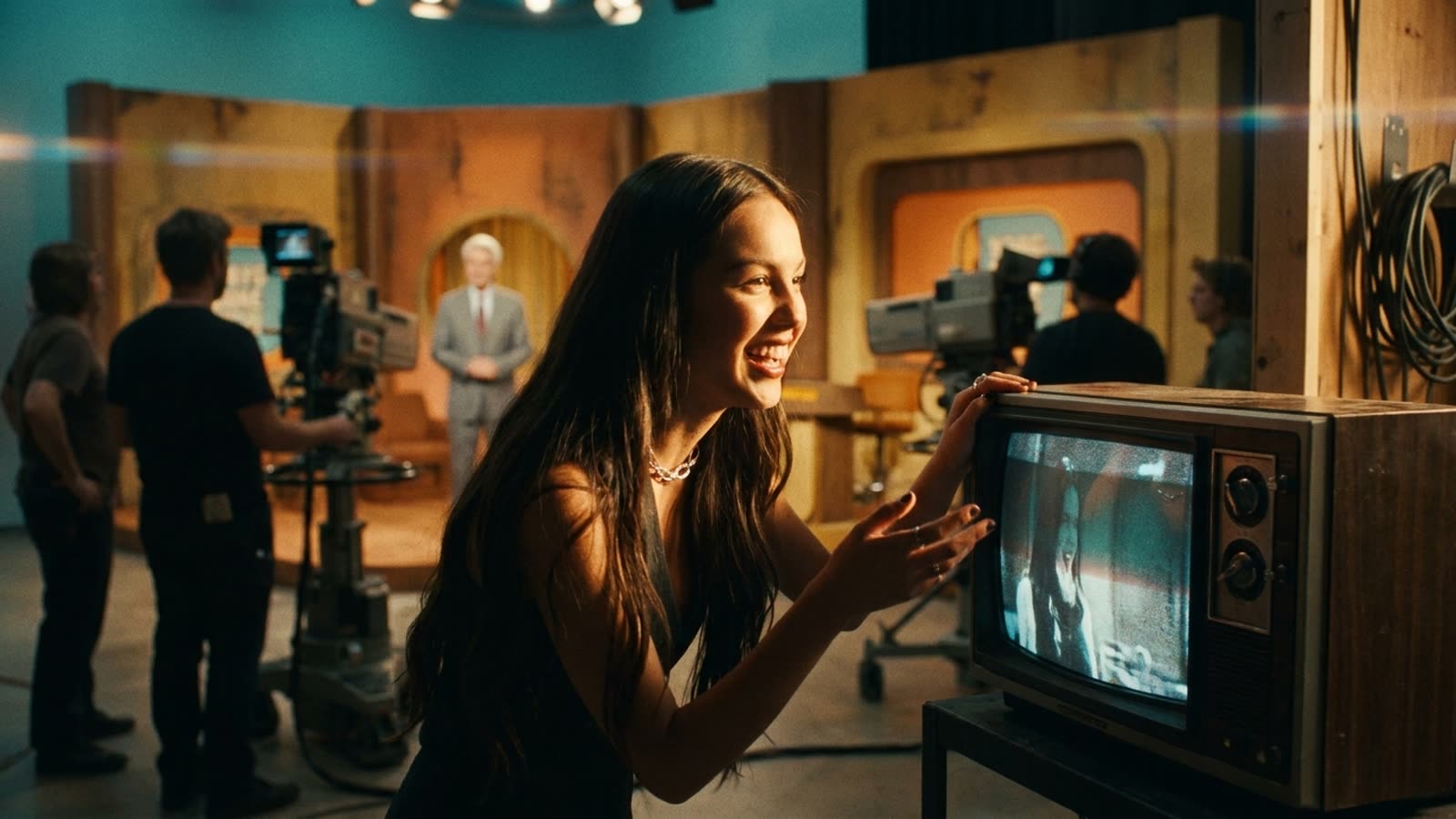
Pop music's two biggest critical darlings have released a music video that looks like it was filmed on a VHS camcorder in 1978, and the choice is anything but accidental. The clip for the "Expectations" remix—a collaboration that unites Olivia Rodrigo's stadium-filling melodrama with Chappell Roan's queer maximalism—drops both artists into a series of retro game shows hosted by Talking Heads frontman David Byrne, complete with scan lines, wood-paneled sets, and the kind of synthetic enthusiasm that once sold laundry detergent between Wheel of Fortune segments.
The visual grammar is deliberate pastiche. Director Bardia Zeinali, who has built a career on music videos that treat irony as a structural material, stages Rodrigo and Roan as contestants competing in absurdist challenges while Byrne delivers questions with the deadpan surrealism he perfected four decades ago. Producer Dan Nigro also appears, completing a triptych of figures who have each, in their own way, made careers out of deconstructing pop sincerity.
Why Byrne Matters Here
Casting David Byrne is the video's sharpest move. At 74, he remains the patron saint of artists who want to be popular and strange simultaneously—a balance Rodrigo and Roan are both actively negotiating. His presence grants the project a credibility that transcends the usual influencer cameo; it signals that the video is aware of its own artifice, and that the artifice is the point. When Byrne asks a game-show question, the joke is that there is no correct answer, only performance.
The Nostalgia Industrial Complex
The retro aesthetic is now so ubiquitous in pop visuals that it risks becoming wallpaper. But the "Expectations" video earns its VHS filter by making the format itself a comment on the song's themes. The original track, from Rodrigo's sophomore album, is about the gap between who you're supposed to be and who you actually are—a tension that game shows, with their scripted spontaneity and canned applause, embody perfectly. Roan's verse, added for the remix, sharpens the critique: her delivery suggests someone who has learned to perform authenticity so well that the performance has become indistinguishable from the real thing.
The Collaboration Economy
This is the third high-profile collaboration between Rodrigo and Roan in eighteen months, and it raises a question the industry prefers not to answer: when does creative partnership become brand synergy? Both artists occupy similar cultural real estate—young, female, critically adored, commercially dominant—and their repeated pairings feel less like artistic inevitability than strategic portfolio diversification. That's not a criticism, exactly; it's simply the logic of pop music in 2026, where even rebellion is a joint venture.
Our take
The video is good—genuinely, surprisingly good—and it knows exactly what it's doing. Rodrigo and Roan have figured out that the way to stand out in an era of infinite content is to make something that looks like it predates the internet entirely. The gambit works because both artists are talented enough to sell the bit, and because Byrne's presence transforms what could have been a gimmick into something closer to commentary. Whether the nostalgia machine can sustain this trick indefinitely is another question. For now, the scan lines are holding.