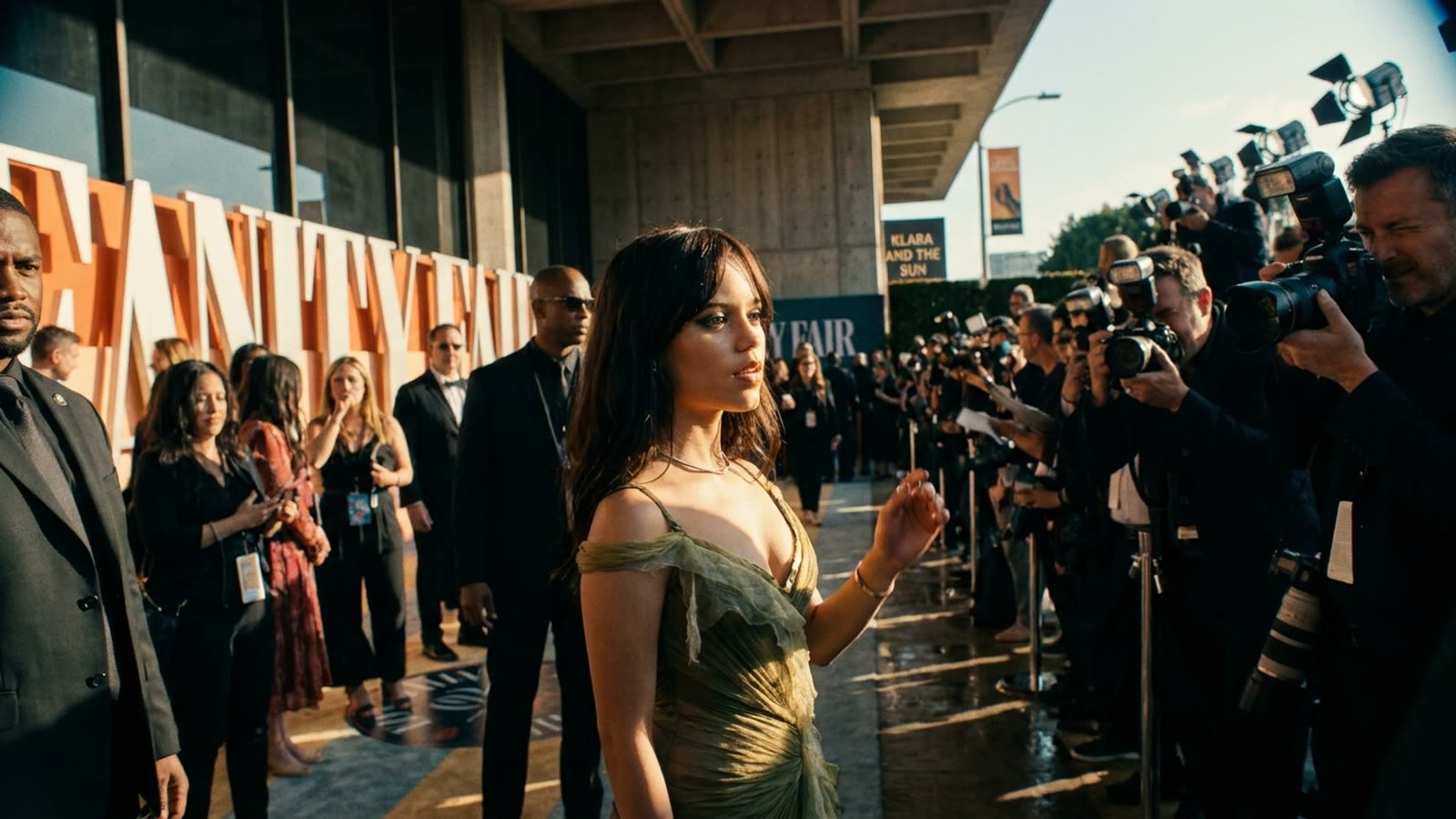
Jenna Ortega has become Hollywood's most bankable young actor by playing characters who observe the world with unnerving stillness — the deadpan Wednesday Addams, the final girl who refuses to scream on cue. Now, at the London premiere of Taika Waititi's adaptation of Kazuo Ishiguro's Klara and the Sun, she is asking audiences to do something radical: observe the world at all.
"I think we gotta put our focus on one another and put down the computers and phones," Ortega told press at the Leicester Square screening, a statement that sounds like boilerplate celebrity wellness-speak until you consider the film she's promoting. In Ishiguro's 2021 novel, Klara is an "Artificial Friend" — a solar-powered companion designed to love a chronically ill teenager named Josie. The story is told entirely from Klara's perspective, her synthetic devotion both touching and deeply uncomfortable. Ortega plays Josie; the AI is voiced by Saoirse Ronan.
The uncomfortable mirror
Waititi's adaptation arrives at a moment when the line between Ishiguro's near-future and our present has grown disturbingly thin. AI companions are no longer speculative fiction — they are subscription services. Character.AI reported over 20 million monthly users earlier this year, many of them teenagers seeking emotional connection with chatbots. The film's central question — whether artificial devotion can substitute for human presence — is no longer philosophical. It is a product category.
Ortega, 23, has been unusually vocal about technology's encroachment on creative work. She publicly clashed with Wednesday producers over AI-generated scripts and has spoken about limiting her own social media consumption despite having built her career partly through viral TikTok moments. Her casting as the human girl loved by a machine carries a certain meta-weight.
Waititi's tonal gamble
The New Zealand director is known for mining absurdist comedy from dark premises — Nazi satire in Jojo Rabbit, vampire bureaucracy in What We Do in the Shadows. Ishiguro's novel is almost entirely devoid of humor, a meditation on mortality and the limits of love told in Klara's eerily polite voice. Early reactions from the premiere suggest Waititi has largely resisted the urge to wink, delivering something closer to his underrated Boy than to Thor: Ragnarok. Whether mainstream audiences will follow him into that register remains uncertain.
The film is distributed by A24, which has bet heavily on prestige science fiction in recent years with mixed commercial results. Klara will need strong reviews and awards-season momentum to justify its reported budget, which sources place north of $60 million — substantial for a film with no explosions and a protagonist who cannot move her face.
Our take
Ortega's plea to put down the phones is easy to dismiss as red-carpet piety, but Klara and the Sun earns the sentiment. Ishiguro's novel understood something that most AI discourse still misses: the danger is not that machines will become too human, but that we will become too comfortable with substitutes for humanity. That a 23-year-old actor is willing to stake her post-Wednesday momentum on a quiet, unsettling film about that trade-off suggests she understands her moment better than most of her peers.