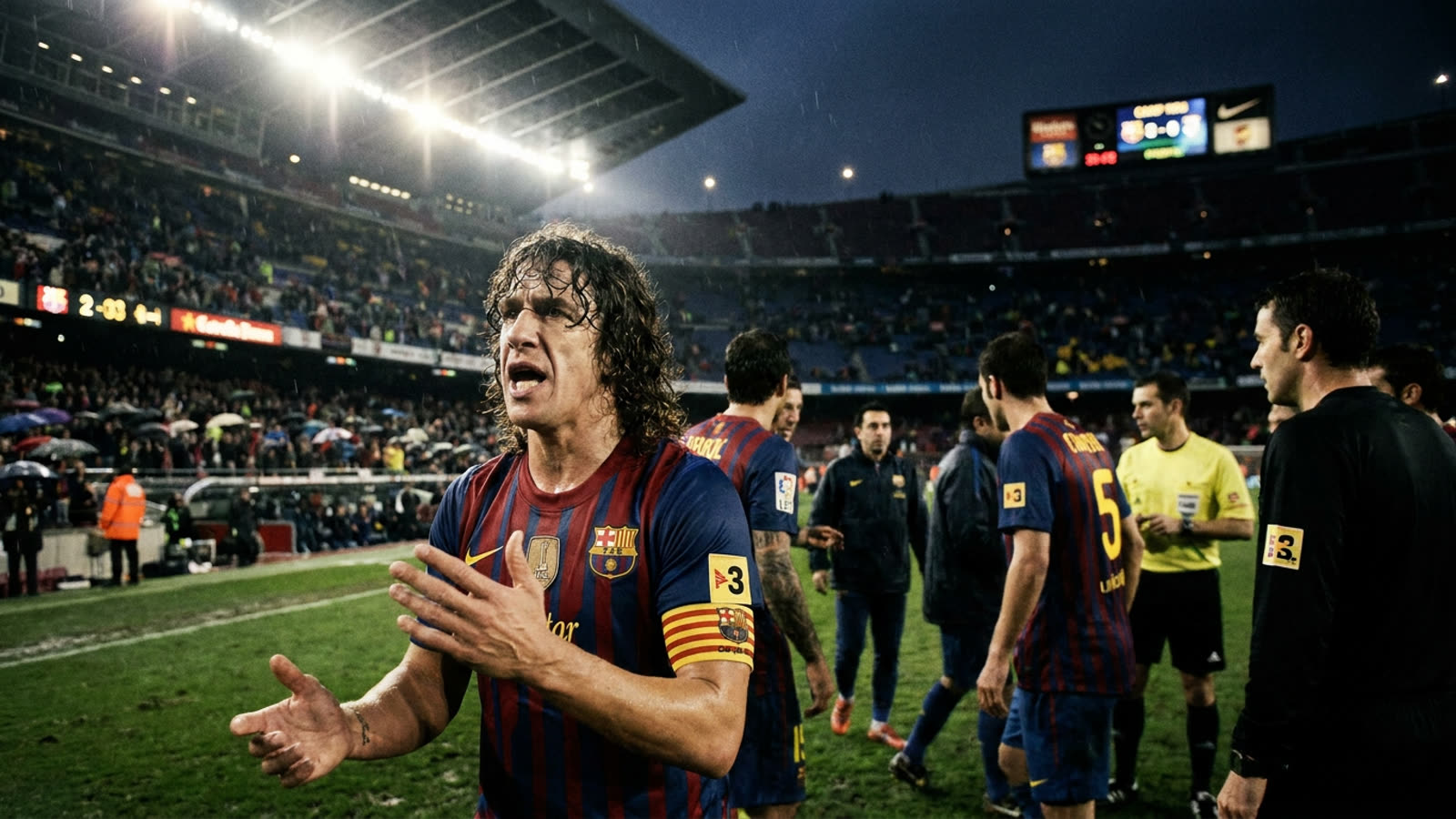
Modern football worships the ball-playing center-back, the defender who can ping sixty-yard diagonals and dribble past pressing forwards. Carles Puyol could do neither with any particular elegance. What he could do was throw his body into spaces where bodies were not meant to go, organize ten teammates through sheer force of personality, and somehow make chaos look like strategy. In an era that increasingly prizes technical sophistication at every position, Puyol's career stands as a reminder that some qualities cannot be coached or quantified.
The image that defines him arrived in the 2010 World Cup semifinal against Germany. A corner swung in, and Puyol launched himself horizontally through a thicket of players, his wild curls trailing behind him like a battle standard. The header was not technically perfect—it was desperate, committed, almost reckless. Spain won 1-0. They went on to lift the trophy. The man who scored the goal that mattered most was the one least likely to appear on a highlight reel in any other context.
The anti-galáctico
Puyol came through Barcelona's academy during the late 1990s, when the club was spending lavishly on foreign stars and largely ignoring homegrown talent. He was not initially a center-back; he played right-back, then defensive midfield, then wherever the team needed someone willing to run through walls. His permanent move to central defense coincided with the arrival of Frank Rijkaard and the beginning of Barcelona's modern golden age.
What made Puyol unusual was his refusal to conform to the aesthetic expectations of the club. Barcelona prided themselves on beautiful football, on positional play and patient construction. Puyol's contributions were frequently ugly: last-ditch tackles, headed clearances, the occasional agricultural challenge that left opponents wondering if they had wandered into a different sport entirely. Yet he captained the most aesthetically pleasing team of his generation for nearly a decade. The contradiction was the point.
Leadership as physical commitment
There is a particular type of captain who leads through example rather than instruction, whose authority derives from the visible evidence that he will sacrifice more than anyone else on the pitch. Puyol belonged to this category. His face, perpetually bloodied or bandaged, became a symbol of what he was willing to endure. Teammates spoke of his presence in the dressing room not in terms of tactical insight but in terms of moral weight—the knowledge that whatever was asked of them, he had already done more.
This style of leadership has become increasingly rare. The modern game's emphasis on rotation, load management, and long-term physical preservation makes the Puyol approach seem almost anachronistic. Players are assets to be protected, not soldiers to be spent. The captain's armband now often goes to the best communicator or the longest-serving player rather than the one most willing to bleed.
Our take
Puyol retired in 2014 with his body essentially broken, his knees having absorbed more punishment than any medical professional would recommend. He won everything available—three Champions Leagues, six league titles, the World Cup, the European Championship—but his legacy transcends the trophy count. He proved that excellence in football does not require elegance, that leadership can be demonstrated through controlled violence, and that sometimes the most important player on a team of artists is the one willing to do the dirty work. The game has moved on, become more sophisticated and more careful. It has not necessarily become better.