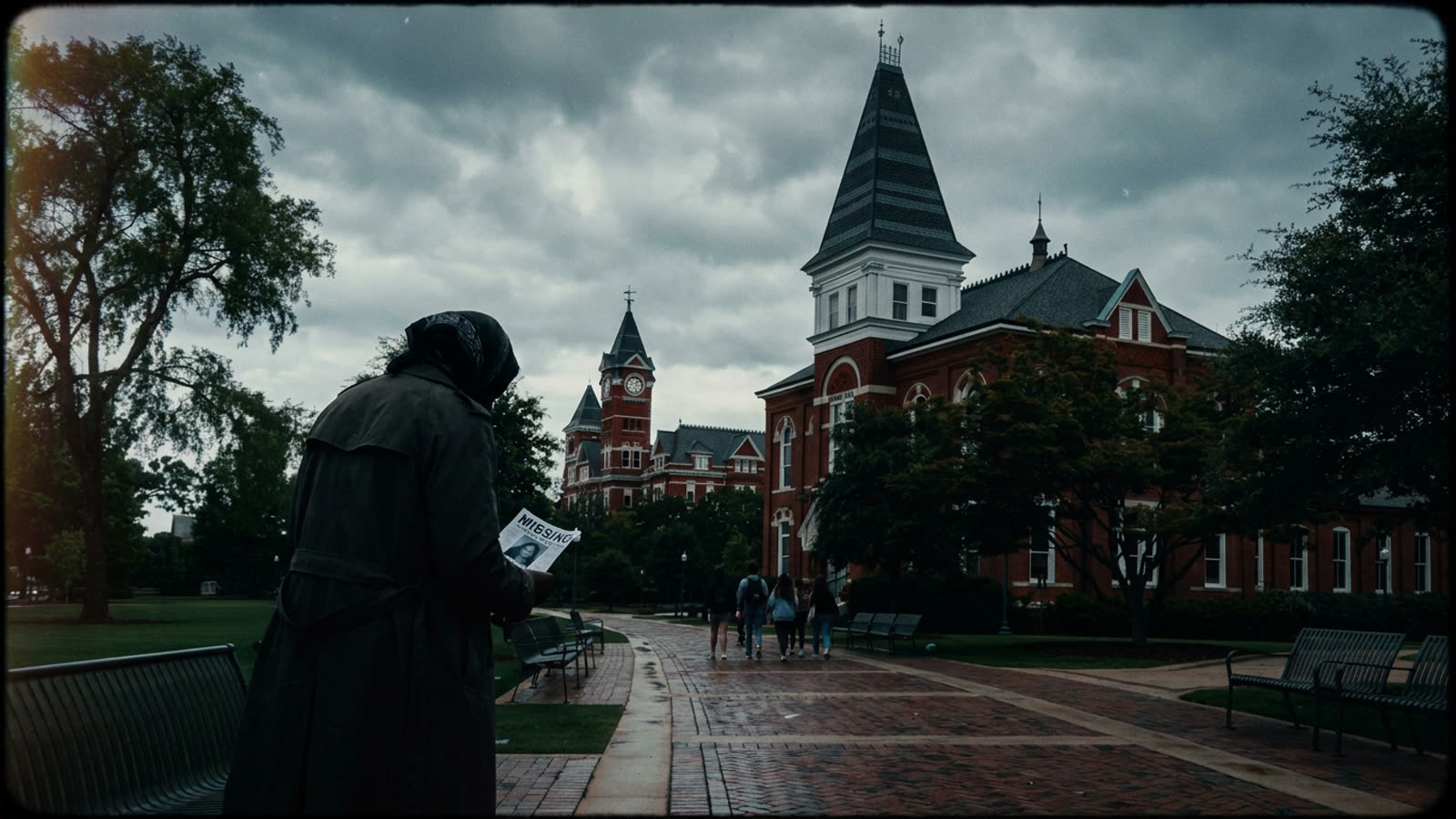
When a college student vanishes, the first 72 hours determine everything—and at Auburn University, those hours have produced more questions than answers.
The disappearance of an Auburn junior, reported missing since Tuesday evening, has transformed a leafy Alabama campus into a study in institutional paralysis. Campus police issued a standard missing-person alert. The university released a statement expressing "concern" and directing students to counseling services. Meanwhile, the student's family has taken to social media with the raw desperation of people who feel the system has already failed them.
The information vacuum
What we know remains frustratingly thin: the student was last seen leaving a campus library, phone activity ceased within hours, and no witnesses have come forward with substantive leads. What we don't know—whether foul play is suspected, whether surveillance footage exists, whether the FBI has been consulted—reflects either an ongoing investigation or an alarming lack of coordination.
Auburn's communications team has defaulted to the standard playbook: privacy concerns, deference to law enforcement, carefully lawyered language designed to minimize liability. For a family watching the clock tick toward statistical grimness, such caution reads as indifference.
Campus safety's persistent blind spots
American universities have spent two decades and billions of dollars on security infrastructure since Virginia Tech. Emergency alert systems can reach every registered phone within seconds. Blue-light stations dot quadrangles. Yet when a student actually disappears, the response often reveals how much of that investment is theater.
The challenge is structural: campus police operate in an awkward jurisdictional limbo, often undertrained for serious criminal investigation and politically constrained from alarming prospective students and their tuition-paying parents. Town-gown tensions complicate cooperation with municipal departments. The result is a patchwork response that serves institutional reputation better than individual safety.
Our take
Every missing-person case deserves the presumption that time is the enemy. Auburn's measured response may prove justified if this resolves safely, but the family's visible anguish suggests they're not feeling partnered with—they're feeling managed. Universities owe their students more than crisis-communications protocols. They owe them the uncomfortable truth that when someone vanishes, bureaucratic caution costs lives.