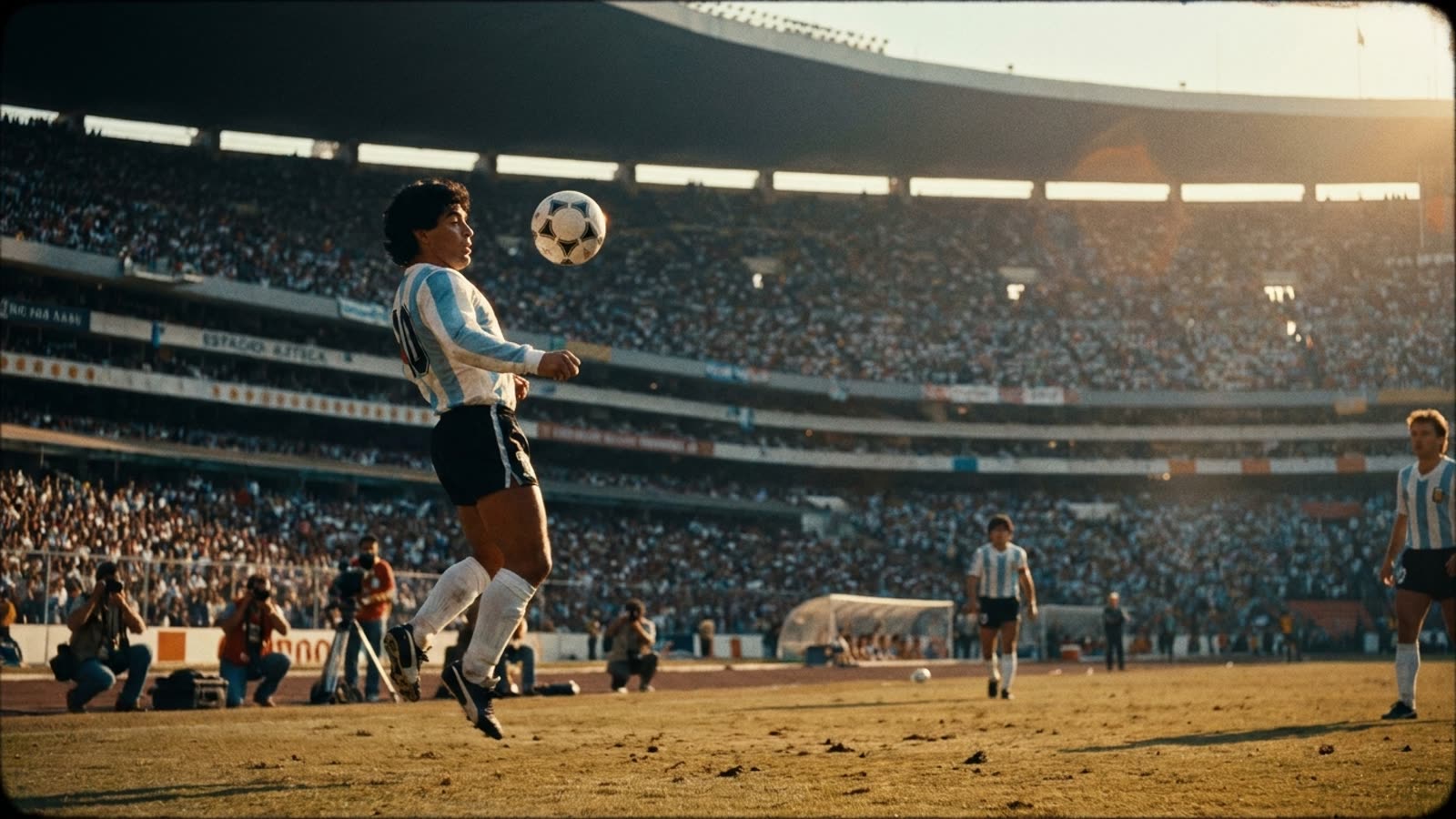
The 1986 World Cup quarterfinal between Argentina and England was never going to be just a football match. Four years after the Falklands War, the fixture carried the weight of geopolitics, wounded national pride, and the simmering resentment of a country that felt humiliated by a distant colonial power. Into this cauldron stepped Diego Armando Maradona, who would deliver not one but two goals that would define the sport's relationship with morality, beauty, and the thin membrane separating them.
The first goal, scored in the 51st minute, was a fraud. Maradona rose with England goalkeeper Peter Shilton, punched the ball into the net with his left fist, and wheeled away in celebration while the English players protested in vain. The Tunisian referee Ali Bin Nasser saw nothing. When asked about it afterward, Maradona offered his famous explanation: the goal was scored "un poco con la cabeza de Maradona y otro poco con la mano de Dios." A little with the head of Maradona, a little with the hand of God.
The goal that absolved everything
Four minutes later, Maradona collected the ball in his own half, turned, and began to run. What followed was sixty meters of controlled chaos — five English players beaten, Shilton sent sprawling, and the ball rolled into the net with Maradona's left foot. FIFA would later officially designate it the "Goal of the Century." The juxtaposition was almost too perfect: the sport's greatest act of cheating followed immediately by its greatest act of genius, both performed by the same man, in the same match, against the same opponent.
This is what makes Mexico City's Estadio Azteca on June 22, 1986, the sport's most important single afternoon. Maradona did not merely score two goals; he created the template for how football would understand itself. The beautiful game contains multitudes. It rewards cunning and artistry in equal measure. The line between gamesmanship and genius is not a line at all but a spectrum, and Maradona occupied every point on it simultaneously.
Why the hand still matters
The Hand of God has never been forgotten because it refuses to resolve into a simple narrative. English fans still seethe at the injustice. Argentine fans shrug and note that England had a navy and Argentina had Maradona. Neutrals remain genuinely uncertain whether they should admire the audacity or condemn the dishonesty. The goal exists in a state of permanent moral suspension, which is precisely why it endures.
VAR would have disallowed it in seconds. Modern football's surveillance apparatus exists in part because of what Maradona did that afternoon. Yet something would have been lost. The Hand of God is not merely a refereeing error; it is a story about power, colonialism, revenge, and the idea that football can matter beyond football. No technology can adjudicate those questions.
Our take
Maradona died in November 2020, and the eulogies inevitably circled back to that afternoon in Mexico City. The Hand of God and the Goal of the Century are inseparable not because they happened four minutes apart but because they represent the same truth about the sport. Football is not chess. It does not reward pure logic or moral clarity. It rewards those who understand that the game is played in the space between rules and reality, between what is permitted and what is possible. Maradona understood this better than anyone who has ever lived. That he was also capable of transcendent beauty only made the paradox more complete.