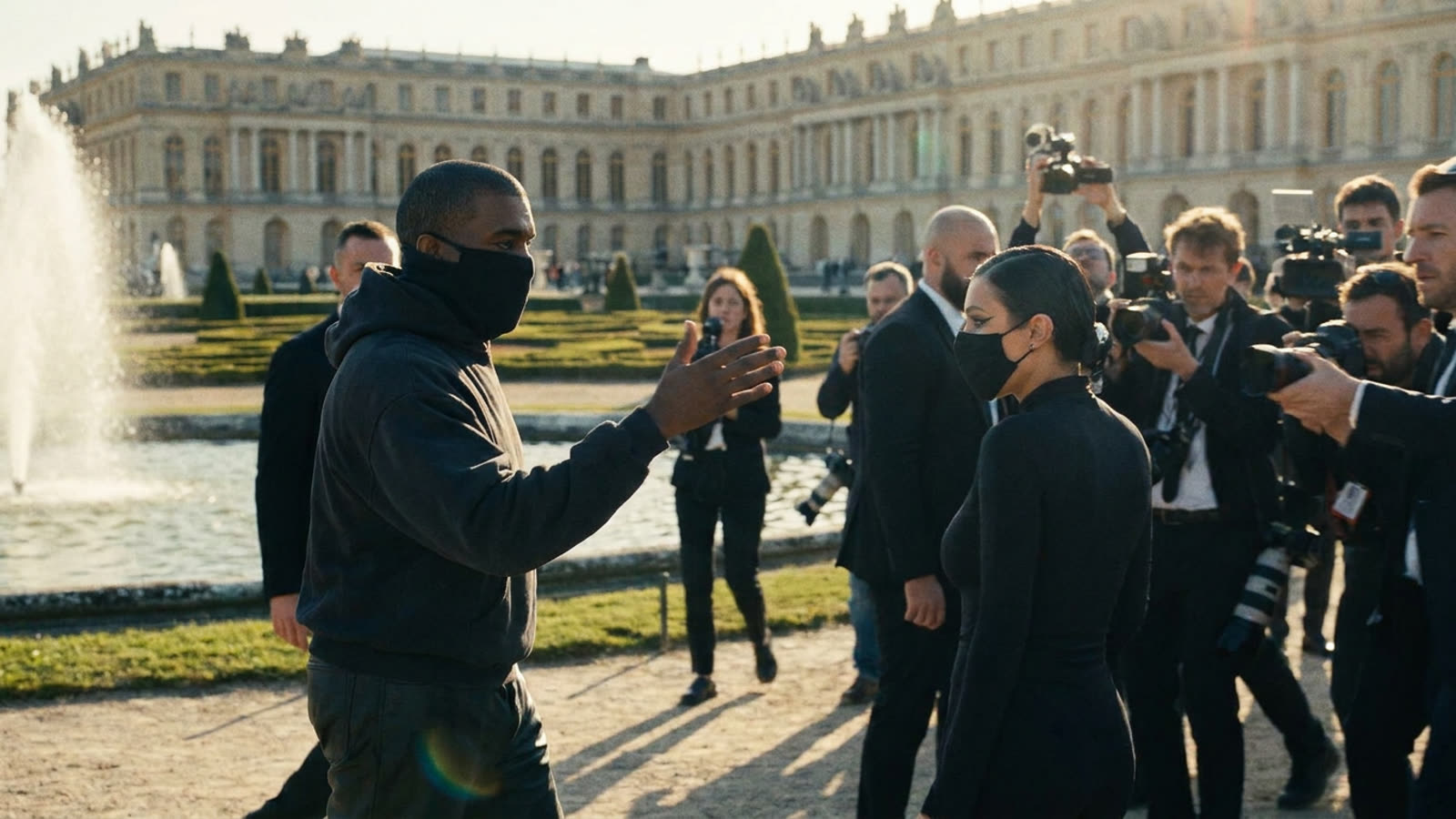
When Ye and Bianca Censori showed up at the Palace of Versailles this week in full masquerade regalia—faces obscured, outfits theatrical—they weren't simply celebrating a birthday. They were staging a performance that crystallizes everything strange about celebrity in 2026: the compulsion to be seen while hiding, the use of history as backdrop, the transformation of public space into private theater.
The images circulating from the visit show the couple wandering the Hall of Mirrors and gardens in elaborate costume, Censori in one of her signature barely-there ensembles paired with an ornate mask, Ye similarly obscured. It is, on one level, absurd. On another, it is entirely logical—the endpoint of a decade in which historical monuments have become content farms and celebrity has become less about being known than about being witnessed.
The palace as prop
Versailles receives roughly eight million visitors annually, making it one of the most trafficked heritage sites on Earth. For most, it represents a pilgrimage to history—the seat of Louis XIV, the birthplace of modern France, the gilded monument to absolute power that eventually sparked revolution. For a certain tier of celebrity, it represents something else: a ready-made set with better production value than any studio could construct.
This is not new, exactly. The wealthy have always sought to associate themselves with grandeur. But the nature of that association has shifted. Where once the point was to own such spaces, or at least to be photographed in them as if one belonged, now the point is to disrupt them—to impose one's personal aesthetic so thoroughly that the monument becomes secondary to the visitor. Ye and Censori did not go to Versailles to see it. They went to be seen at it.
The mask paradox
The masquerade element adds a layer of deliberate contradiction that has become Ye's signature. The mask says: I am hiding. The setting says: Look at me. The combination says: I control the terms of my visibility. This is celebrity as power play, presence as performance.
Censori has become central to this project. Her wardrobe choices—frequently minimal to the point of controversy—generate headlines reliably. The addition of an elaborate mask does not diminish her visibility; it amplifies it by adding mystery to provocation. She has become, in effect, a walking art installation, with Ye as curator and the world's most famous buildings as gallery walls.
Our take
There is something both tiresome and fascinating about the Ye-Censori project. Tiresome because the provocation feels mechanical at this point—another week, another boundary tested, another monument conscripted into the content machine. Fascinating because it works, every time, revealing something uncomfortable about our collective attention. We know we are being manipulated. We look anyway. Versailles was built to awe visitors into submission before the power of the Sun King. Now it serves the same function for a different kind of royalty—one that rules not through divine right but through the algorithm's favor.