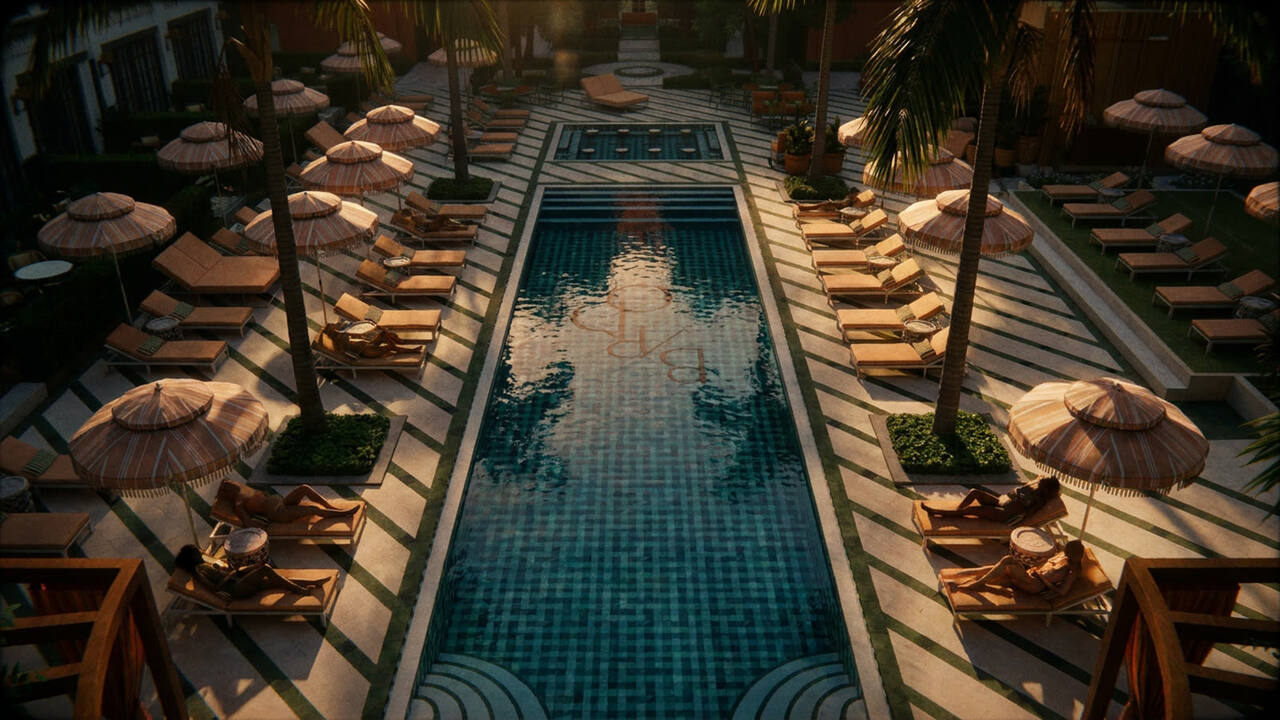
The swimming pool is architecture's great leveler. For the price of a room — or sometimes just a drink at the bar — anyone can float in the same water where movie stars once sunbathed, gaze at the same mountain range, feel the same desert heat. No other amenity in hospitality has done more to democratize the experience of leisure than the hotel pool, and no other amenity is being more quietly abandoned.
The golden age began in the American Southwest, where mid-century architects discovered that a rectangle of blue water could anchor an entire aesthetic philosophy. The pools at Palm Springs' hotels weren't afterthoughts tucked behind service buildings; they were the buildings' reason for being. Architects like Albert Frey and Donald Wexler designed structures that existed primarily to frame views of water against desert. The Kaufmann House's pool, photographed by Slim Aarons in images that would define an era, taught Americans that swimming was not exercise but lifestyle.
The infinity pool and its contradictions
The concept of the vanishing edge — water appearing to spill into the horizon — existed in engineering for decades before it became hospitality's most coveted feature. But when luxury resorts in Bali and Thailand began building infinity pools overlooking rice terraces and oceans in the 1990s, they created an arms race that transformed hotel development worldwide. Suddenly every property needed a signature pool, preferably cantilevered over something dramatic.
This escalation produced genuine architectural achievements. Singapore's Marina Bay Sands, with its rooftop pool suspended across three towers, became more photographed than most national monuments. The pool at Amangiri in Utah, carved into raw sandstone, achieved something rare: a man-made structure that enhanced rather than diminished its natural setting. These pools weren't amenities; they were destinations.
But the infinity pool also revealed a paradox. The more spectacular pools became, the less they functioned as places for actual swimming. They became backdrops for photography, stages for status performance. The guest floating in the Marina Bay Sands pool isn't really swimming; they're creating content.
Why pools are disappearing
The economics of hotel pools have always been brutal. They consume enormous amounts of water, energy, and real estate. They require constant maintenance, specialized staff, and substantial liability insurance. In dense urban markets, the square footage occupied by a pool could generate far more revenue as additional rooms or event space. Many hotel developers now view pools as expensive anachronisms.
Climate change accelerates this calculation. Water scarcity in the American Southwest — the very region that invented the hotel pool aesthetic — makes maintaining large pools increasingly untenable and politically fraught. Some Las Vegas properties have quietly reduced pool hours or restricted access. Others have converted pool decks into "day clubs" where the pool is almost incidental to the bottle service.
The pandemic delivered another blow. For two years, hotel pools sat empty or operated at such reduced capacity that many properties discovered they could function without them. Some never fully reopened their pool programs. Others found that guests had grown accustomed to their absence.
Our take
The hotel pool's decline matters because it represents something larger: the slow retreat of shared luxury in favor of private experience. The industry is moving toward in-room soaking tubs, private plunge pools for suite guests, exclusive access tiers that fragment the guest population. This is efficient and profitable, but it abandons something valuable. The hotel pool was one of the last spaces where a honeymooning couple, a traveling salesman, and a retired professor might all find themselves in the same water, sharing the same view, temporarily equal in their leisure. That democratic promise — the idea that certain pleasures should be available to anyone who shows up — deserves preservation, even when the spreadsheets argue otherwise.