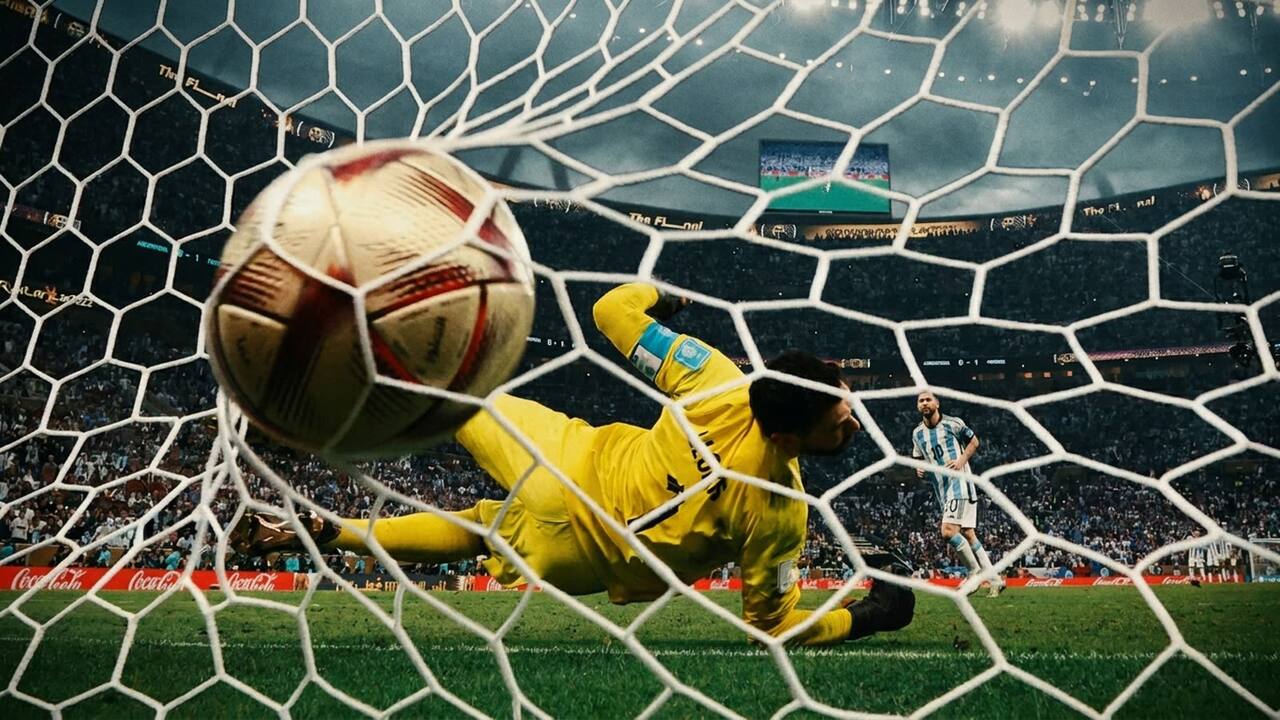
The walk from the center circle to the penalty spot takes roughly fifteen seconds. In that interval, a player must metabolize the weight of a nation's expectations, the memory of every missed kick that preceded his, and the gaze of a billion strangers who will remember his face depending on what happens next. It is sport's loneliest commute.
Penalty shootouts were introduced to the World Cup in 1982 as a humane alternative to the coin toss that had previously decided deadlocked knockout matches. The irony is rich: the solution meant to inject fairness became football's most psychologically brutal mechanism, a format that rewards nerve over skill and punishes hesitation with generational shame.
The architecture of pressure
What makes the shootout so singular is its inversion of football's usual grammar. For ninety minutes, players operate within a collective; responsibility diffuses across eleven bodies. The shootout atomizes that collective into five sequential individuals, each bearing total accountability for a single action. There is no teammate to cover a mistake, no second chance, no ambiguity about who failed.
The spot itself is absurdly close—twelve yards from an eight-foot-high, twenty-four-foot-wide target, defended by a goalkeeper who must guess rather than react. Statistically, the kicker should convert roughly three-quarters of the time. Yet in World Cup shootouts, that percentage drops noticeably, and certain nations—England most famously—have historically performed well below expected rates. The difference is not technique. It is what happens between the ears during that fifteen-second walk.
Memory as opponent
National teams carry their shootout histories like inherited debt. English players stepping up in a World Cup shootout are not merely facing a goalkeeper; they are facing Southgate in 1996, Batty in 1998, the accumulated footage of hands on heads and tears on cheeks. This is not metaphor. Sports psychologists have documented how negative collective memory creates a self-reinforcing expectation of failure, tightening muscles and narrowing vision at precisely the moment both need to stay loose.
Germany, by contrast, built a counter-mythology: clinical, inevitable, almost bored in their efficiency. German players were not inherently better strikers of a dead ball. They simply inherited a story that said they would win, and that story became physiologically true in the moment of execution.
The goalkeeper's asymmetric gamble
Goalkeepers occupy a strange position in shootout psychology. They are expected to lose—a save is heroic, a conceded goal is merely normal. This asymmetry liberates them. The best shootout keepers exploit their freedom to unsettle kickers through gamesmanship: delays, stares, small movements on the line designed to plant doubt. The kicker, already burdened with expectation, now faces an opponent who has nothing to lose and everything to gain from chaos.
Our take
The shootout endures because it is unfair in exactly the way life is unfair—arbitrary, high-stakes, and indifferent to past merit. A team can dominate for one hundred and twenty minutes and lose to a twenty-two-year-old's trembling leg. This offends our sense of justice, which is precisely why we cannot look away. The shootout is football stripped to its existential core: one person, one moment, no excuses. It will never be reformed, because it gives us something the sport otherwise withholds—absolute clarity about who blinked.