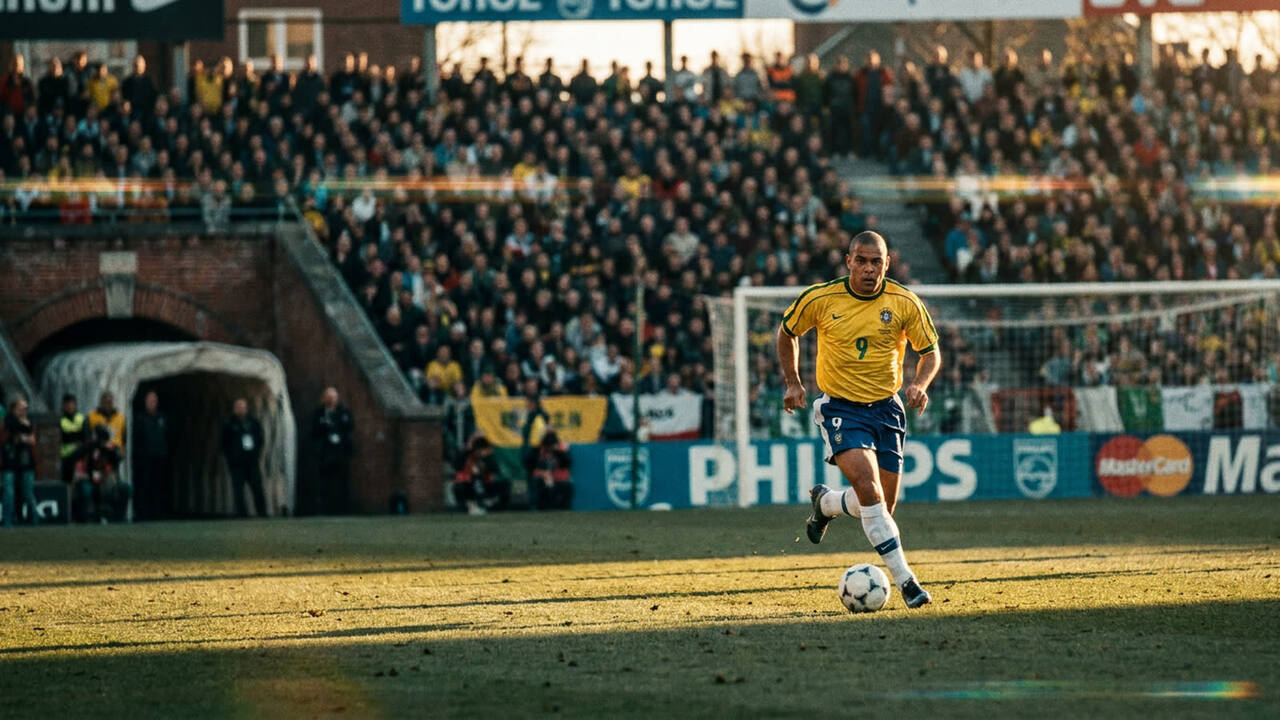
There is a tendency in football discourse to conflate longevity with greatness, to measure players by trophy cabinets and statistical accumulations. By those metrics, Ronaldo Luís Nazário de Lima — the Brazilian striker who terrorised defenders across three continents — might appear diminished. Injuries robbed him of perhaps five prime years. His body betrayed him repeatedly. And yet to watch footage of Ronaldo at his peak is to witness something that transcends career totals: a player who seemed to operate outside the normal constraints of the sport.
The physics of the impossible
What made Ronaldo singular was the combination of attributes that should not have coexisted in one body. He possessed sprinter's acceleration, a low centre of gravity that allowed impossible changes of direction, the close control of a futsal player, and the finishing instinct of a pure poacher. Most devastating forwards specialise. Ronaldo did everything, and did it at a speed that made defenders look like they were moving through water. His goals for Barcelona in the mid-1990s remain startling: solo runs that began in his own half, stepover sequences that left multiple defenders on the ground, chips of exquisite delicacy after bursts of raw power. He was seventeen when he arrived in Europe. By twenty, he was the best player in the world.
The cruelty of the knee
The first serious rupture came in November 1999, during a match for Inter Milan. The second, seventeen months later, was worse — his kneecap tendon tearing away from the bone during a Coppa Italia final, an injury so severe that retirement seemed likely. That Ronaldo returned at all was remarkable. That he returned to win the 2002 World Cup, scoring eight goals including both in the final against Germany, was something approaching miraculous. The player who lifted that trophy in Yokohama was not the same creature who had destroyed defences in Barcelona and Milan. He was slower, more calculated, reliant on positioning and timing rather than pure explosion. He was still lethal enough to be the tournament's best player.
The shadow of the other
History has played a strange trick on Ronaldo's legacy. The emergence of Cristiano Ronaldo — a player of extraordinary achievement but fundamentally different character — has created permanent confusion. The Portuguese Ronaldo is a monument to self-optimisation, a player who bent his body and career to his will through relentless discipline. The Brazilian Ronaldo was closer to a natural phenomenon, a player whose gifts seemed to arrive from somewhere beyond training regimes and tactical systems. One represents what can be achieved through human effort. The other represented what human effort cannot quite explain.
Our take
Football has produced more decorated careers since Ronaldo's peak, players with more trophies and more goals and longer reigns at the summit. None of them have replicated what he did at his best. The sport has become more systematised, more athletic, more tactically sophisticated — and somehow less capable of producing a player who could take the ball on the halfway line and make the next eight seconds feel like a violation of natural law. Ronaldo's career is a reminder that greatness is not always about accumulation. Sometimes it is simply about what you do when the ball arrives at your feet.