Modern football worships the spectacular — the curling free kick, the mazy dribble, the bicycle kick that trends for forty-eight hours. Carles Puyol offered none of this. What he offered was the absence of catastrophe, the quiet architecture of clean sheets, the unglamorous work of making sure the beautiful game stayed beautiful for everyone else.
This is the paradox of the great central defender: success is defined by negation. A striker's brilliance produces something; a defender's brilliance prevents it. Puyol spent his career ensuring that the most dangerous forwards in the world produced nothing at all.
The physiology of commitment
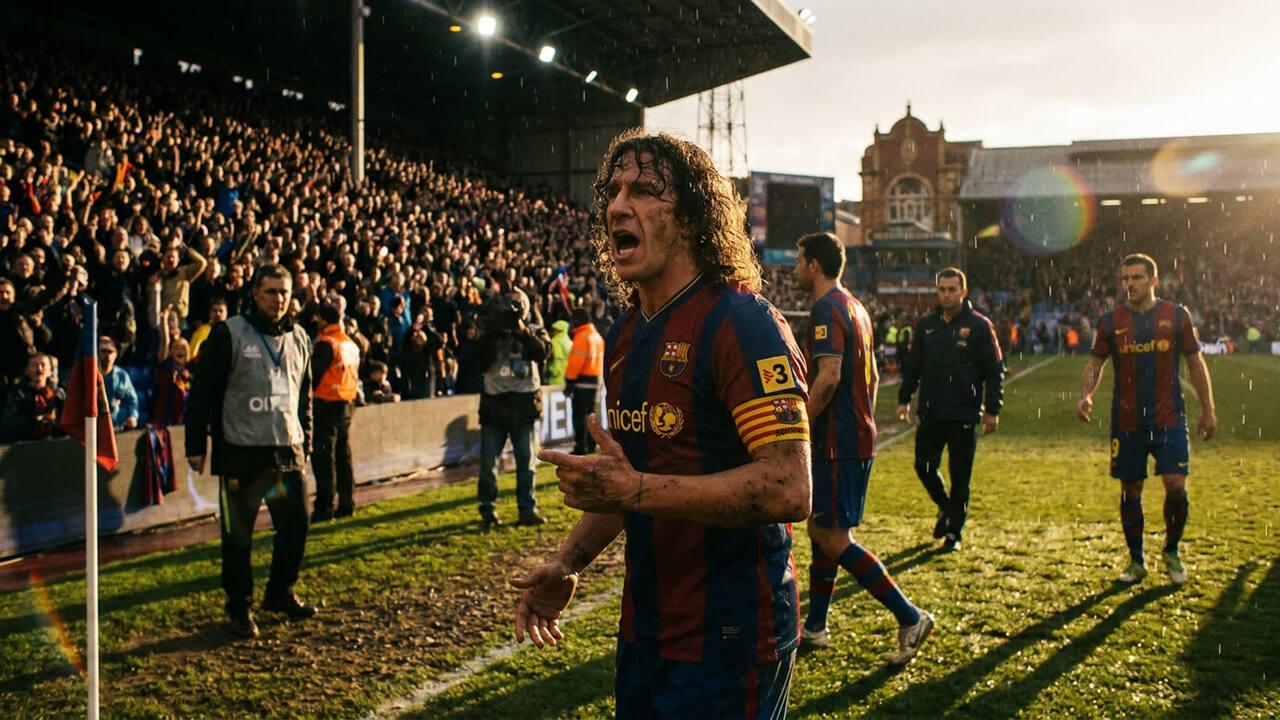
Puyol was not built like a modern defender. He stood just under six feet tall, modest by contemporary standards, and lacked the explosive pace that scouts now consider essential. What he possessed instead was an almost pathological willingness to put his body in harm's way. His headers were not elegant; they were acts of controlled violence, his wild curls whipping through the air as he launched himself into challenges that more sensible players would avoid.
His goal in the 2010 World Cup semifinal against Germany — a thumping header from a corner that sent Spain to their first final — remains the defining image of his career. It was entirely characteristic: no finesse, just overwhelming desire meeting opportunity at the precise moment it mattered most.
The captain's burden
Leadership in football is often reduced to armband ceremonies and motivational clichés. Puyol practiced a different kind of authority. He led through accountability, through being the first to accept blame and the last to seek credit. His teammates at Barcelona speak of his influence in terms that border on reverence — not because he delivered inspirational speeches, but because he held himself to standards that shamed anyone who fell short.
This was the spine of the greatest club side ever assembled. While Xavi and Iniesta orchestrated and Messi devastated, Puyol ensured the foundation never cracked. He was the insurance policy that allowed genius to flourish without consequence.
The extinction of his species
The modern game has little room for Puyol's archetype. Defenders are now expected to be auxiliary playmakers, comfortable receiving the ball under pressure and spraying passes into the final third. The pure stopper — the player whose primary virtue is stopping — has become unfashionable, almost quaint.
This is football's loss. There is something irreplaceable about a player whose entire purpose is sacrifice, whose greatest performances are defined by what the opponent failed to achieve. Puyol's Barcelona conceded goals at historically low rates not because of tactical innovation alone, but because one man refused to let anything through.
Our take
The Ballon d'Or will never go to a central defender again, and perhaps it never should have. The award measures individual brilliance, and defensive excellence is fundamentally collective, fundamentally invisible. But if football understood its own values, it would recognize that Puyol's career represented something more valuable than any individual trophy: the proof that greatness can be measured in absence, in the goals that never came, in the chaos that never materialized. He was the reason the beautiful game stayed standing.