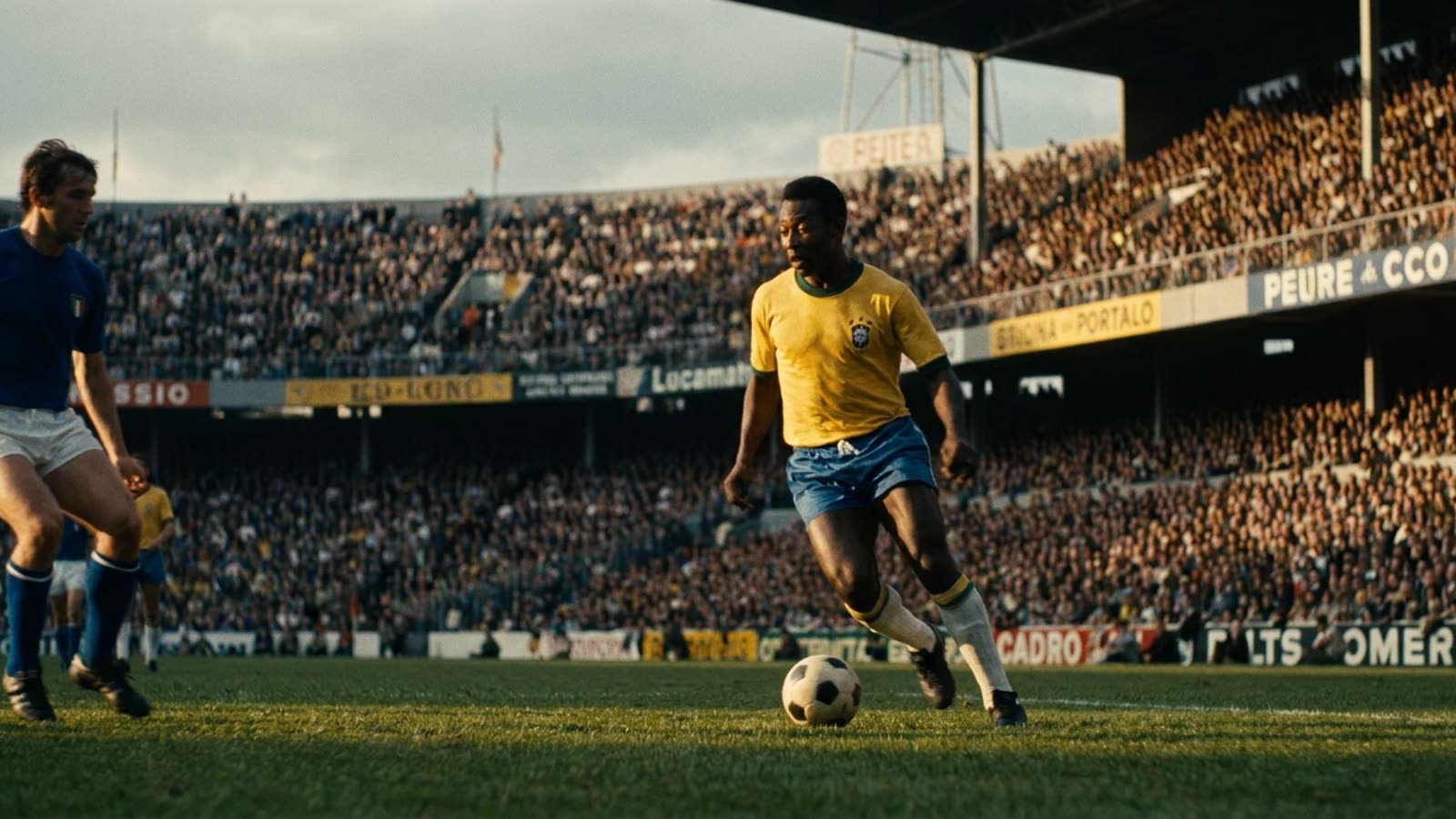
On a November night in 1969, the Maracanã fell silent as Pelé placed the ball on the penalty spot. The entire stadium—and much of Brazil—knew this would be his thousandth career goal. What followed was pure theater: Pelé's deliberate run-up, the goalkeeper's futile dive, and then the eruption. Fans stormed the field, hoisting the striker on their shoulders as he wept. The game was stopped for nearly 30 minutes. No sporting milestone before or since has been so perfectly choreographed.
The mythology machine
Pelé didn't just score a thousand goals—he turned the achievement into global news. For weeks before that Santos-Vasco da Gama match, Brazilian media had been counting down. Pelé himself had missed penalties in previous games, heightening the drama. When the moment finally arrived, he was ready with a pre-written speech dedicating the goal to Brazil's poor children. The number itself was disputed even then (friendly matches, youth games, military service kickabouts were all counted), but that hardly mattered. Pelé understood something fundamental: sports immortality isn't just about what you do, but how you frame it.
This was revolutionary for its time. Athletes in 1969 rarely controlled their narratives so deliberately. But Pelé, who had already won two World Cups and would win a third in Mexico the following year, grasped that longevity required more than talent. It required moments that cameras could capture and newspapers could mythologize. That penalty became a stamp, a coin, a national holiday in Santos.
The template for greatness
Modern athletes have internalized Pelé's lesson completely. LeBron James choreographed his scoring record moment with his family courtside. Cristiano Ronaldo celebrates each hundred-goal milestone with trademark poses. Lionel Messi's World Cup triumph was immediately framed as destiny fulfilled. They all understand what Pelé pioneered: that sports greatness requires not just achievement but authored moments that crystallize a legacy.
Yet something has been lost in this evolution. The spontaneity that made sports compelling—Diego Maradona's raw fury, Muhammad Ali's unscripted poetry—has given way to careful brand management. Pelé's thousand goals feel quaint now, almost innocent in their theatrical ambition. Today's stars would never allow such disputed statistics. Their moments are verified by data teams, optimized for social media, scrubbed of controversy.
Our take
Pelé's thousandth goal marks a turning point in sports history—the moment athletes became auteurs of their own legends. He showed that greatness could be packaged, that milestones could be transformed into mythology. Every carefully staged celebration since, every documentary-ready achievement, owes something to that night at the Maracanã. The irony is that in teaching athletes to control their narratives, Pelé may have killed some of the beautiful chaos that made him and his era so magnetic. Today's stars are more accomplished, more athletic, more media-savvy. But they'll never match the audacity of stopping a match for half an hour to celebrate a goal that may or may not have been real.