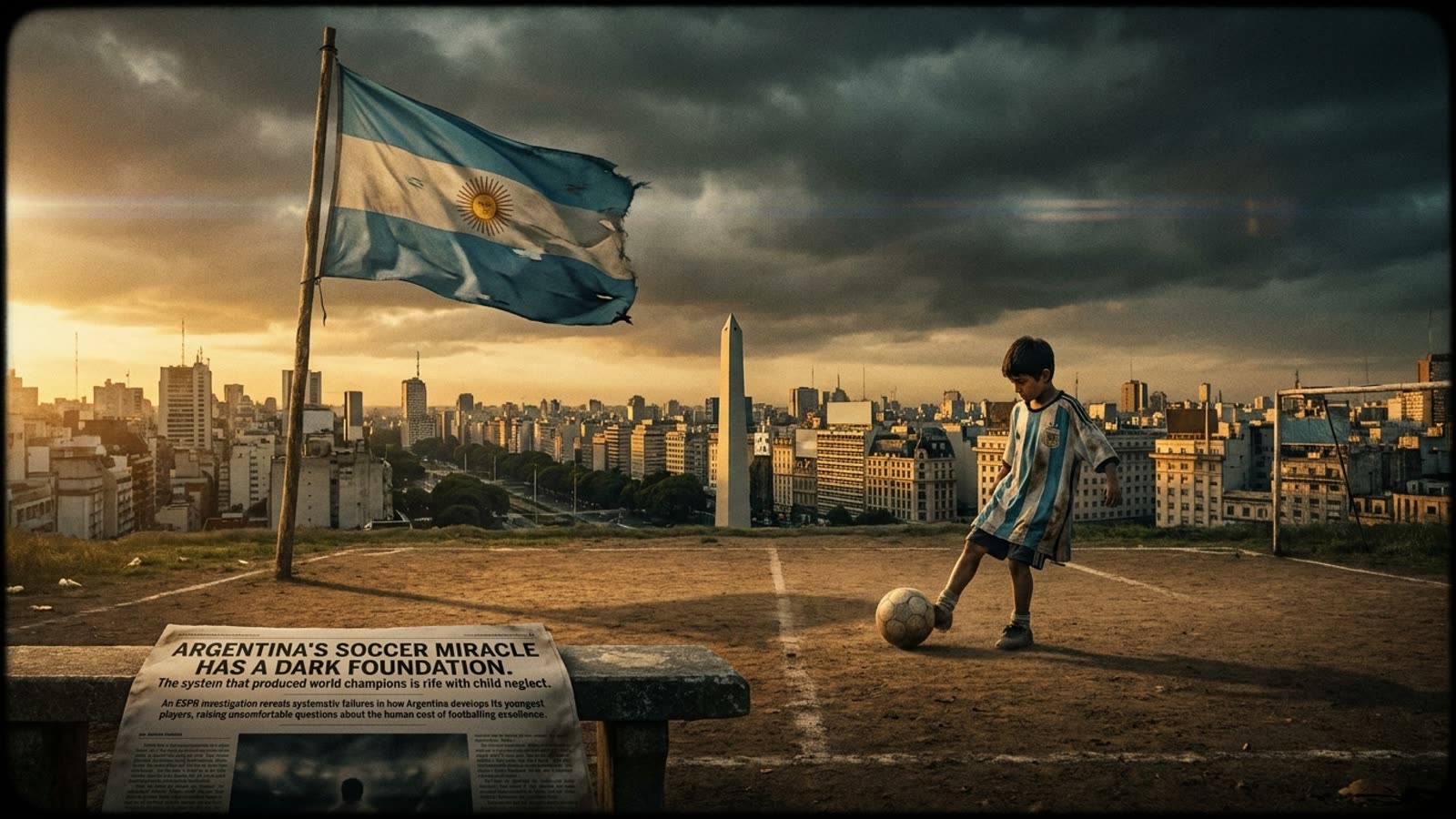
The same Argentine youth development system that produced Lionel Messi, Julián Álvarez, and the reigning World Cup champions has been operating with what investigators describe as systematic child neglect—a revelation that forces an uncomfortable reckoning with how the beautiful game's most celebrated pipeline actually functions.
An ESPN investigation published this week documents patterns of inadequate supervision, insufficient nutrition, and psychological pressure placed on children as young as eight in Argentina's famed inferiores academies. The findings suggest that the country's footballing dominance comes with costs that extend far beyond the pitch.
The price of production
Argentina's youth system operates on a model of early identification and intensive cultivation that has become the envy of football federations worldwide. Clubs scout children in primary school, separating promising players from their families and communities to train at residential academies. The approach has yielded extraordinary results: Argentina has won two of the last three World Cups and consistently exports talent to Europe's top leagues.
But the investigation reveals that for every player who reaches the professional ranks, hundreds pass through a system that treats them as expendable assets. Former academy residents describe inadequate medical care, irregular schooling, and a culture that prioritizes football development over basic welfare. One former youth coach told ESPN the system operates with "no rules, no protocols"—a phrase that captures both its creative freedom and its institutional negligence.
A familiar pattern
The revelations echo scandals that have emerged from elite youth programs in other sports and countries. British football confronted similar issues in 2016 when former players came forward about abuse in youth academies. Gymnastics programs in the United States and elsewhere have faced reckoning over the treatment of young athletes. The pattern suggests that wherever adults have unchecked authority over children pursuing competitive dreams, the potential for exploitation follows.
What makes Argentina's case distinctive is the scale of the system and its centrality to national identity. Football is not merely a sport in Argentina; it is a pathway out of poverty, a source of collective pride, and an industry that generates billions in transfer fees. The pressure to produce talent creates incentives that can override concern for individual welfare.
Our take
The uncomfortable truth is that Argentina's football excellence and its youth system failures may not be separate phenomena. The same ruthless focus that identifies talent early and develops it intensively can also rationalize cutting corners on child welfare. This does not mean success requires cruelty—Germany and Spain have built competitive youth systems with stronger protections—but it does mean that Argentina's federation and its clubs have chosen to tolerate conditions that would be unacceptable in other contexts. The World Cup trophy looks different when you understand what some children endured to make it possible.