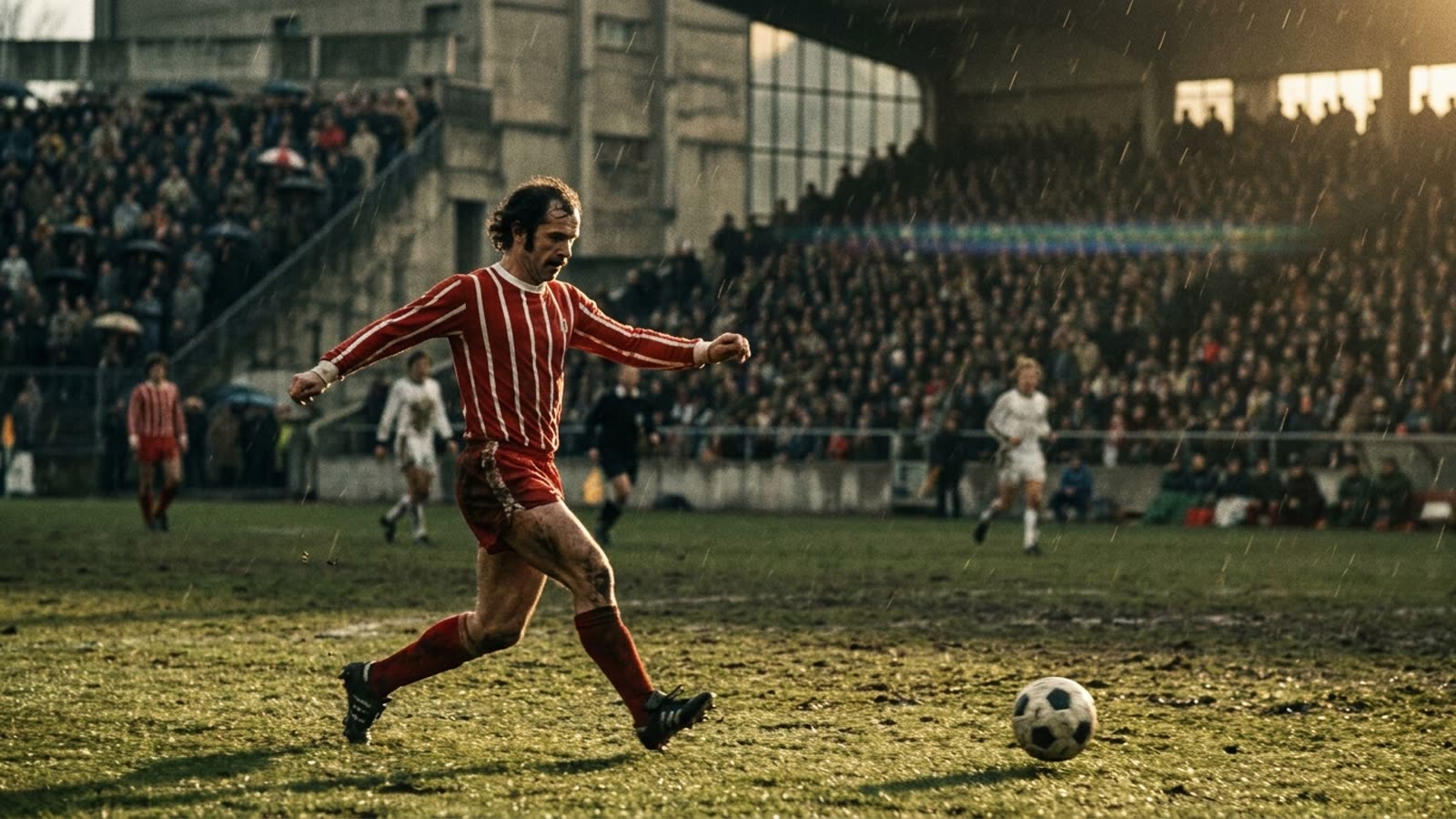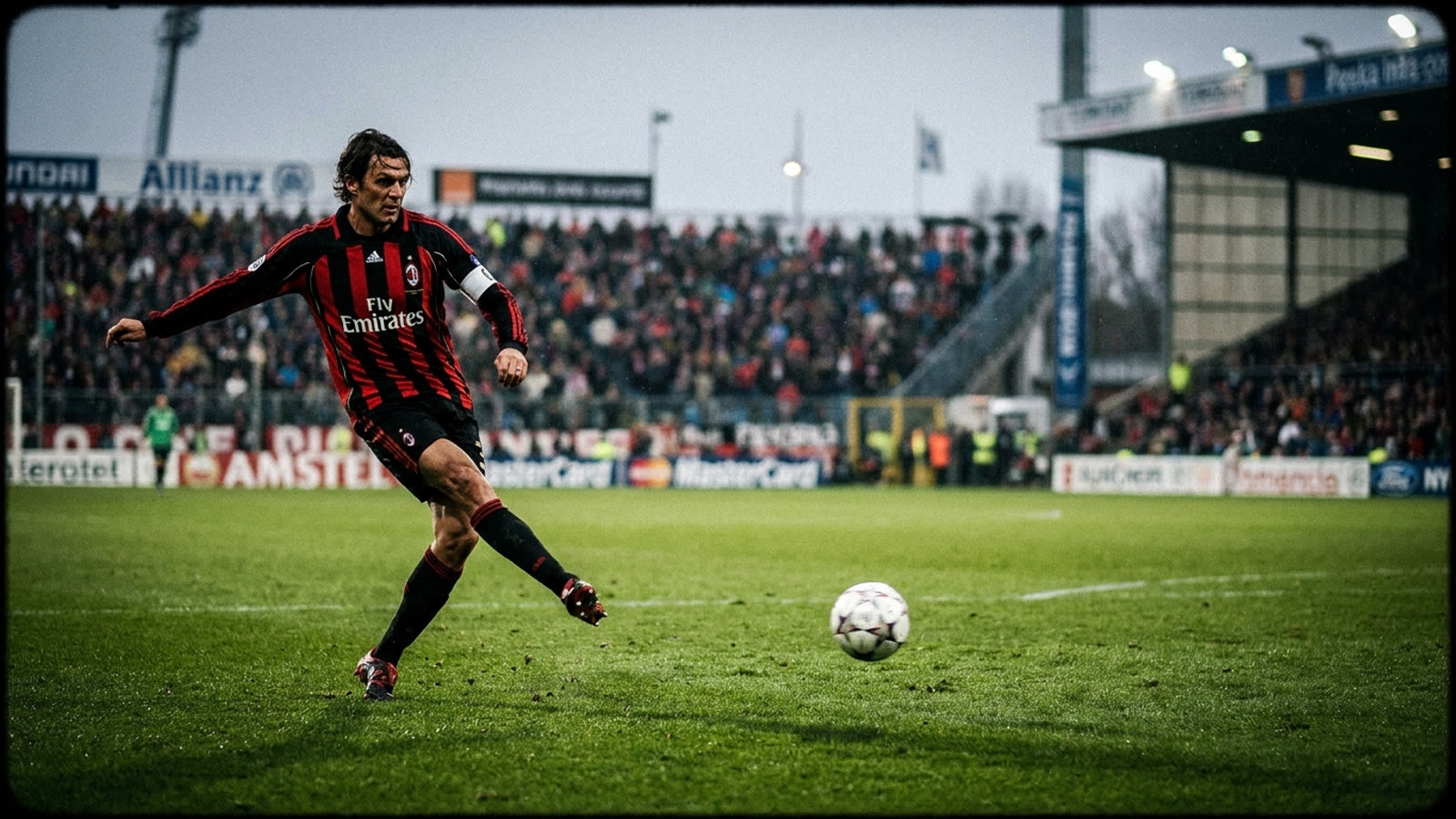
There is a famous photograph of Paolo Maldini sliding in to dispossess an attacker, his body fully extended, one arm raised for balance like a dancer completing an arabesque. The ball is already gone, redirected precisely to a teammate. The attacker's face registers confusion more than frustration—he has been pickpocketed by a ghost. This was Maldini's signature: the tackle that wasn't quite a tackle, the interception that seemed to occur before the pass was even conceived.
Maldini spent his entire professional career at AC Milan, from his debut as a teenager in the mid-1980s until his retirement in 2009, collecting five Champions League titles and seven Serie A championships along the way. But statistics flatten what made him singular. Other defenders have won more trophies. Others were faster, stronger, more physically imposing. What Maldini possessed was something closer to prescience—an ability to read the geometry of an attack so completely that he could extinguish it with minimal violence.
The geometry of anticipation
Maldini's defensive philosophy was built on a simple premise: the best tackle is the one you never have to make. He positioned himself so immaculately that attackers would run into dead ends of their own construction. His closing speed was excellent but rarely necessary; he had already occupied the space you wanted before you knew you wanted it. Watching compilations of his career, one is struck by how often the ball simply appears at his feet, as if magnetized. The chaos that surrounds most defensive work—the lunging, the desperate recovery runs, the theatrical slides—is largely absent.
This was partly inheritance. His father, Cesare, captained Milan and Italy, and Paolo grew up studying the game's architecture from the inside. But it was also temperament. Maldini approached defending as an intellectual exercise, not a physical confrontation. He famously said that if he had to make a tackle, he had already made a mistake.
Why his style became extinct
Modern football has made Maldini's brand of defending structurally obsolete. The pressing systems that dominate elite competition demand defenders who can win the ball high up the pitch, who can cover vast distances, who can function as auxiliary midfielders. The romantic notion of the pure defender—the artist of denial—has been replaced by the industrious all-rounder who defends adequately and contributes to build-up play.
This is not necessarily a decline in quality. Centre-backs today are more technically accomplished than any previous generation. But something has been lost in the transition: the specialist's elegance, the sense that defending itself could be an aesthetic achievement rather than a necessary evil between attacking phases. Maldini made you want to watch him defend. Contemporary systems make defending a collective responsibility distributed across eleven players, which is tactically sound but visually anonymous.
Our take
Maldini's career is a reminder that excellence in sport is not always progressive. Some peaks are reached and then abandoned, not surpassed. The position he played no longer quite exists, and the skills he perfected are no longer quite valued. This does not diminish what he achieved—it makes it more precious, an artifact from a game that has moved on. Football got faster and more systematic. It did not get more beautiful.