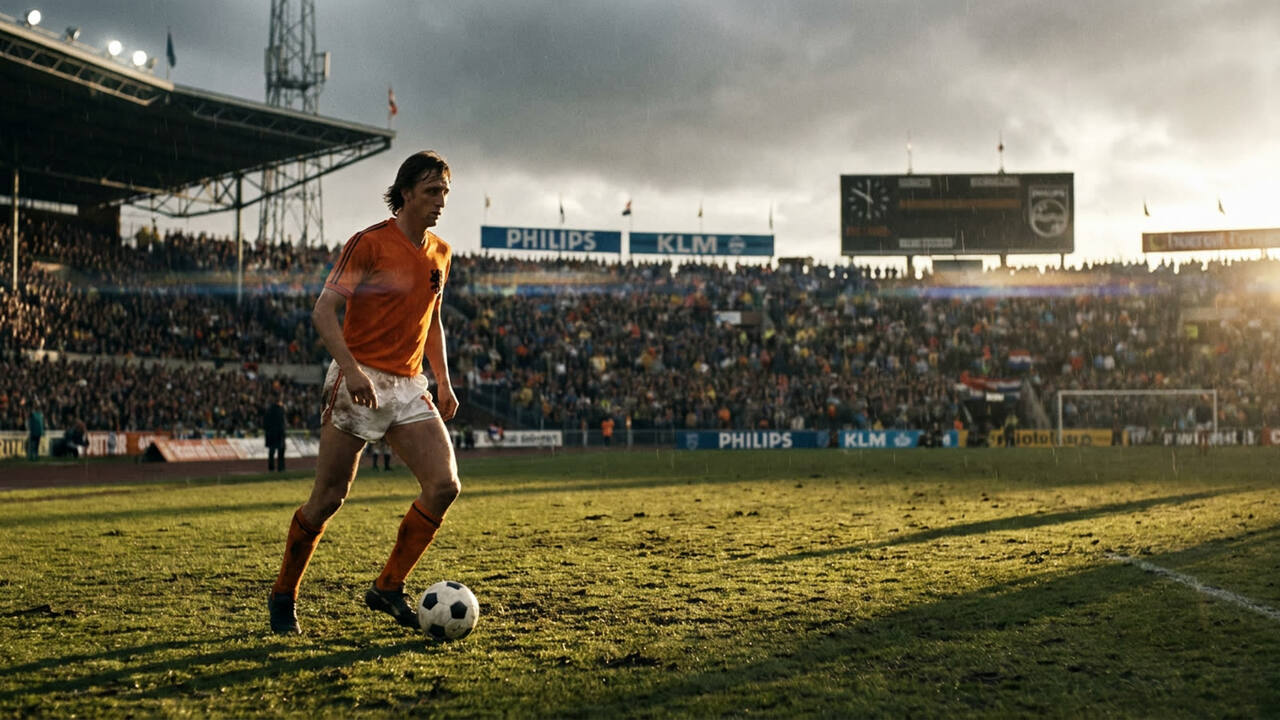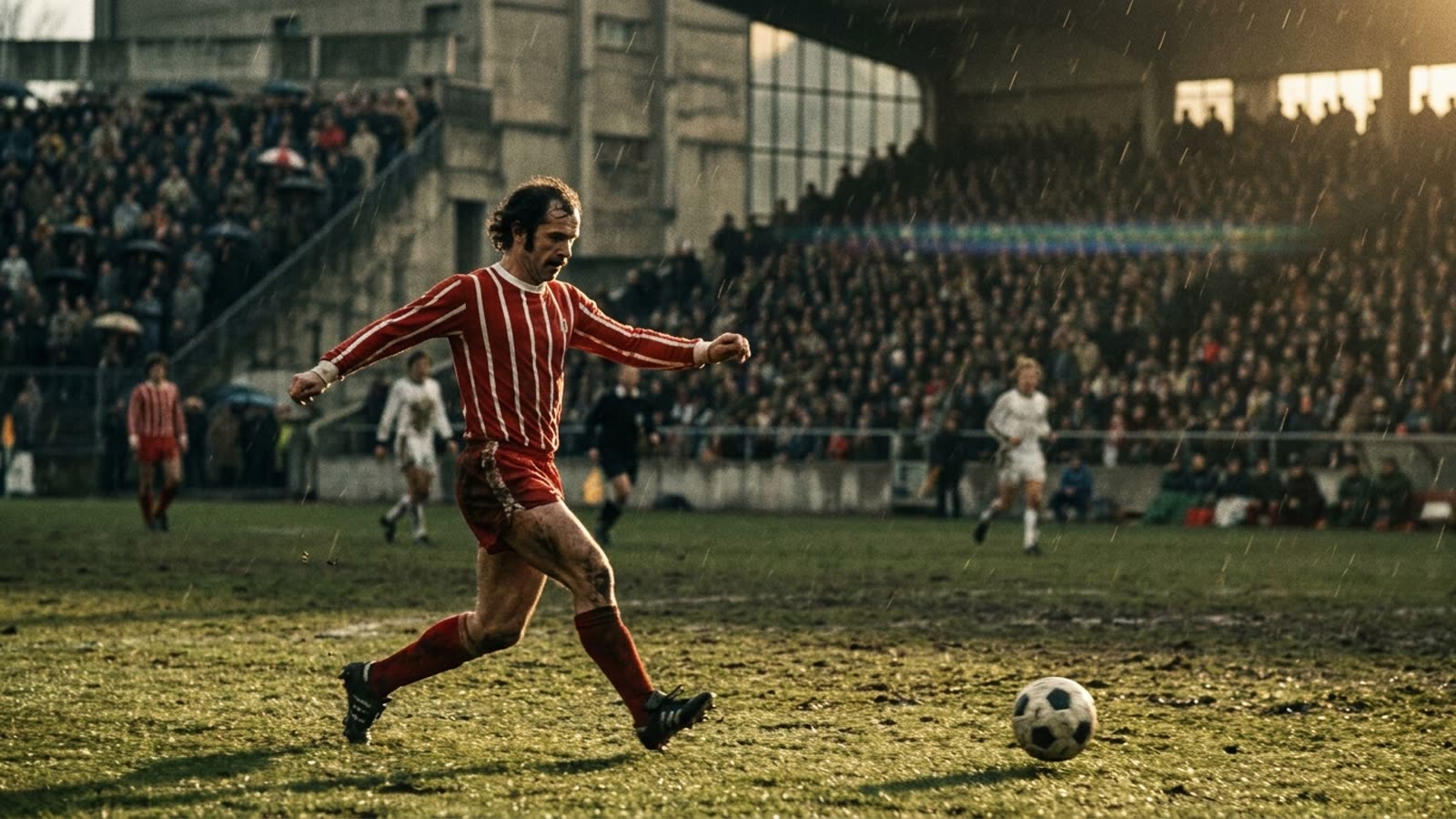
Most strikers score goals. Gerd Müller solved them. The distinction matters. Watch any compilation of his work for Bayern Munich or West Germany and you notice something strange: the goals look easy, almost accidental, as if the ball simply found him because physics required it. That apparent simplicity was the product of a mind operating several frames ahead of the defense, a spatial intelligence so refined that coaches and teammates often described it in terms bordering on the mystical.
Müller retired with numbers that remain staggering: 365 goals in 427 Bundesliga appearances, 68 in 62 internationals, a World Cup and a European Championship to his name. Yet statistics alone cannot explain why, decades later, elite finishing coaches still dissect his movement the way chess grandmasters study Capablanca.
The geometry of anticipation
Müller stood just 176 centimeters tall, stocky and conspicuously un-athletic by the standards of his era's glamorous forwards. What he possessed instead was an uncanny ability to read the geometry of a developing attack before it fully developed. He did not chase crosses; he arrived at their terminus. He did not muscle past defenders; he occupied the one sliver of space they had momentarily vacated. His goals came from distances measured in centimeters rather than meters — toe-pokes, shin deflections, headers from impossible angles. Critics called them ugly. Coaches called them inevitable.
Bayern's dominance in the early 1970s, culminating in three consecutive European Cups, was built on many talents, but Müller was the fulcrum. Franz Beckenbauer orchestrated from deep; Müller converted the orchestra's work into scoreboard reality with ruthless economy.
A template no one replicates
Modern football has embraced data, expected-goals models, and positional analytics, yet the pure penalty-box predator Müller embodied has become a rarity. Today's forwards are asked to press, link play, drift wide, and contribute to build-up. The specialist poacher — the player who does almost nothing except score — is viewed as a tactical liability. This evolution is understandable, but it has also obscured the sheer difficulty of what Müller did. Finishing, at his level, was not a skill but an art form requiring millisecond decisions, proprioceptive genius, and ice-cold composure repeated hundreds of times.
Thomas Müller (no relation) has often spoken of studying Gerd's movement, and Miroslav Klose credited him as an inspiration before breaking his World Cup scoring record. The lineage is clear, even if no successor has matched the original's conversion rate in tight spaces.
Our take
Gerd Müller's legacy is paradoxical: universally admired, almost never imitated. Football has decided that versatility trumps specialization, and perhaps it is right. But every time a forward snatches at a half-chance, every time a striker arrives a heartbeat too late, we are reminded that Müller's gift was not merely rare — it may have been unrepeatable. The Bomber did not beat defenders; he rendered them irrelevant by existing in a future they could not yet see.