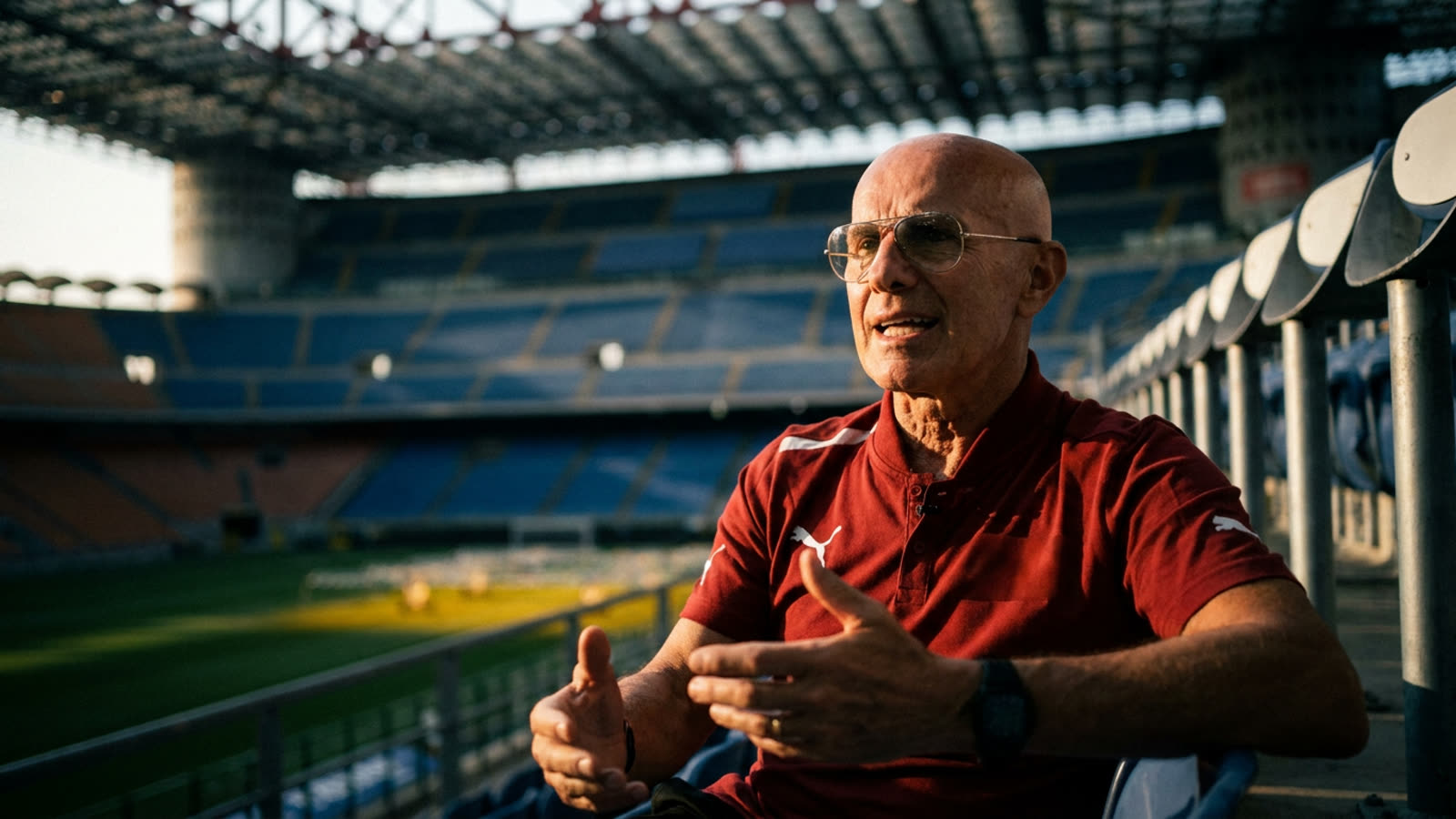
Before Arrigo Sacchi arrived at AC Milan in 1987, the conventional wisdom in Italian football was immutable: defending was an art form, attacking was a risk, and coaches who hadn't played at the highest level had no business managing there. Sacchi violated all three premises and won everything.
The son of a shoe factory worker from Fusignano, Sacchi's playing career peaked in the amateur leagues. When Parma's president asked why he should hire a manager who never played professionally, Sacchi reportedly replied that one needn't have been a horse to become a jockey. It was the kind of answer that either ends a conversation or starts a revolution. For Milan, it started a revolution.
The pressing heresy
Italian football in the 1980s worshipped the catenaccio — the bolt, the lock, the deep defensive block that conceded territory to strangle space. Sacchi's Milan did the opposite. They pressed high, squeezed the pitch into a forty-meter corridor, and suffocated opponents before they could breathe. The back four moved as a single organism, stepping up in unison to catch attackers offside or compress the midfield into chaos.
This required something Italian football had never truly demanded: collective movement over individual brilliance. Sacchi drilled his players obsessively, running shadow sessions without a ball, teaching them to move in relation to each other rather than in reaction to opponents. Franco Baresi, Mauro Tassotti, Paolo Maldini, and Alessandro Costacurta became the most synchronized defensive unit in memory — not because they were the fastest or strongest, but because they thought as one.
The Dutch connection
Sacchi's system found its perfect instruments in Ruud Gullit, Marco van Basten, and Frank Rijkaard — the Dutch triumvirate who brought Total Football's fluidity to Milan's tactical rigidity. Van Basten's movement created space that Gullit's power exploited; Rijkaard's intelligence anchored a midfield that could transition from defense to attack in three passes. The blend of Dutch creativity and Italian discipline produced something genuinely new: a team that could dominate possession, press relentlessly, and finish clinically.
Milan won consecutive European Cups in 1989 and 1990, dismantling Real Madrid and Benfica with performances that felt less like football matches than tactical demonstrations. The four-nil destruction of Steaua Bucharest in the 1989 final remains one of the most complete performances in the competition's history.
The long shadow
Sacchi's influence radiates through every pressing system in modern football. Pep Guardiola has cited him as a foundational influence; Jürgen Klopp's gegenpressing descends from the same philosophical tree. The idea that a team's shape without the ball matters as much as its shape with it — now a commonplace — was radical when Sacchi preached it.
His tenure was brief by the standards of dynasty-builders. He left Milan in 1991, returned briefly, then took the Italian national team to a World Cup final they lost on penalties. But longevity was never the point. Sacchi proved that football could be taught systematically, that tactics could override individual talent, and that a man who never played the game professionally could see it more clearly than those who had.
Our take
Sacchi's real legacy isn't the trophies or the pressing traps — it's the legitimization of the coach as intellectual architect. Before him, managers were former players who organized training and picked the team. After him, they could be theorists, obsessives, men who studied the game like chess players study openings. Every tactical podcast, every expected-goals model, every analytics department owes something to the shoe salesman who watched football and saw geometry where others saw chaos.