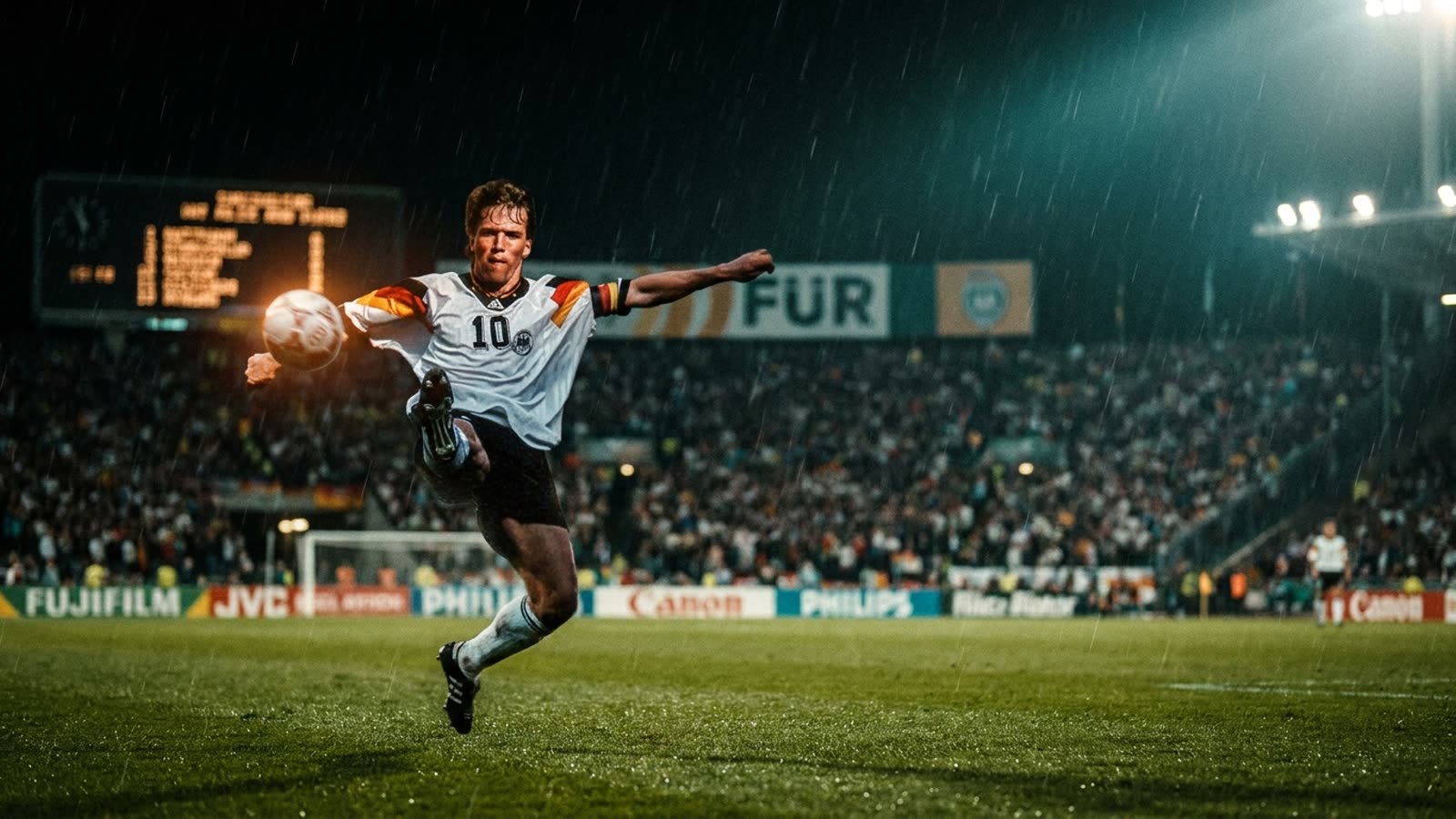
When Lothar Matthäus lifted the World Cup trophy in Rome in 1990, he had already been playing in the tournament for eight years. When he finally hung up his international boots after the 2000 European Championship, he had accumulated twenty-five World Cup matches across five separate tournaments — a record that still stands and may never be broken.
The longevity itself is remarkable. But what makes Matthäus singular is not merely that he lasted, but how comprehensively he transformed his game to do so. The player who terrorised opponents with lung-bursting runs in 1982 bore little resemblance to the cerebral sweeper marshalling Germany's defence in 1998. Most careers describe an arc of rise and decline. Matthäus's described something closer to a metamorphosis.
The box-to-box years
Matthäus announced himself at the 1982 World Cup in Spain as a 21-year-old substitute, already displaying the ferocious competitive drive that would define his career. By Mexico 1986, he was tasked with man-marking Diego Maradona in the final — a job he performed admirably until Maradona simply transcended marking altogether. Four years later in Italy, Matthäus was the complete midfielder: powerful, technically precise, with a right foot that could bend free kicks around walls and drive shots through them. He won the Ballon d'Or that year, and deservedly so.
What distinguished him even then was an almost pathological will to win. Teammates and opponents alike noted his intensity, which could shade into abrasiveness. He was not universally beloved in German dressing rooms. But he was universally respected, because when matches tightened, Matthäus invariably found another gear.
The defensive reinvention
By the mid-1990s, Matthäus's legs had begun to betray him. The explosive acceleration that once carried him past midfielders had dulled. A lesser player would have accepted diminished minutes, then retirement. Matthäus instead dropped thirty yards deeper and became a sweeper.
The positional shift was not cosmetic. Playing as a libero required different instincts entirely — reading danger before it materialised, organising defensive lines, choosing when to step forward and when to hold. Matthäus mastered these demands with the same obsessive attention he had once applied to arriving late in the box. At the 1998 World Cup in France, now thirty-seven years old, he captained Germany from the back with an authority that belied his age.
Why the record may stand
Five World Cups requires a player to remain at international level for roughly sixteen to twenty years, depending on when they debut. It also requires their national team to qualify each time, which is not guaranteed even for football's traditional powers. And it requires the player to be selected — not merely available, but chosen over younger alternatives by successive managers with different philosophies.
The modern game's physical demands have intensified considerably since Matthäus's era. Players peak earlier and burn out faster. The relentless club schedules leave less room for international longevity. Cristiano Ronaldo, despite his extraordinary physical preservation, managed only five European Championships and World Cups combined. Lionel Messi reached five World Cups in 2022, but his tournament minutes in the first two were limited. Neither has matched Matthäus's cumulative presence.
Our take
Matthäus was not the most gifted footballer of his generation — that honour belongs to Maradona, and possibly a few others. But he may have been the most intelligent about managing a career. He understood that excellence is not a fixed state but a moving target, and he kept adjusting his aim. In an era that celebrates youthful brilliance and discards players the moment their pace declines, his example feels almost subversive. Longevity at the highest level is not merely about staying fit. It is about being willing to become someone else entirely.