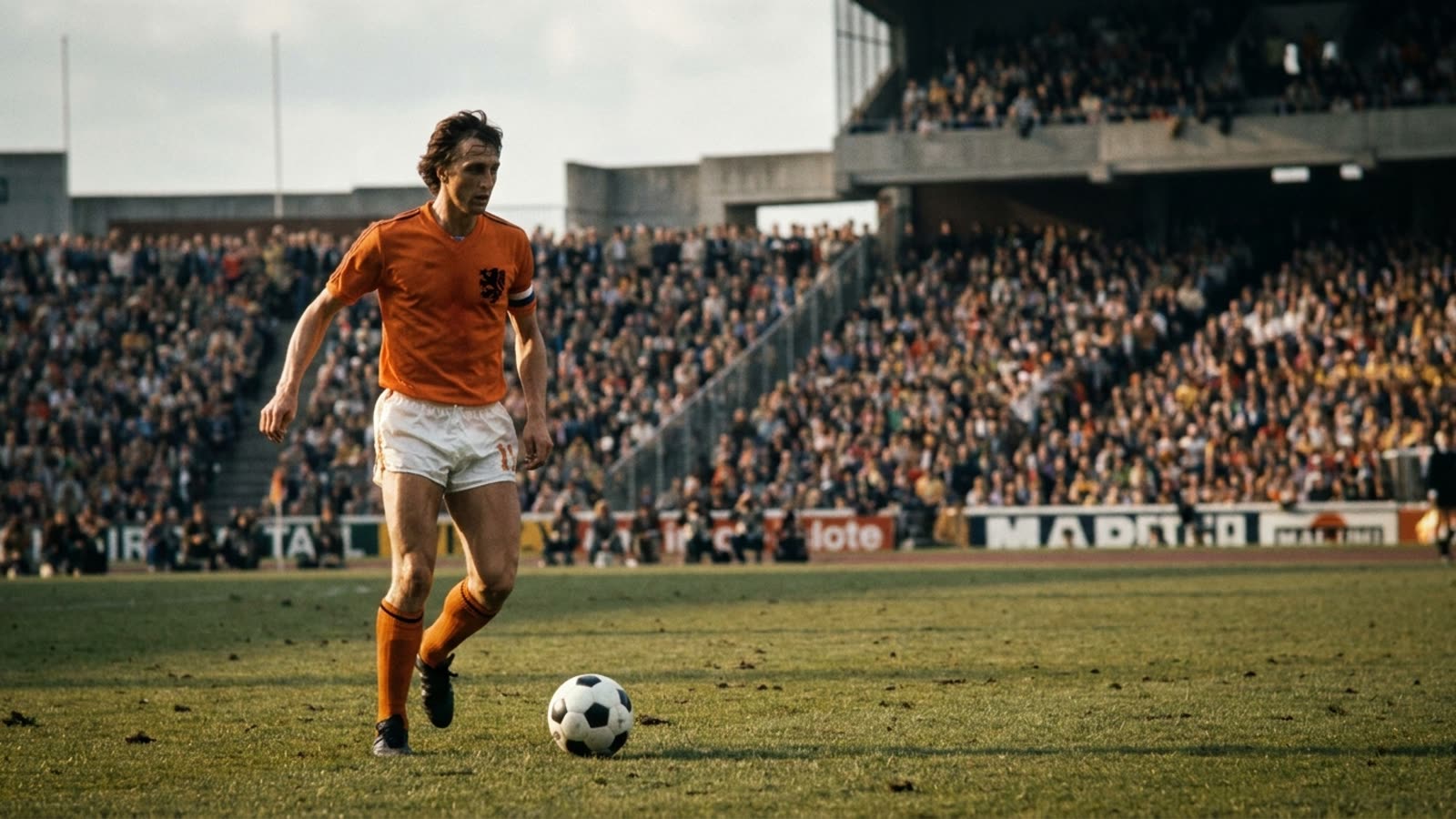
There is a moment in the 1974 World Cup, Netherlands versus Sweden, when Johan Cruyff receives the ball with his back to goal and a defender breathing down his neck. What happens next takes perhaps two seconds. Cruyff feints to pass, drags the ball behind his standing leg with the inside of his foot, pivots, and accelerates into space that did not exist a heartbeat earlier. The Swedish defender, Jan Olsson, is left examining the philosophical implications of his own obsolescence.
The Cruyff Turn, as it came to be known, was not merely a trick. It was a declaration of principles. Football, Cruyff was saying, is not about occupying space but about creating it. The defender had done everything right by the conventions of his era. He was tight, balanced, positioned between man and goal. And he was completely wrong, because Cruyff was playing a different game entirely.
The architecture of space
Cruyff's genius was spatial before it was technical. He understood the pitch as a series of geometric relationships that could be manipulated through movement, and he spent his career teaching this to anyone who would listen — first as a player at Ajax and Barcelona, later as the coach who built the Barcelona academy into the most influential football institution on earth. The tiki-taka that would win Spain a World Cup and two European Championships was Cruyff's intellectual property, even if he never collected royalties.
What made him singular was the integration of thought and action. Many players see space; Cruyff seemed to feel it, the way a jazz musician feels the silence between notes. His movement off the ball was as revolutionary as his movement on it. He would drift from centre-forward into midfield, pulling defenders into uncomfortable decisions, creating numerical advantages that his teammates could exploit. The false nine, now a tactical commonplace, was Cruyff's invention decades before Pep Guardiola gave it a name.
The coach as philosopher
Cruyff's playing career was remarkable, but his coaching career was transformative. At Barcelona, he inherited a club that had won a single league title in over a decade and turned it into the dominant force in Spanish football. More importantly, he established the principles that would define the club's identity for generations: possession as control, pressing as philosophy, youth development as institutional religion.
La Masia, Barcelona's academy, became Cruyff's laboratory. The players who emerged — Guardiola, Xavi, Iniesta, Messi — were not accidents. They were products of a system designed to select for intelligence and spatial awareness over physical attributes. Cruyff wanted players who thought like him, even if they could not move like him. The result was a style of football that prioritised collective geometry over individual athleticism.
Our take
The Cruyff Turn endures on YouTube compilations, a party trick frozen in amber. But Cruyff's real legacy is invisible — it lives in the positioning of a centre-back stepping into midfield, in the movement of a forward dropping deep, in the thousand small decisions that separate modern football from its agricultural past. He did not merely play the game better than his contemporaries; he played a better game. That the sport eventually caught up to him is the sincerest tribute it could offer.