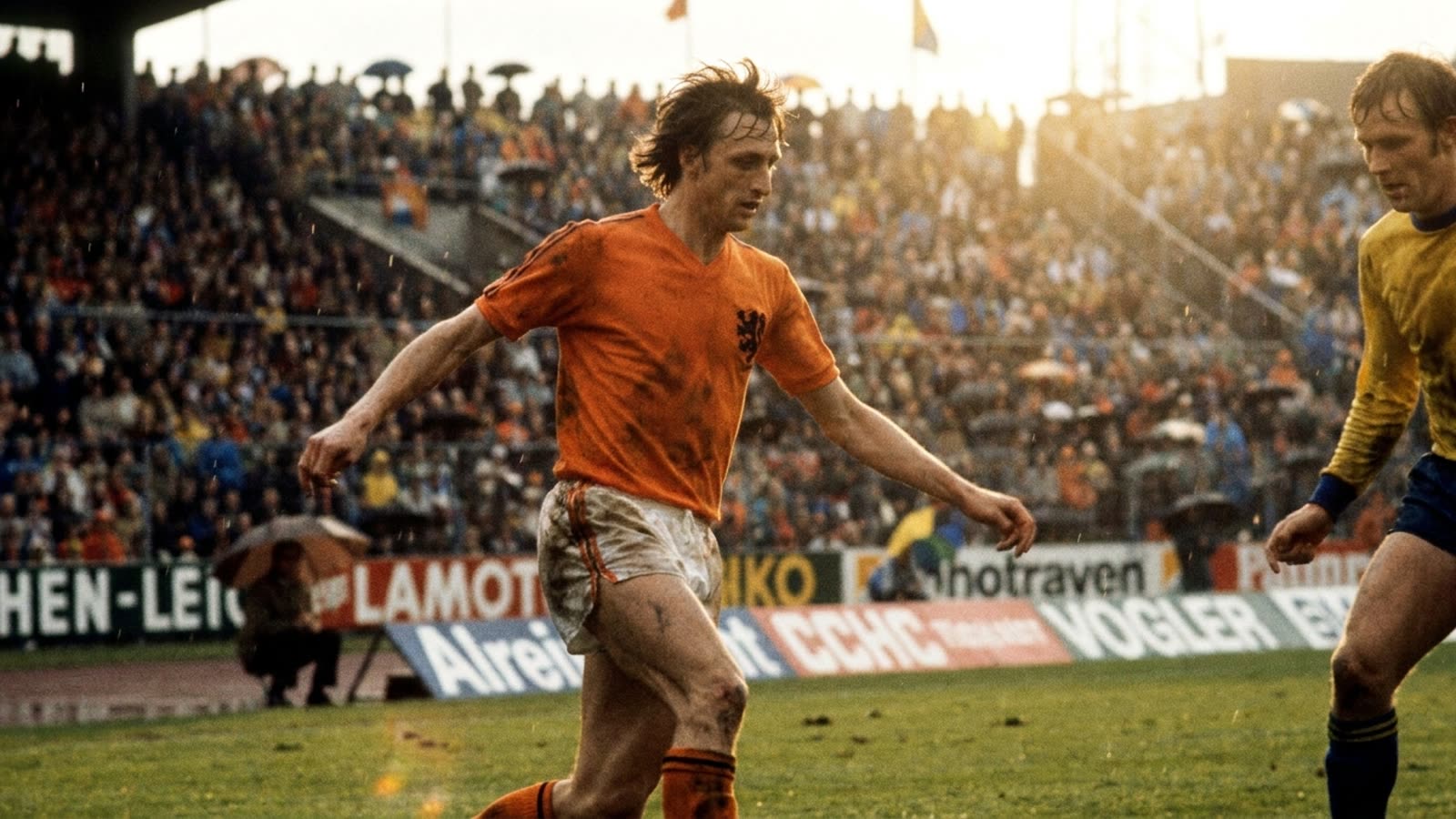
Football remembers its goals, but it canonizes its gestures. Diego Maradona's Hand of God, Zinedine Zidane's headbutt, and Johan Cruyff's turn against Sweden in the 1974 World Cup group stage all occupy the same sacred register—moments where the sport's grammar was rewritten in real time. Of these, only the Cruyff Turn was designed to be repeated. And repeated it has been, on every continent, at every level, for half a century now, the single most democratic piece of skill football has ever produced.
The move itself is almost insultingly simple when diagrammed: the attacker shapes to pass or cross, plants the standing foot, then drags the ball behind it with the inside of the striking foot, pivoting away from the defender. A child can learn it in an afternoon. Jan Olsson, the Swedish fullback who was left flailing in Dortmund that June evening, spent the rest of his life being asked about it. He took it with grace, understanding that he had become the necessary straight man in football's most famous magic trick.
Why the turn mattered more than the match
The Netherlands won the game three-nil, and Cruyff did not score. By conventional metrics, the turn was irrelevant to the result. Yet it became the defining image of Total Football, the Dutch system that treated positions as suggestions and demanded that every player think like a playmaker. The turn was Total Football compressed into a single synapse: spatial awareness, deception, and the audacity to attempt something beautiful when something functional would suffice.
Cruyff did not invent the move. Variations existed in South American football, and street players had been embarrassing defenders with similar feints for decades. What Cruyff did was perform it on the largest stage, with a television audience of hundreds of millions, and do so with such casual elegance that it immediately entered the coaching lexicon. Within months, youth academies were drilling it. Within years, it had a name.
The democratization of skill
The turn's genius lies in its accessibility. Unlike the bicycle kick, which requires acrobatic timing, or the elastico, which demands ankle flexibility most players simply do not possess, the Cruyff Turn asks only for nerve. It works for slow players, small players, players with modest technique. It works in futsal courts and on muddy Sunday-league pitches. It is perhaps the only elite skill that genuinely scales down to amateurs without losing its effectiveness.
This democratization reshaped how football thought about individual brilliance. Before Cruyff, skill moves were often dismissed as showboating, tolerated in South America but viewed with suspicion in European football's more utilitarian traditions. After Cruyff, they became teachable curriculum. The turn legitimized flair as function.
Our take
Football's greatest players are often measured by trophies, goals, and statistical dominance. Cruyff won fewer World Cups than Pelé, fewer Ballon d'Ors than Messi. But he may have influenced more actual football played by actual humans than anyone in the sport's history. Every time a nine-year-old in Lagos or Lyon or Los Angeles drags the ball behind their standing leg and spins away from a defender, they are quoting a man who understood that football is, at its core, a conversation—and that the wittiest reply is always the one the opponent never saw coming.