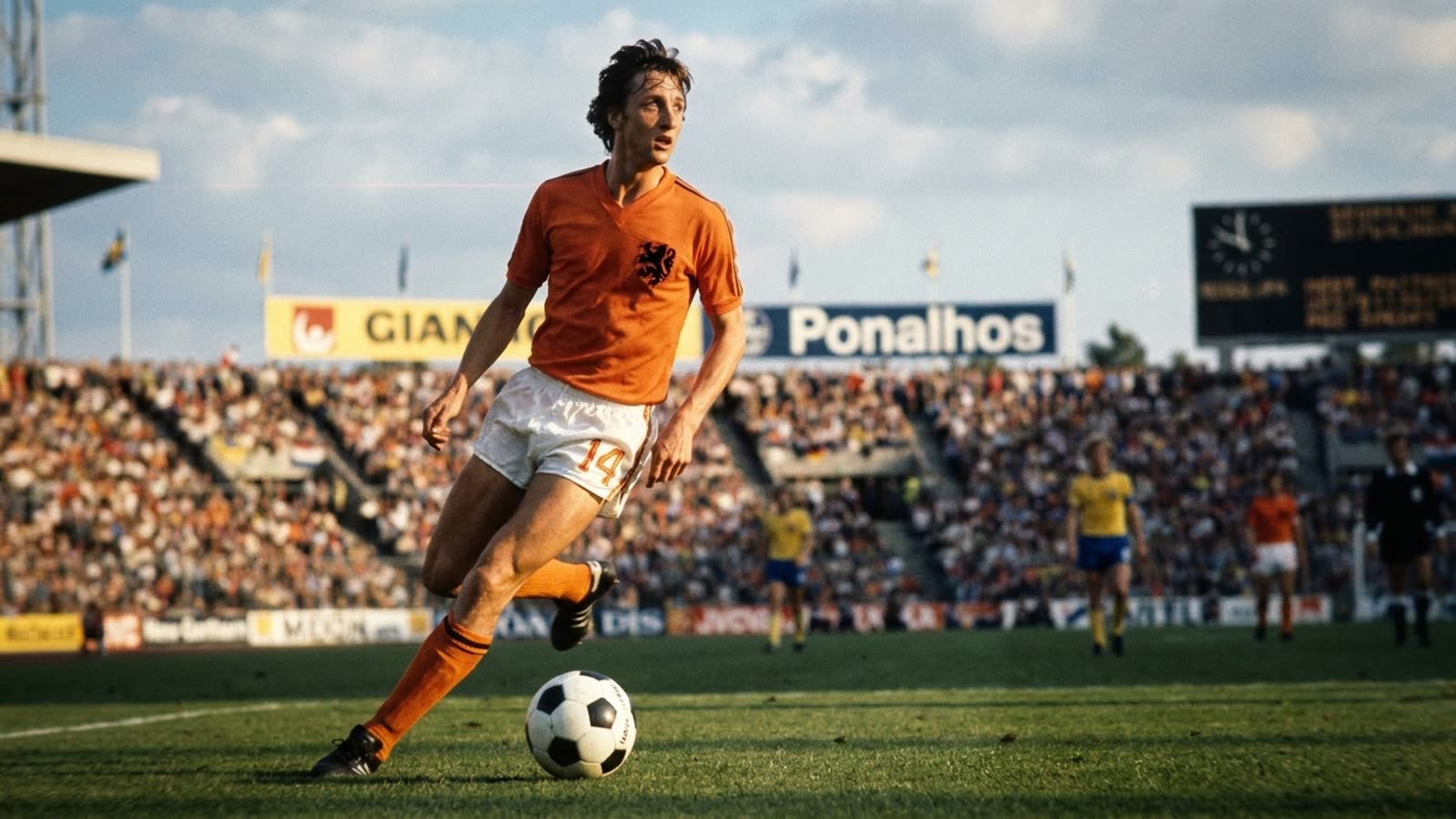
The move itself takes less than a second. A player shapes to pass or cross, drags the ball behind their standing leg with the inside of the foot, pivots, and accelerates away in the opposite direction. Children learn it on playgrounds from São Paulo to Seoul. Coaches drill it into academy players before they've memorized the offside law. Yet when Johan Cruyff executed it against Sweden's Jan Olsson at the 1974 World Cup, he didn't merely beat a defender — he encoded an ideology into a gesture.
The Cruyff Turn, as it became universally known, was not technically unprecedented. Similar feints existed in street football across South America and southern Europe. What made Cruyff's version canonical was context and consequence. Here was the avatar of Total Football, the system in which every outfield player could occupy any position, performing a skill that embodied the philosophy's core premise: that space is not fixed but created, that deception is a form of intelligence, and that the beautiful solution is often the correct one.
The architecture of a philosophy
Total Football, developed at Ajax under Rinus Michels and exported to the Dutch national team, demanded players who could think several moves ahead. Cruyff was its quarterback, its point guard, its conductor. The turn was merely the visible expression of something deeper: a refusal to accept the geometry the opponent offered. Where conventional wingers of the era stayed wide and delivered crosses, Cruyff drifted, dropped, surged centrally, and generally made himself impossible to mark by refusing to be where defenders expected.
This spatial anarchy required teammates who understood it. The 1974 Dutch side moved like a murmuration of starlings, positions fluid, responsibilities shared. They lost the final to West Germany, yet their influence proved more durable than the trophy they missed. The tournament established that football could be played as a form of collective improvisation rather than industrial organisation.
Barcelona's inheritance
Cruyff's playing career at Barcelona planted seeds; his managerial tenure cultivated a forest. The Dream Team of the early 1990s won four consecutive La Liga titles and the club's first European Cup, but the deeper legacy was La Masia, the youth academy Cruyff restructured around his principles. Positional play, relentless pressing, comfort on the ball under pressure — these became institutional DNA.
Pep Guardiola, a La Masia graduate who played under Cruyff, later codified and extended the ideas. His Barcelona side that won fourteen trophies in four seasons played football that was recognisably descended from 1974: the same emphasis on retaining possession as a defensive act, the same belief that the best players should touch the ball most often, the same conviction that aesthetics and effectiveness are not opposites. Guardiola's subsequent work at Bayern Munich and Manchester City spread the gospel further, until positional play became the default aspiration of elite coaching.
The turn as synecdoche
Why does a single skill move bear so much interpretive weight? Partly because football lacks the statistical granularity of American sports; narrative and symbol fill the analytical gap. The Cruyff Turn functions as a logo, instantly recognisable, endlessly reproducible, yet always pointing back to its originator. It appears in video-game skill tutorials and coaching manuals alike, a bridge between playground mimicry and professional methodology.
More substantially, the turn captures something true about Cruyff's genius: the marriage of audacity and efficiency. The move is showy, yes, but it is also devastatingly practical. It creates separation, changes the angle of attack, and leaves the defender facing the wrong direction. Beauty as utility, flair as function — this was Cruyff's thesis, and football has been arguing about it ever since.
Our take
Cruyff died in 2016, yet his fingerprints remain on almost every side that aspires to play progressive football. The turn endures not because it is difficult — any competent youth player can execute it — but because it distils a worldview into a motion. Football is poorer for his absence, richer for his influence, and perpetually in dialogue with the question he posed: what if the game could be both intelligent and joyful? The answer, demonstrated one June evening in Dortmund, was a drag of the ball and a burst into space.