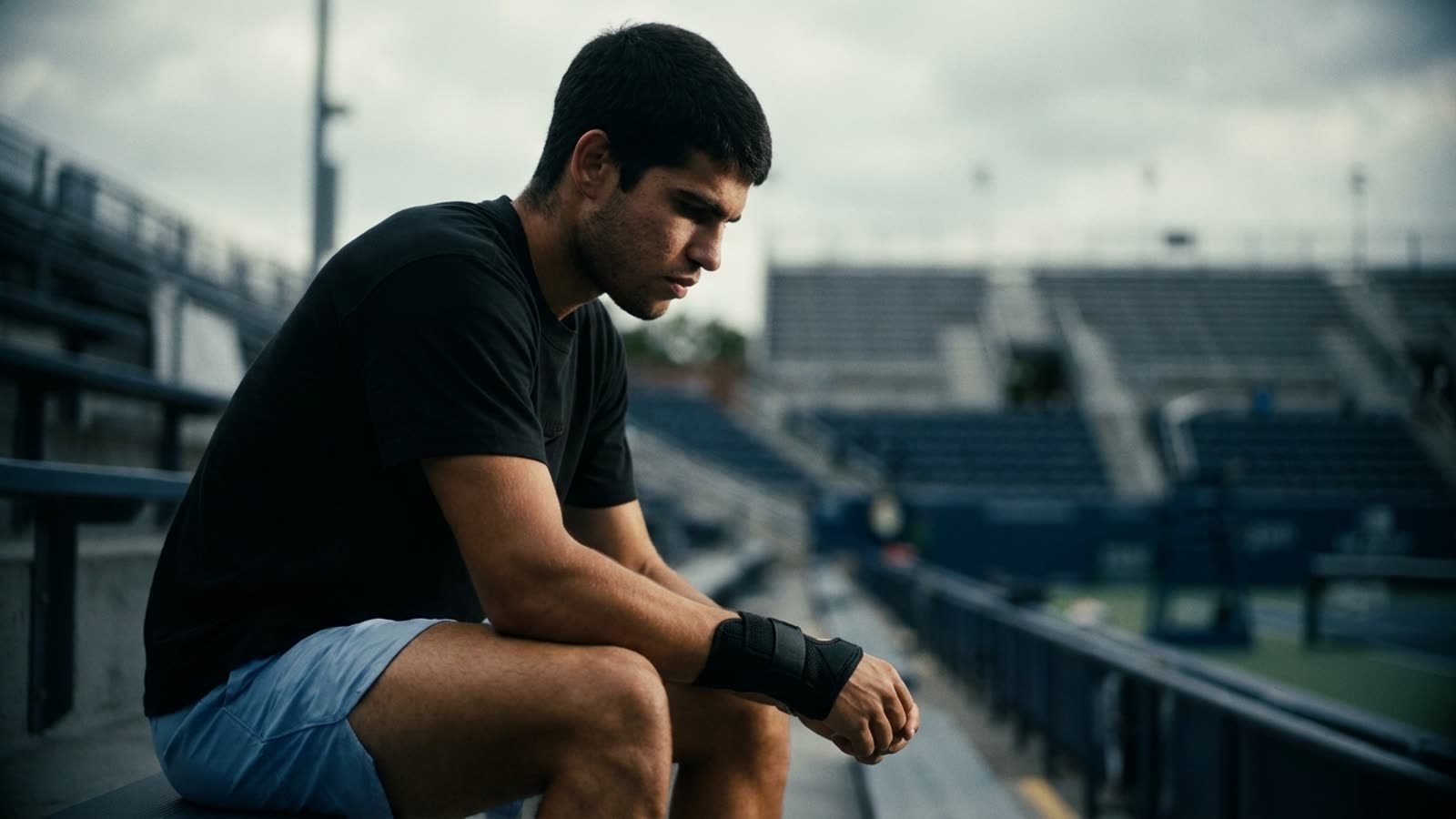
For two consecutive summers, Carlos Alcaraz has owned the All England Club with the casual authority of someone who might do it for the next decade. Now the 23-year-old Spaniard will watch from the sidelines as his wrist — the same one that has troubled him intermittently since Roland Garros — refuses to cooperate with the grass-court calendar.
The announcement confirms what insiders had feared since Alcaraz withdrew from Queen's Club last week. A lingering injury that seemed manageable on clay has proven incompatible with the low-bounce, quick-reflex demands of grass. His team has declined to specify a return timeline, saying only that the priority is "long-term career health."
A vacuum at SW19
Wimbledon without its defending champion is not unprecedented, but Wimbledon without Alcaraz in 2026 creates a peculiar void. Novak Djokovic, now 39, has managed his schedule so carefully that his participation remains uncertain until the final entry deadline. Rafael Nadal retired eighteen months ago. Roger Federer has been gone even longer. The tournament that once guaranteed at least one generational talent in the second week now faces the possibility of crowning a champion from a muddled middle tier.
Jannik Sinner, the world number one, becomes the presumptive favorite by default, but the Italian's grass-court record remains modest compared to his hard-court dominance. Daniil Medvedev has never advanced past the fourth round at the All England Club. The draw suddenly looks like a bracket of opportunity rather than a coronation.
The economics of absence
Broadcasters and sponsors had already built their Wimbledon campaigns around the Alcaraz-Sinner rivalry that has defined the tour for three years. Nike's summer tennis push featured Alcaraz prominently; those assets will need hasty revision. The All England Club itself, which has invested heavily in promoting a new generation after the Big Three era, loses its most charismatic ambassador at the worst possible moment.
Alcaraz's absence also complicates the US Open Series calculus. If he returns for the North American hard-court swing, he will arrive without match sharpness on any surface since May. If he doesn't, the sport's second half of 2026 becomes a Sinner exhibition tour with diminished dramatic stakes.
Our take
Injuries are not moral failings, and Alcaraz is right to protect his wrist rather than risk a Rafael Nadal-style decade of chronic management. But tennis has spent years promising that the post-Big Three era would be exciting rather than diminished, and that promise required Alcaraz and Sinner to be healthy and present at the majors that matter. One withdrawal doesn't invalidate the thesis, but it does remind everyone how thin the margin is between a golden age and a holding pattern.