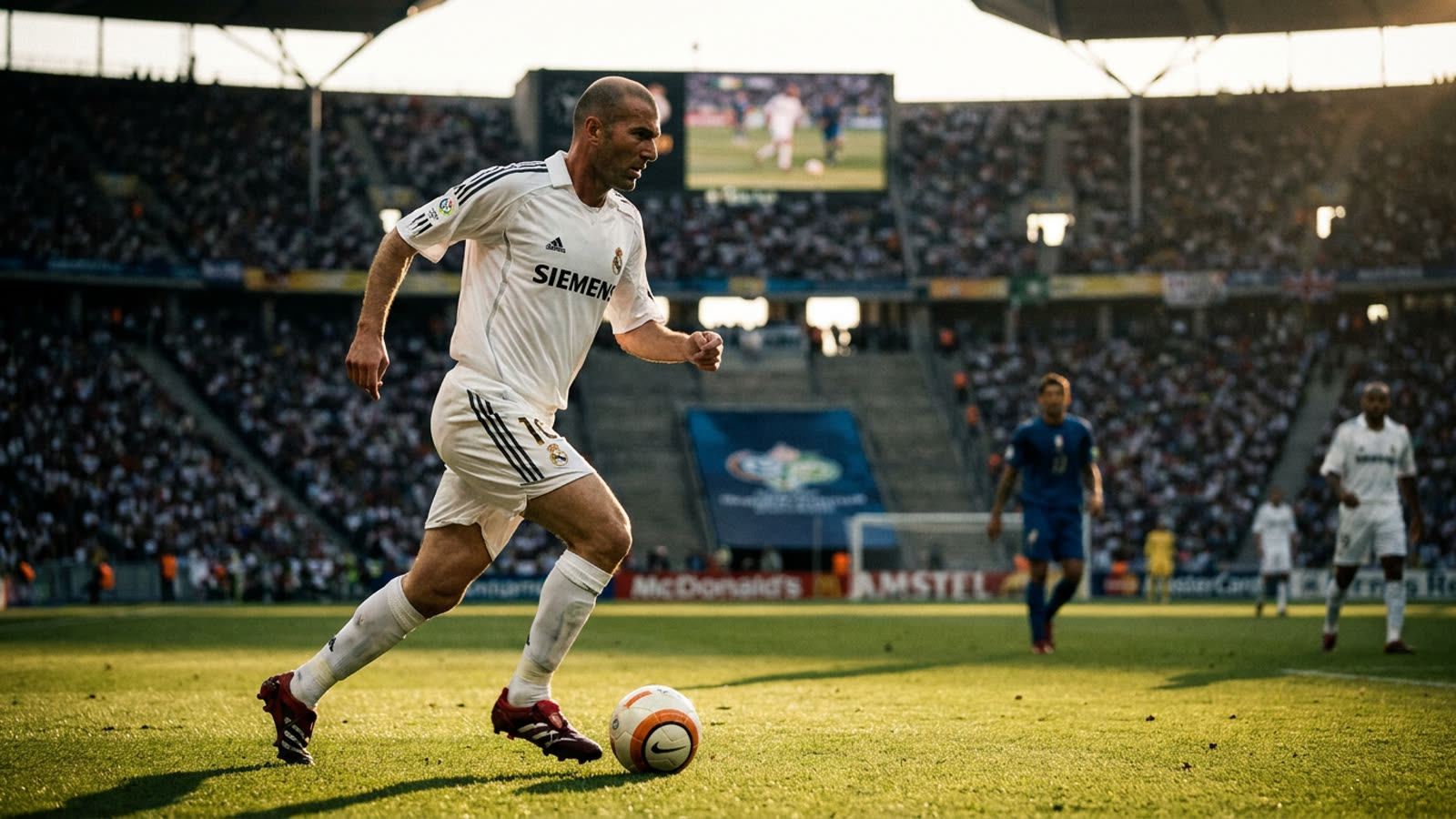
Great careers are supposed to end with triumph or tragedy, not with a chest-to-chest confrontation in extra time of a World Cup final that leaves everyone, including the protagonist, struggling to explain what just happened. Zinedine Zidane's headbutt on Marco Materazzi in Berlin was neither heroic nor villainous in any conventional sense. It was simply, irreducibly strange—a moment of supreme self-destruction from a player who had spent the tournament proving he remained the most elegant footballer alive.
The strangeness is the point. Zidane had already scored from the penalty spot, a nerveless Panenka chip that kissed the underside of the crossbar. France looked likely to win. At 34, playing his final professional match, Zidane was minutes away from cementing a legacy that needed no cementing. Then Materazzi said something, and Zidane walked calmly into him, lowered his head, and drove it into the Italian defender's chest.
The interpretive vacuum
What makes the incident so enduring is that it refuses to resolve into a simple narrative. Was it a moment of Latin honor? A psychological collapse? A strange act of self-sabotage from a man who could not bear the weight of a perfect ending? Zidane himself has offered varying accounts over the years, acknowledging that Materazzi's words were insulting but never quite explaining why this particular insult, at this particular moment, required this particular response.
The footage doesn't help. Watched in slow motion, Zidane appears almost serene as he turns and walks toward Materazzi. There is no explosion of rage, no loss of control in the conventional sense. He looks, if anything, like a man who has made a decision and is now executing it with the same precision he brought to a through ball or a volley.
The career it capped
Context matters. Zidane was not a saint. He had been sent off multiple times before, including at the 1998 World Cup, where he stomped on a Saudi Arabian player and missed two matches. The headbutt was not an aberration in an otherwise spotless record; it was the final, most dramatic instance of a pattern that had always been part of his game.
But Zidane was also, unarguably, one of the most gifted players to ever touch a football. His first touch was supernatural. His body feints were works of choreography. In the 2006 tournament, at an age when most midfielders are commentating rather than competing, he had been France's best player by a considerable margin. The headbutt did not erase any of this. It simply made his legacy more complicated, more human, more resistant to hagiography.
Our take
Sport loves clean endings—the champion walking off into the sunset, the final shot swishing through the net. Zidane denied us that satisfaction, and in doing so, he gave us something more valuable: a moment that still provokes argument and reflection nearly two decades later. The headbutt was inexcusable, inexplicable, and somehow inevitable. It was the final brushstroke of an artist who refused to be predictable, even when predictability would have served him better. Football is poorer for his absence and richer for his contradictions.