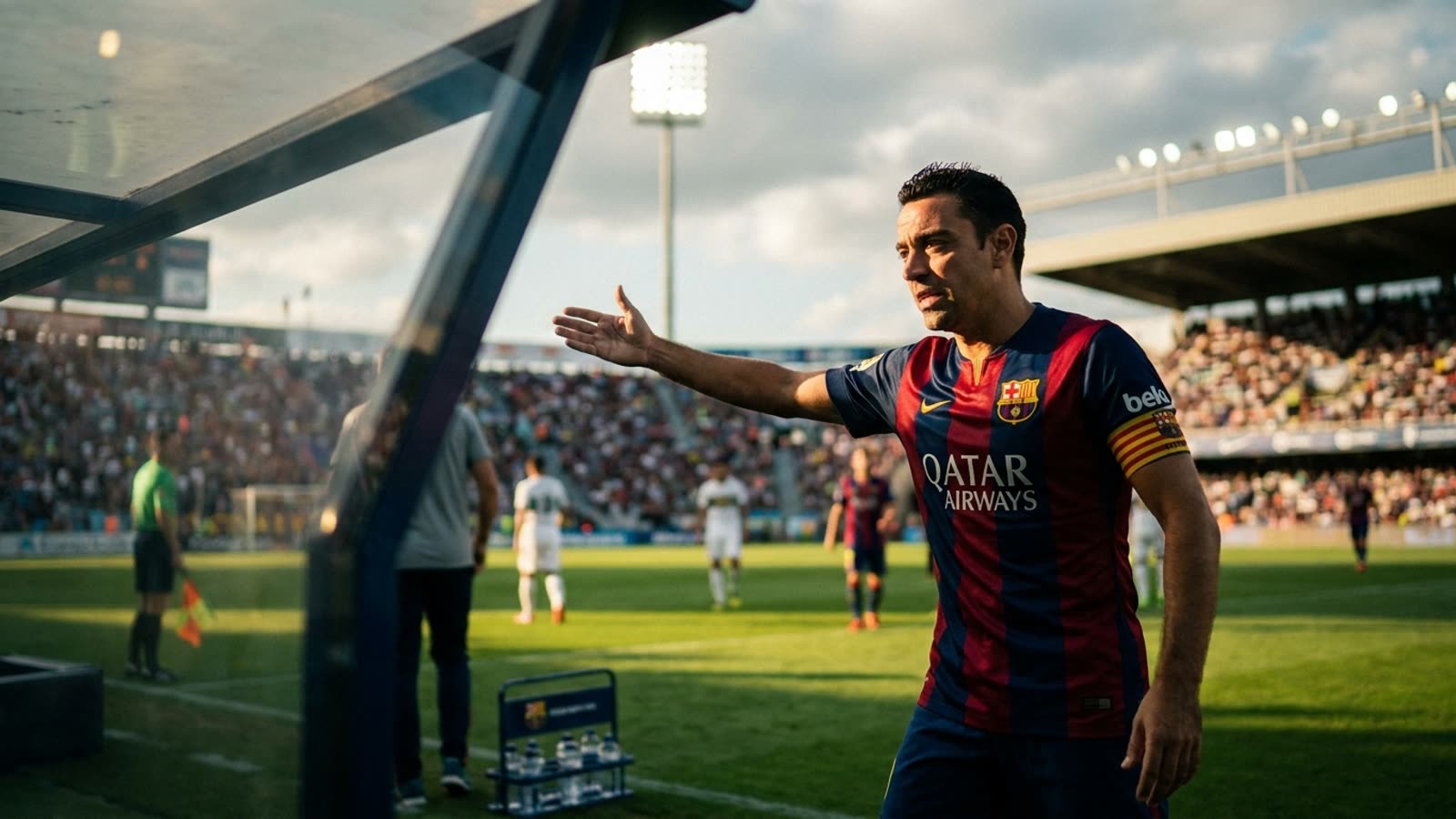
There is a famous piece of footage from a training session at La Masia, Barcelona's youth academy, in which a teenage Xavi Hernández receives the ball, pivots, and releases a pass so quickly that his marker is left frozen mid-stride. The sequence takes perhaps two seconds. What makes it remarkable is not the pass itself—a simple ten-meter ball to a teammate's feet—but the three micro-adjustments Xavi makes before receiving it: a glance over his left shoulder, a half-step to create separation, and a subtle opening of his hips to expand his passing angles. By the time the ball arrives, the decision has already been made. The execution is merely a formality.
This was the essence of Xavi's genius. In a sport that increasingly fetishizes pace, power, and vertical directness, he built a career on the radical premise that football is fundamentally a game of time and space—and that both could be manufactured through intelligence rather than athleticism.
The geometry of possession
Xavi's gift was positional. He understood, almost intuitively, that the value of a pass is determined not by its destination but by the options it creates. A ball played to a teammate facing his own goal is worth less than one played to a teammate facing forward, even if the distance is identical. This sounds obvious. It is not. Most midfielders think in terms of completing passes; Xavi thought in terms of what happens two passes later.
His partnership with Andrés Iniesta at Barcelona and with the Spanish national team produced some of the most suffocating football ever played. The 2010 World Cup final against the Netherlands remains instructive: Spain completed over seven hundred passes, many of them seemingly going nowhere, yet each one subtly repositioned the Dutch defense until gaps appeared. It was football as siege warfare, patient and methodical, and Xavi was its architect.
Why the style endures
The tactical pendulum has swung since Xavi's peak years. Pressing, transitions, and athletic intensity have become the dominant currencies. Liverpool under Jürgen Klopp, Manchester City's controlled chaos, and the high-octane Bundesliga have all pushed football toward greater verticality. Yet Xavi's influence persists, embedded in the DNA of every team that believes possession is not merely a statistic but a weapon.
His post-playing career as a coach has been an attempt to prove the philosophy remains viable. The results have been mixed, as they always are when idealism meets the compromises of management. But the project itself is coherent: football played on the front foot, with the ball, dictating terms rather than reacting to them.
Our take
Xavi Hernández was never the best player on his own team—that honor belonged to Messi—nor the most spectacular midfielder of his generation. What he was, and remains, is the most influential thinker to play the position in the modern era. He proved that football's physical arms race has limits, that there will always be room for the player who sees the game a half-second before everyone else. In an age of athletes, he was an intellectual, and the game is richer for it.