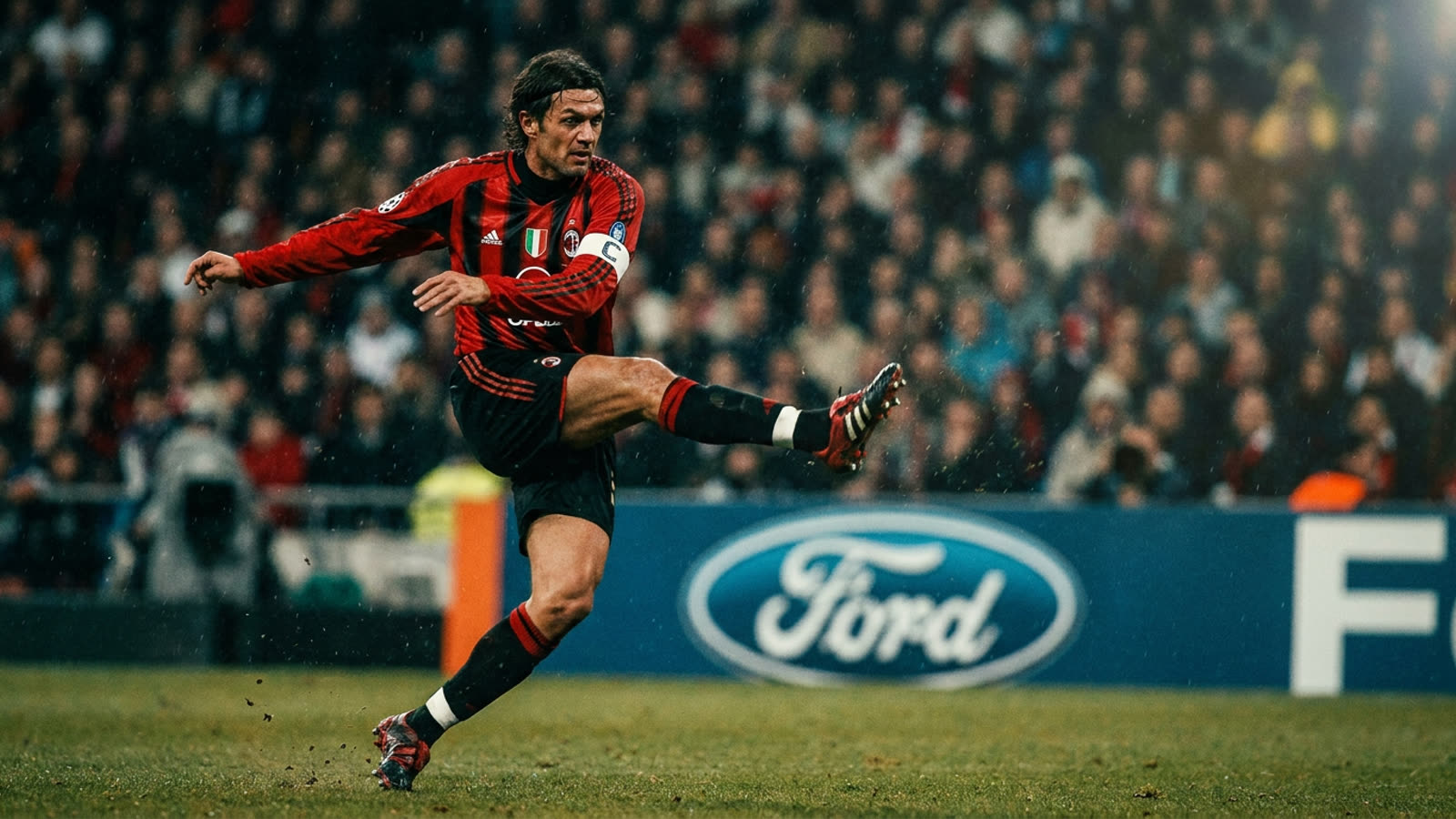
There is a clip, endlessly circulated among football obsessives, of Paolo Maldini defending against a winger in full flight. What happens next is almost nothing: a slight adjustment of the hips, a half-step to the left, and the attacker finds himself shepherded harmlessly toward the corner flag, dispossessed without Maldini having made what anyone would call a tackle. The defender barely breaks stride. The winger looks confused, as if he has been pickpocketed in broad daylight by a man who never reached into his pocket.
This was Maldini's genius, and it was a genius of negation. In a sport that celebrates goals, assists, and dramatic interventions, he built a career on ensuring that drama never arrived. His famous dictum—that if he had to make a tackle, he had already made a mistake—was not false modesty. It was a precise description of his method: reading the game so thoroughly that physical confrontation became unnecessary.
The geometry of space
Maldini's defensive intelligence operated on principles that have become increasingly rare. Where modern defenders are coached to press aggressively, to win the ball high, to be comfortable playing as auxiliary midfielders, Maldini was a specialist in what might be called defensive architecture. He understood that the space between himself and his opponent was not empty—it was information. The angle of a striker's hips, the weight distribution before a first touch, the geometry of passing lanes: all of this told him where the ball would go before the attacker had decided to send it there.
This anticipatory style required something that contemporary football development often neglects: patience. Maldini spent his entire career at a single club, from his debut as a teenager to his retirement at forty, and that continuity allowed him to develop a defensive vocabulary that younger players, shuttled between academies and loan spells, rarely have time to acquire.
The position's transformation
The modern full-back is expected to be a winger who can occasionally defend. The metrics that clubs use to evaluate defenders—progressive carries, expected assists, touches in the final third—would have seemed bizarre applied to Maldini's generation. This is not necessarily a criticism of tactical evolution; football changes, and the high-pressing systems that dominate European competition demand different skill sets. But something has been lost in the transition.
What has been lost is the defender as reader rather than reactor. Maldini's positioning was so precise that he could play at the highest level into his forties, long after his pace had diminished, because pace was never the foundation of his game. He had learned to see the future a few seconds before it happened, and that foresight does not age.
Our take
Football's obsession with the spectacular has made defending a secondary art, something to be tolerated rather than celebrated. Maldini's career stands as a reminder that the absence of drama can be its own form of brilliance—that the tackle not made, the cross not delivered, the chance not created can represent a higher form of mastery than the desperate last-ditch intervention. The game is poorer for having forgotten how to value what he did, even as it remains richer for having witnessed him do it.