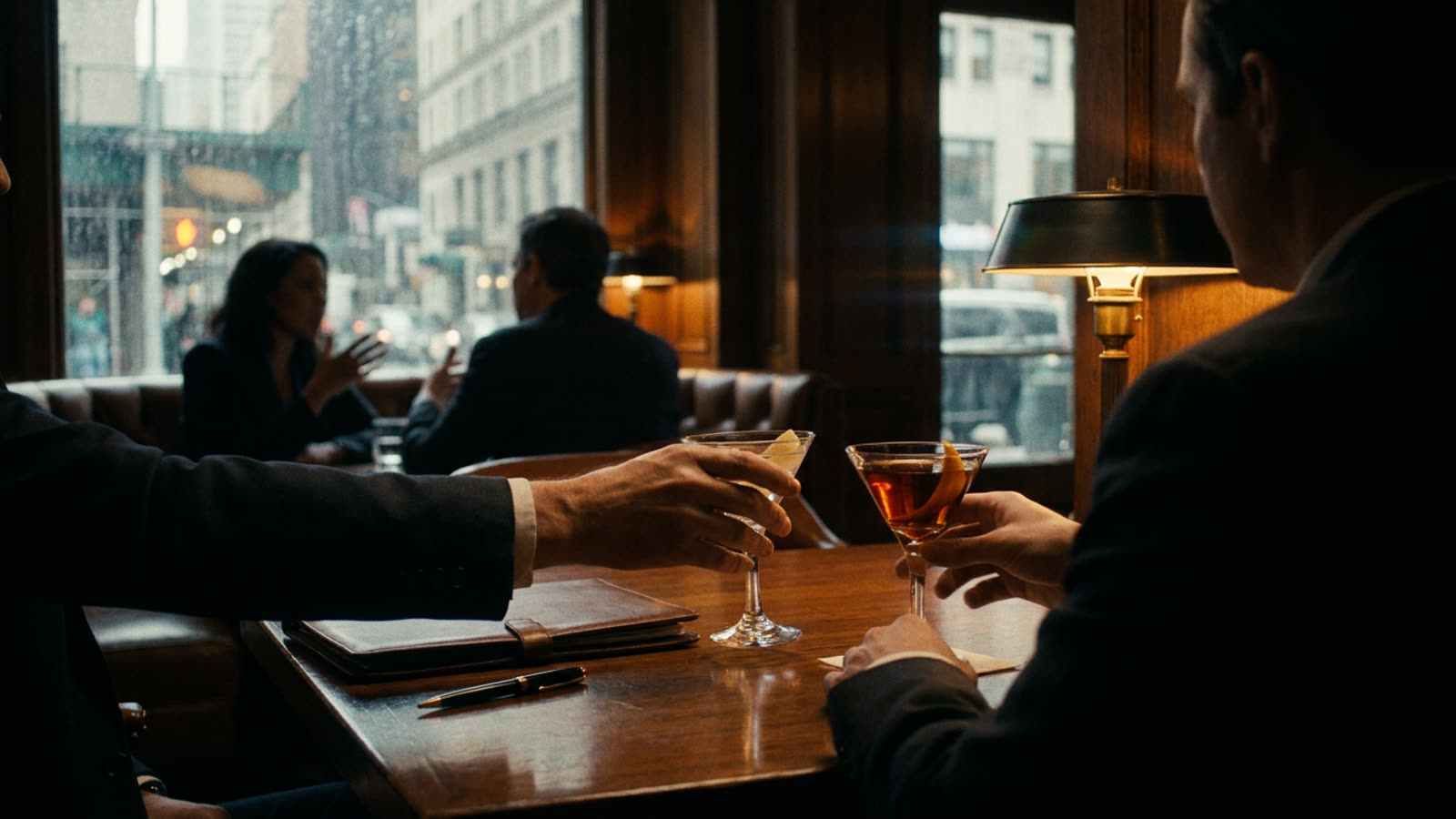
The mythology goes like this: sometime in the early 1980s, the American expense-account lunch—that gin-soaked institution of the postwar corporate class—died a sudden death, killed by fitness culture, liability concerns, and a new generation of executives who preferred mineral water to vermouth. The reality is considerably more interesting.
The midday cocktail never vanished. It simply learned to read the room.
The golden age and its discontents
From roughly 1950 to 1975, the two-martini lunch was less a cliché than a job requirement for anyone in advertising, publishing, finance, or law. The ritual served multiple functions simultaneously: it demonstrated that you were important enough to have a long lunch, wealthy enough to afford it, and socially fluent enough to conduct business while moderately impaired. The restaurants that catered to this crowd—the Four Seasons in New York, the Pacific Dining Car in Los Angeles, the London Chop House in Detroit—understood that the food was almost beside the point. What mattered was the theater of consumption, the visible expenditure of time and money in service of relationships that couldn't be built over a desk.
The backlash, when it came, was swift and moralistic. Mothers Against Drunk Driving, corporate wellness programs, and a general cultural shift toward performative health consciousness made the visible midday drink a liability rather than an asset. By the 1990s, ordering alcohol at a business lunch had become vaguely transgressive, a signal that you were either old-fashioned or had a problem.
The quiet persistence
And yet the practice never actually stopped. What changed was the semiotics. The power lunch migrated from steakhouses to omakase counters, where a single glass of sake carries none of the cultural baggage of a martini. It moved to private clubs where discretion is the entire point. It relocated to wine-focused restaurants where a bottle split among four people reads as connoisseurship rather than indulgence. The alcohol remained; the optics evolved.
Today, the midday cocktail has completed its transformation from mass ritual to elite signifier. The people who can still take a proper lunch—unhurried, expensive, lubricated—are precisely those who no longer punch a clock: founders, investors, senior partners, the independently wealthy. The two-martini lunch didn't die with the Mad Men era. It simply became a marker of a different kind of power, one defined by temporal freedom rather than corporate position.
Our take
Every generation believes it invented both productivity and pleasure, and every generation is wrong. The midday drink endures because the human need it serves—to slow down, to connect, to mark the middle of the day as something other than a brief interruption in the march toward evening—is more durable than any cultural fashion. The only thing that changes is who gets to indulge and how guilty they're supposed to feel about it.