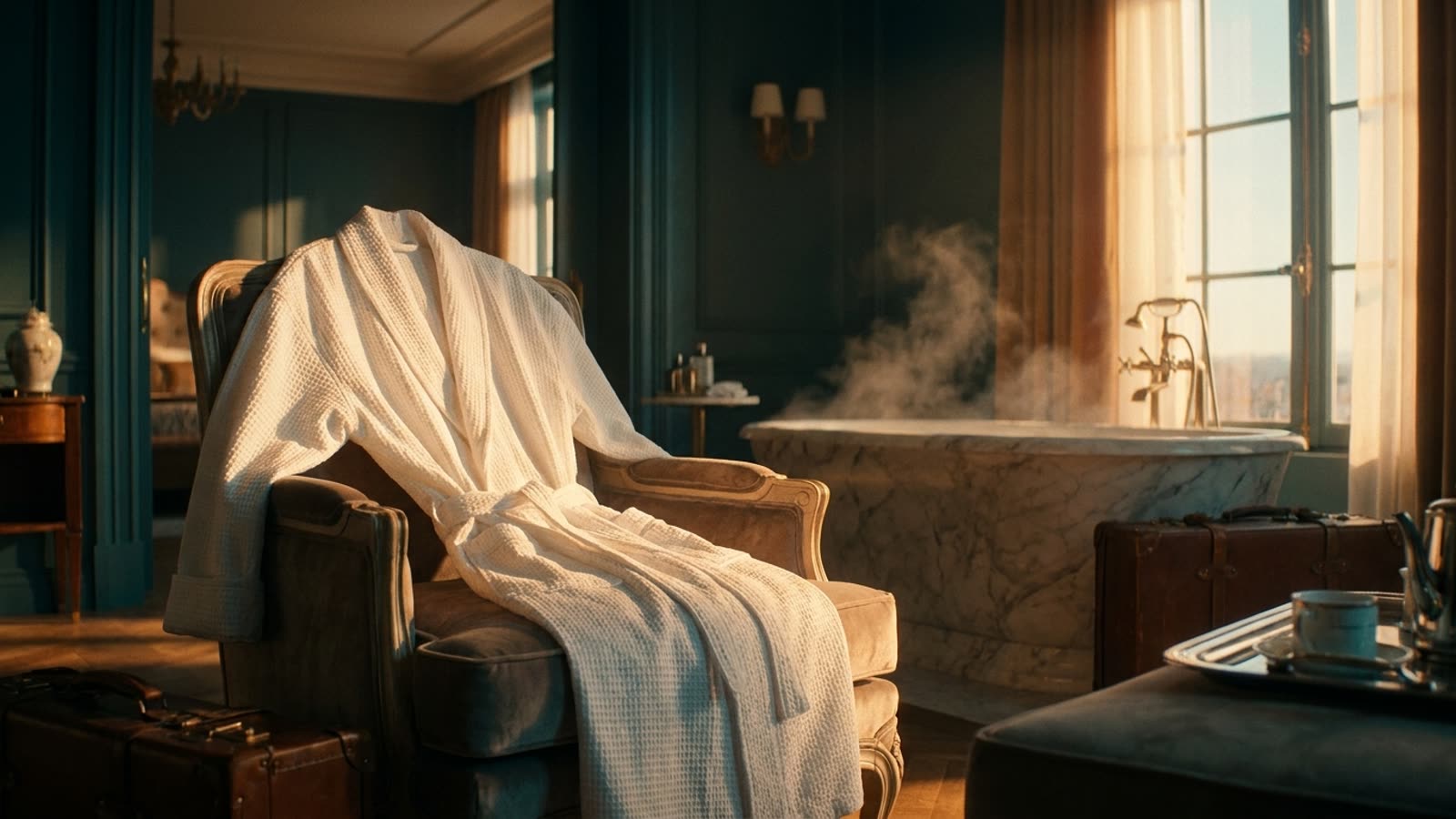
The first thing you do in a good hotel room, before unpacking, before checking the view, before judging the thread count, is put on the robe. You know this. The industry knows this. And the entire economics of luxury hospitality pivots on the fact that this robe—thick, white, hanging with suspicious perfection on the bathroom door—will make you feel like a different person. Someone who deserves room service at midnight. Someone who tips well.
This is not an accident. The modern hotel bathrobe is one of the most carefully engineered objects in the hospitality arsenal, designed not merely for comfort but for a specific psychological transformation. It works. And the reason you cannot recreate the experience at home, despite owning three robes purchased in fits of post-vacation optimism, reveals something essential about how luxury actually functions.
The weight problem
Professional-grade hotel robes typically weigh between 1.5 and 2.5 kilograms, constructed from terry cloth with a GSM (grams per square meter) rating between 400 and 500. This is substantially heavier than most consumer robes, which hover around 300 GSM to keep shipping costs and washing machine strain manageable. The weight matters because it creates what textile engineers call "drape pressure"—a gentle, distributed heaviness across the shoulders and back that triggers the same neurological response as a weighted blanket. You are, quite literally, being hugged by a towel.
But weight alone doesn't explain the magic. Hotels launder their robes in industrial machines using specific chemical cocktails—optical brighteners that make white appear more luminous than physics should allow, fabric softeners calibrated to create slip without residue, and starches that add body without stiffness. The robe you encounter has been processed dozens of times through systems that cost more than your car. It has achieved a texture that exists nowhere in nature.
The context multiplier
The more interesting question is why the same robe, purchased from the hotel gift shop and transported to your bathroom at home, immediately becomes ordinary. Part of this is practical: your home washing machine cannot replicate industrial laundering, and within three washes, the robe has become merely a thick towel with sleeves. But the deeper answer is that the robe was never the product. The robe was a delivery mechanism for a feeling that requires the entire hotel infrastructure to function.
You put on the robe after someone else made the bed. You wear it while standing at a window overlooking a city where you have no obligations. You cinch the belt knowing that if you spill coffee on it, someone else will deal with the stain. The robe is comfortable, yes, but what it actually provides is a costume for a role: the person who is taken care of. This is the service the robe performs, and it cannot be shipped.
The economics of aspiration
Hotels understand this perfectly, which is why the gift-shop robe is priced at a point designed to create desire without satisfying it. At many luxury properties, the retail robe costs between one hundred and three hundred dollars—enough to feel like a commitment, not enough to feel insane. The guest buys it believing they are purchasing the feeling. They are actually purchasing a memento of the feeling, which is a different and far less valuable object. The hotel has successfully monetized nostalgia for an experience that ended the moment the guest checked out.
This is not cynicism; it is simply how aspiration markets function. The robe is a synecdoche for the entire luxury hospitality proposition: you are paying for temporary access to a version of yourself that requires significant infrastructure to maintain. The minibar, the concierge, the turndown service, the robe—these are all props in a theatrical production where you play someone whose problems are handled by staff.
Our take
The hotel bathrobe works because it is honest about its dishonesty. It does not pretend to be a superior garment; it is a superior context, wrapped in terry cloth. The guests who buy the gift-shop version are not fools—they are optimists, hoping that objects can carry experiences across thresholds. They cannot. But the attempt is very human, and the hotels that profit from it have earned their margin. They have, after all, figured out how to sell a feeling that weighs two kilograms and disappears the moment you do your own laundry.