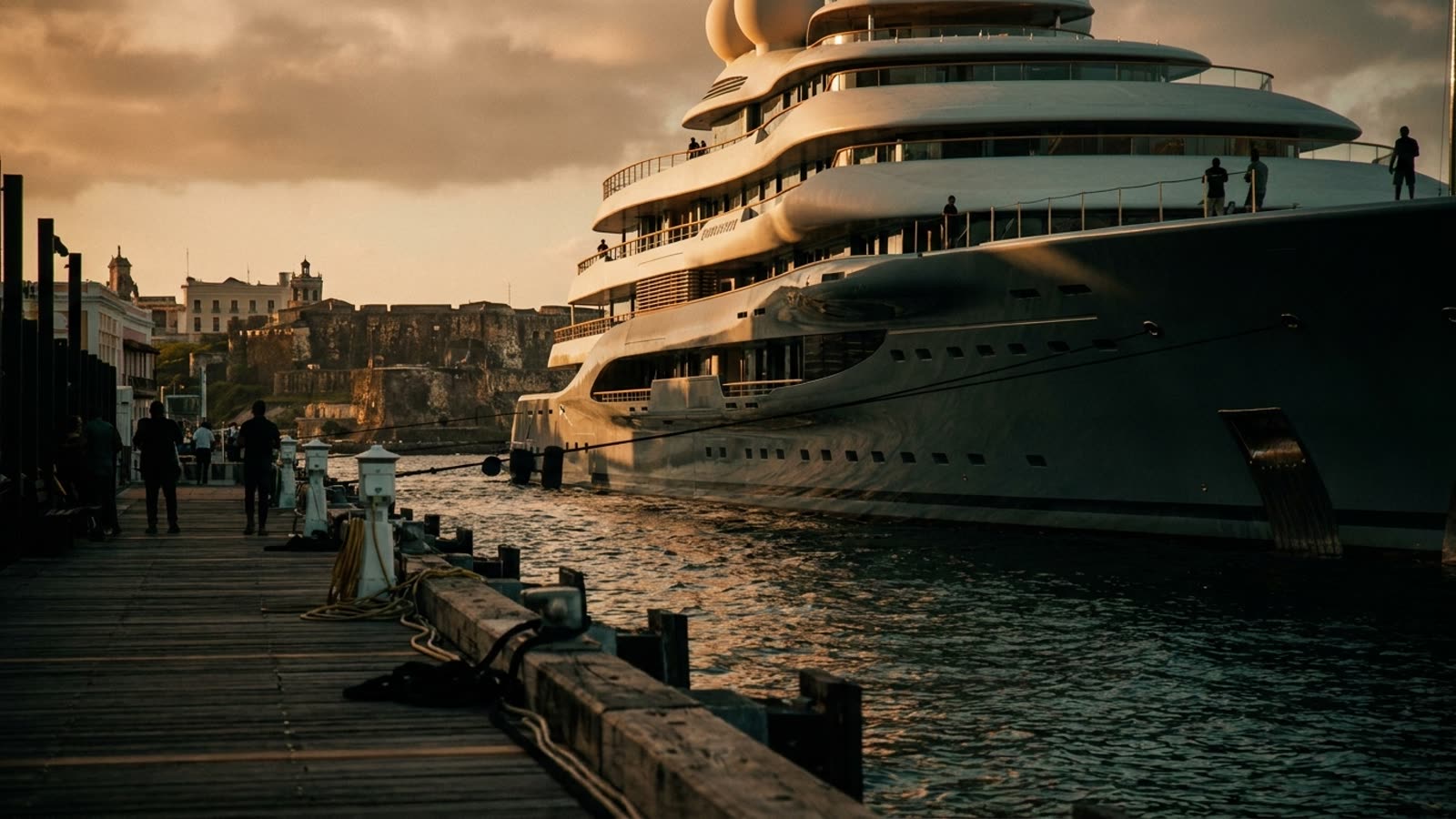
Every major American holiday now arrives with the same visual payload: famous people on boats. The Fourth of July weekend, in particular, has become a reliable showcase for yacht content — celebrities lounging on decks, diving into impossibly blue water, toasting with champagne against sunset backdrops. The images are so ubiquitous they've become ambient noise. But their persistence tells a story about how we've come to visualize success, and why the boat has eclipsed nearly every other luxury signifier in the celebrity image economy.
The grammar of the yacht shot
The contemporary yacht photo follows strict compositional rules that have emerged organically over the past decade. Subject positioned at bow or stern, never mid-deck. Water visible in frame, preferably Mediterranean or Caribbean blue. Minimal visible crew. The aesthetic borrows from paparazzi candids but is almost always staged — a simulation of being caught in the act of leisure. What distinguishes the yacht shot from other luxury content (private jets, designer wardrobes, real estate tours) is its suggestion of escape. The boat exists nowhere in particular. It implies freedom from geography, from schedules, from the earthbound concerns of ordinary life.
This is why the format has proven so durable even as other status displays have grown tiresome. The mansion tour feels gauche. The private jet post invites climate criticism. But the yacht occupies a curious middle ground — obviously expensive, yet somehow less aggressive about it. Water softens everything.
Why boats beat houses
Real estate, once the primary canvas for celebrity wealth display, has lost its visual power. A house is fixed, assessable, comparable. Zillow has democratized property voyeurism to the point where anyone can estimate what a celebrity paid for their compound. The yacht, by contrast, resists easy valuation. Charter or owned? What size? What crew costs? The ambiguity serves the image. It suggests wealth without inviting precise calculation.
There's also the question of accessibility. Most people will never own a home in Malibu, but yacht charters have become surprisingly attainable for upper-middle-class vacationers in certain markets. This creates a useful fantasy gradient: the celebrity yacht shot feels aspirational but not impossibly distant. You could, theoretically, be on a boat like that someday. This is the sweet spot for effective status imagery — close enough to desire, far enough to admire.
Our take
The annual flood of holiday yacht content has become so predictable it barely registers as noteworthy. Yet its very banality is the point. The boat has won the status-symbol wars not through novelty but through repetition, becoming the default visual language for "I have made it" in ways that feel almost quaint. In an era of increasingly baroque wealth displays — space tourism, private islands, bunker complexes — the yacht photo persists because it offers something simpler: the dream of floating away from everything, if only for a weekend. That this dream is now as choreographed as a fashion shoot doesn't diminish its power. If anything, the performance has become the point.