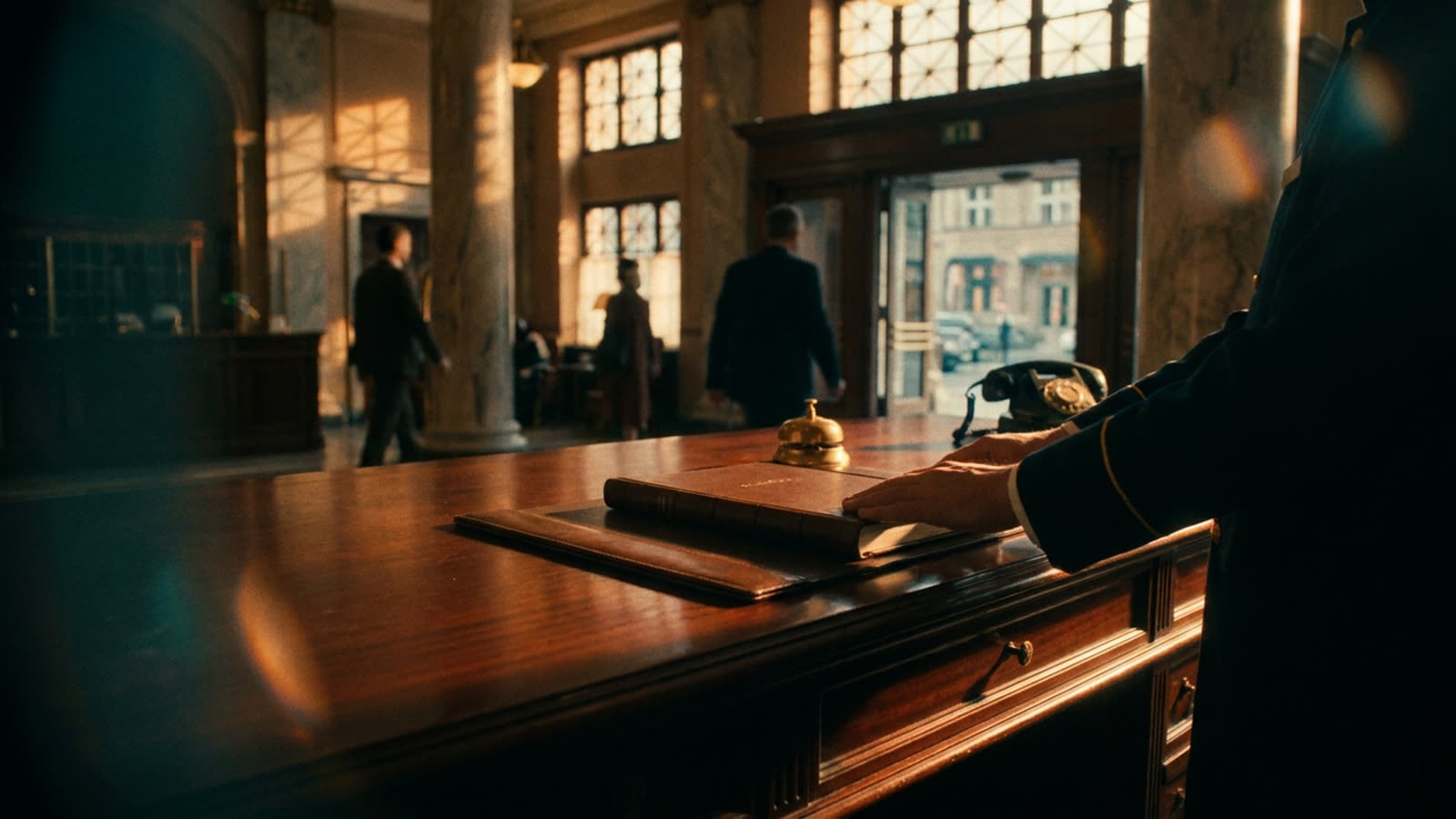
The concierge desk sits in the lobby like a vestigial organ, staffed by someone in a suit who knows which florist delivers after midnight and which museum guard can be persuaded to open the Caravaggio room early. In theory, this person has been obsolete since roughly 2010. In practice, the role has never been more central to what a great hotel actually sells.
The paradox is worth examining. Every service a concierge traditionally provided—restaurant reservations, theatre tickets, car hire, local recommendations—can now be accomplished in seconds by a guest lying in bed, thumbing through apps. The Four Seasons and the Aman and the Ritz know this. They employ concierges anyway, often expanding their teams. The explanation lies not in what concierges do but in what their existence communicates: that the hotel believes your time and attention are too valuable to spend on logistics, and that human judgment, properly trained, remains superior to algorithmic suggestion for anything that matters.
The economics of friction
Luxury, at its core, is the purchase of someone else's problem-solving. A bespoke suit eliminates the problem of fit. A private jet eliminates the problem of scheduling. A concierge eliminates the problem of local knowledge—but more subtly, eliminates the cognitive burden of having to want something specific before you can get it. The best concierges are not order-takers but interpreters of half-formed desires. A guest says she wants "somewhere interesting for dinner," and the concierge, having noted her shoes and her reading material and the questions she asked at check-in, suggests not the Michelin three-star but the family-run trattoria that doesn't take reservations, then makes a call to ensure she gets the corner table.
This is expensive. Training a concierge takes years. The networks they maintain—the personal relationships with maître d's, gallery owners, private drivers—cannot be purchased wholesale. Hotels pay for this because the alternative, a guest Googling "best restaurant near me" and receiving the same twelve results as everyone else, subtly degrades the premise of the entire enterprise. If the experience inside the hotel is identical to the experience outside it, the room rate becomes difficult to justify.
The guild and its keys
The profession has its own mythology. Les Clefs d'Or, the international concierge association founded in France in 1929, awards golden crossed-key pins to members who meet its standards—a visible credential that guests who know what to look for will recognize. The organization maintains that its members can fulfill virtually any legal request, a boast that sounds like marketing until you hear the stories: the concierge who sourced a high-school yearbook from 1943 for a dying guest, the one who arranged a private blessing from a cardinal, the one who found a replacement for a child's lost stuffed animal by tracking down the original manufacturer's discontinued inventory.
These feats are not scalable. They cannot be templated or automated. They depend on a single person's accumulated relationships and lateral thinking, which is precisely why they retain value. The concierge is, in economic terms, a positional good—useful partly because most people don't have one.
Our take
The persistence of the concierge in the age of infinite information is not nostalgia or inertia. It is a coherent philosophy: that convenience and quality are not synonyms, that expertise is worth paying for, and that the highest form of service is not giving people what they ask for but understanding what they actually need. Every hotel that maintains a concierge desk is making a quiet argument against the flattening logic of the algorithm. Whether guests consciously appreciate this is almost beside the point. They feel it in the texture of the stay, in the sense that someone is paying attention. That feeling, irreducible and human, is what the room rate really buys.