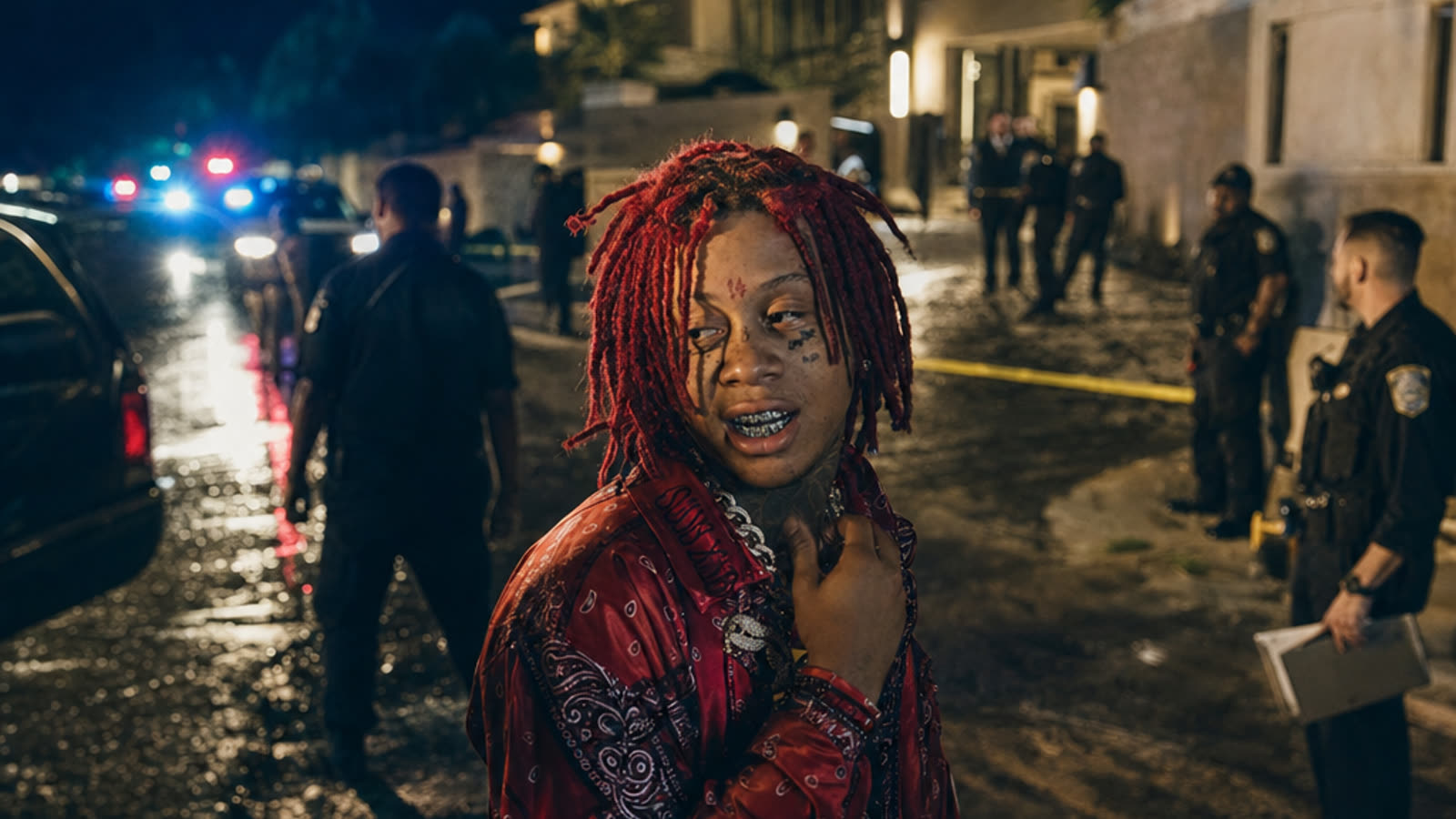
When law enforcement descended on Trippie Redd's residence this week, they weren't looking for the rapper—they were looking for someone who apparently felt comfortable enough to be there. The raid resulted in the arrest of an attempted murder suspect, a development that places the 27-year-old artist in that peculiar celebrity purgatory: not accused of anything, yet somehow at the center of everything.
Trippie Redd, born Michael Lamar White II, rose to prominence during the SoundCloud rap explosion of the late 2010s, building a devoted following with his genre-blending approach and distinctive red-dyed hair. His 2018 debut album went platinum; his collaborations with the late Juice WRLD and XXXTentacion cemented his place in a generation of artists who traded traditional industry gatekeeping for viral moments and streaming dominance. None of that history, however, explains why his home became relevant to a violent crime investigation.
The address problem
Celebrity homes have always attracted unwanted attention, but the nature of that attention has evolved. Where previous generations of famous musicians worried about overzealous fans or paparazzi, today's artists—particularly those from hip-hop's more chaotic corners—face a different calculus. The entourages that signal success and provide security can also introduce liability. A home address, once merely private information to protect, becomes a nexus point for whoever has access to it.
The details of the attempted murder case remain largely sealed, and there is no public indication that Trippie Redd had any involvement in or knowledge of the underlying crime. But the optics are unavoidable: someone facing serious violent charges was found at his property. For an artist whose aesthetic has long flirted with darkness—face tattoos, demonic imagery, lyrics that court controversy—the real-world intrusion of actual violence presents a different kind of brand problem.
A genre's recurring pattern
Hip-hop has buried too many of its young stars to treat proximity to violence as merely theoretical. XXXTentacion was murdered at 20. Juice WRLD died at 21. Pop Smoke was killed during a home invasion at 20. King Von was shot at 26. PnB Rock was murdered in front of his girlfriend at 30. The list extends grimly backward and, one fears, forward. Trippie Redd collaborated with several of these artists; he has eulogized friends publicly and frequently.
This context doesn't implicate him in anything. It does, however, illuminate why a raid at his home registers as more than tabloid fodder. The SoundCloud generation achieved fame young, often without the institutional buffers—managers, labels, security teams—that once insulated artists from their most dangerous associations. Some have matured into those structures; others remain porous to the streets that made them.
Our take
Trippie Redd may emerge from this episode with nothing more than an unpleasant news cycle. He wasn't arrested; he wasn't charged; his name appears in headlines only because of geography. But the incident serves as a reminder that for a certain cohort of artists, the line between persona and peril remains disturbingly thin. The SoundCloud era democratized fame. It did not democratize safety. At some point, the question stops being whether an artist courts danger for aesthetic effect and starts being whether they've built a life that keeps danger out. The raid suggests that question remains unanswered.