Every few seasons, a major fashion house rediscovers the flight attendant. Dior did it with structured capes. Prada did it with retro-futurist metallics. Gucci did it with silk scarves knotted just so. The references are always the same: the Pan Am era, roughly spanning the late 1950s through the early 1970s, when commercial aviation was expensive, exclusive, and dressed accordingly.
The persistence of this aesthetic—call it stewardess chic, jet-set revival, or simply midcentury airline nostalgia—reveals something deeper than fashion's usual cyclical hunger for the past. It speaks to a collective longing for a time when travel itself was a performance, when getting somewhere required looking like you deserved to arrive.
The uniform as status symbol
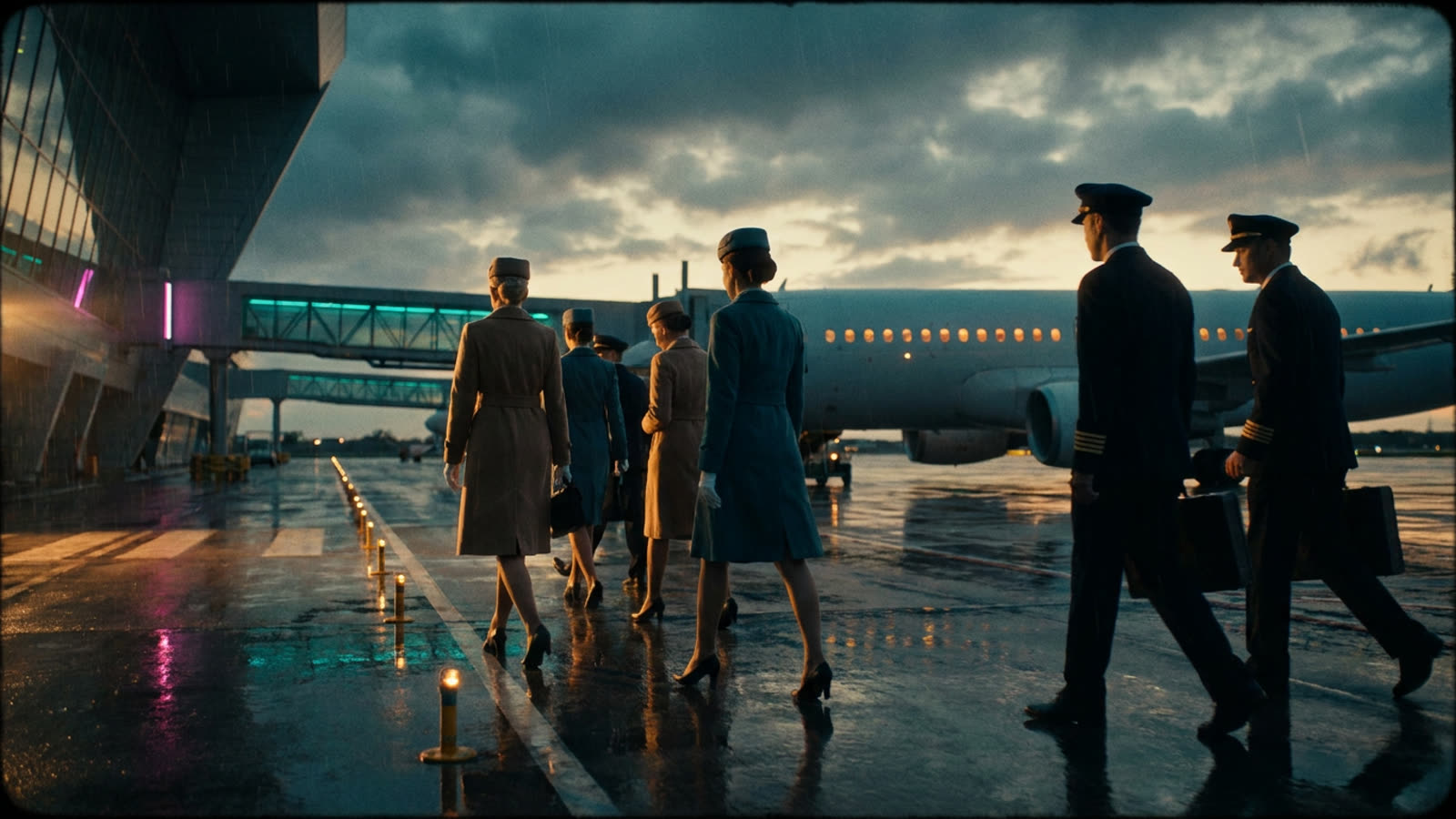
Airline uniforms of the golden age were designed by couturiers, not corporate committees. Emilio Pucci created psychedelic shifts for Braniff International. Balenciaga dressed Air France. The uniforms signaled that flight attendants were not service workers in the contemporary sense but ambassadors of a lifestyle most passengers could barely afford to glimpse.
The women wearing these uniforms were selected for height, weight, and marital status—requirements that would be illegal today and were exploitative then. Yet the imagery persists, scrubbed of its discriminatory context, reduced to pure aesthetic: the gloves, the brooches, the immaculate chignons.
Why the fantasy survives
Modern air travel is the opposite of glamorous. It is a system optimized for throughput, not experience. Seats have shrunk. Legroom has vanished. The cabin crew uniform at most carriers is designed for practicality and brand recognition, not aspiration.
This is precisely why the old imagery retains its power. It represents a fantasy of friction—of a world where getting from New York to Paris required effort, expense, and a certain sartorial commitment. In an era of algorithmic convenience, the idea that travel once demanded performance feels almost subversive.
Social media has amplified this. Vintage airline posters circulate endlessly on Pinterest. TikTok creators stage "old Hollywood airport" videos, complete with matching luggage sets and headscarves. The aesthetic has become a genre, detached from any actual airline or era, signifying only a vague longing for elegance.
The business of nostalgia
Brands have noticed. Away luggage built an empire partly on the promise that your suitcase could make you feel like a midcentury traveler, even if your flight is a budget carrier to Fort Lauderdale. Luxury hotels market "arrival experiences." First-class cabins on Emirates and Singapore Airlines are designed less for comfort than for the Instagram shot—the lie-flat bed, the champagne flute, the pajamas.
Even airlines themselves occasionally lean into the archive. Qantas and British Airways have released heritage liveries. Pan Am, defunct since 1991, lives on as a licensing property, its logo appearing on everything from tote bags to hotel lobbies.
Our take
The golden age of airline glamour was built on exclusion—economic, racial, gendered. Remembering that matters. But the aesthetic's survival is not simply false consciousness or misplaced nostalgia. It is a reaction to the genuine ugliness of contemporary travel, a protest lodged in silk scarves and vintage Samsonite. Fashion will keep returning to this well because the well is deep, and because the present keeps giving us reasons to look backward for beauty.