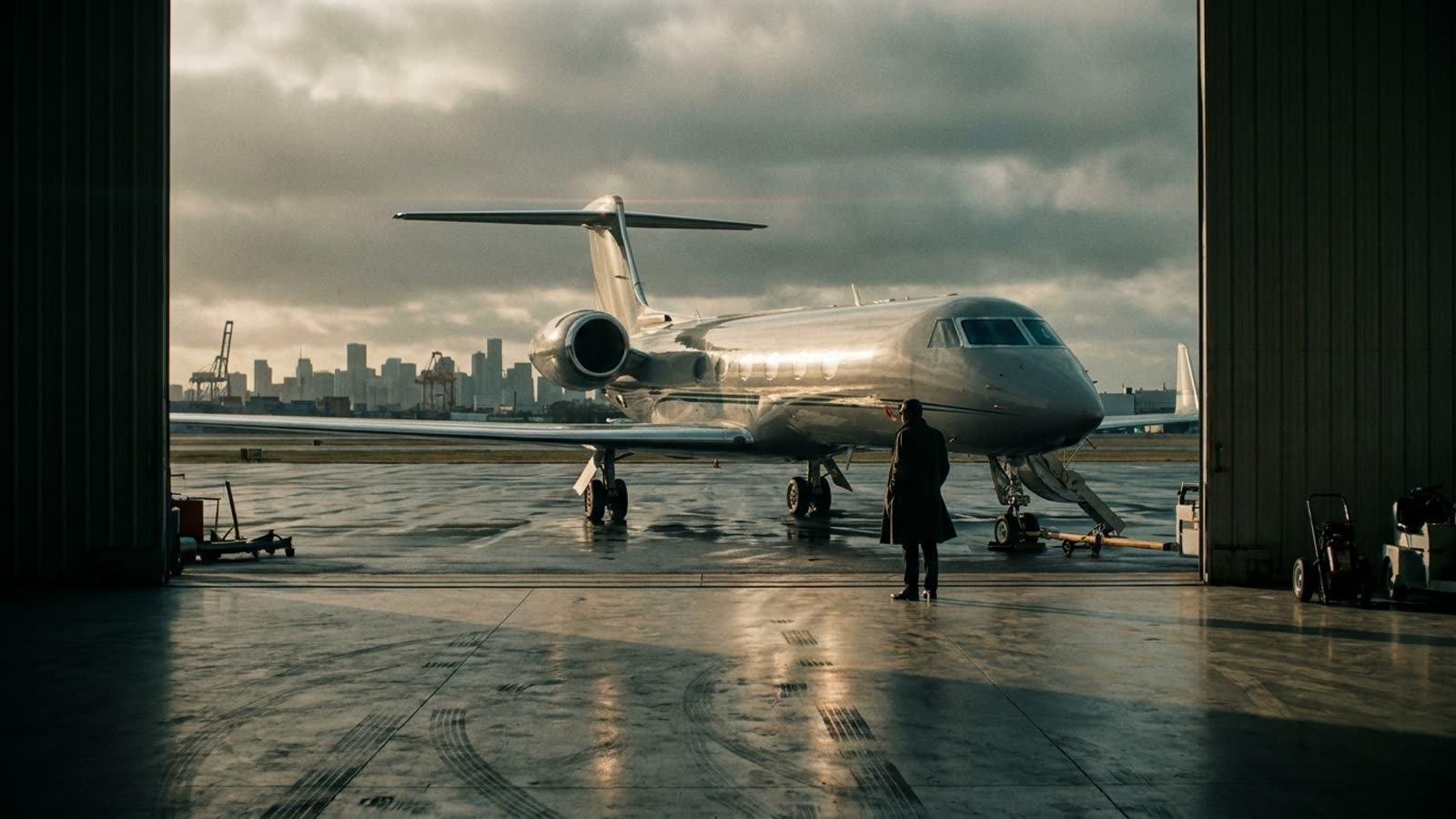
The mathematics of private aviation should kill the industry. A new Gulfstream G700 costs roughly seventy million dollars, depreciates faster than a luxury sedan, requires a full-time crew whether it flies or not, and burns through operating costs that would make a yacht owner wince. And yet the order books remain full, the fractional ownership programs keep expanding, and the fixed-base operators at Teterboro and Van Nuys continue building ever-larger private terminals.
The disconnect between financial logic and market reality reveals something fundamental about how the genuinely wealthy think about money, time, and status—three currencies that trade at very different rates depending on which side of the velvet rope you stand.
The hourly equation
Private aviation's value proposition becomes coherent only when you price time at rates that seem absurd to anyone who has never billed four figures per hour. A commercial flight from New York to Los Angeles consumes roughly eleven hours door-to-door when you factor in the recommended early arrival, security theater, boarding delays, taxiing, and the inevitable wait for checked luggage. The same journey by private jet takes approximately five hours, including the drive to a general aviation terminal where the plane waits for you rather than the reverse.
For someone whose time genuinely bills at several thousand dollars per hour—or whose deal-making requires showing up fresh rather than crumpled—the six-hour differential starts to look like a bargain even against eye-watering charter rates. The math does not work for most executives who fly private; it works for perhaps one in ten. The other nine are paying for something else entirely.
Status as infrastructure
The private jet functions less as transportation than as a sorting mechanism. It signals membership in a club whose entrance fee is denominated not in money alone but in the willingness to spend money in ways that would strike a merely affluent person as wasteful. This is the point. Conspicuous consumption works precisely because it is inefficient; if everyone could afford it, it would cease to signal anything.
The fractional ownership model—pioneered decades ago and now dominated by a handful of major players—democratized private aviation just enough to dilute its exclusivity, which in turn pushed the truly wealthy toward whole ownership of larger aircraft. The arms race continues: the newest ultra-long-range jets exist partly because flying nonstop from New York to Tokyo without refueling has become the new marker of having truly arrived.
The maintenance of mystique
Private aviation companies have mastered the art of selling aspiration to people who will never buy. The glossy brochures, the airport lounge partnerships, the membership cards that grant access to nothing more than a booking platform—all of it serves to keep the dream alive for the aspirational class while extracting maximum revenue from the actual buyers. The industry's marketing budget functions as a subsidy paid by those who want to feel adjacent to wealth toward those who possess it.
Our take
The private jet is perhaps the purest expression of a truth the luxury industry understands but rarely articulates: past a certain threshold, spending becomes a language spoken only among those who can afford to be wasteful. The aircraft itself is almost incidental. What matters is the message it sends—to business rivals, to social peers, to oneself—that time and comfort have become resources too precious to compromise. Whether this represents freedom or a particularly expensive form of imprisonment depends entirely on your relationship with the spreadsheet.