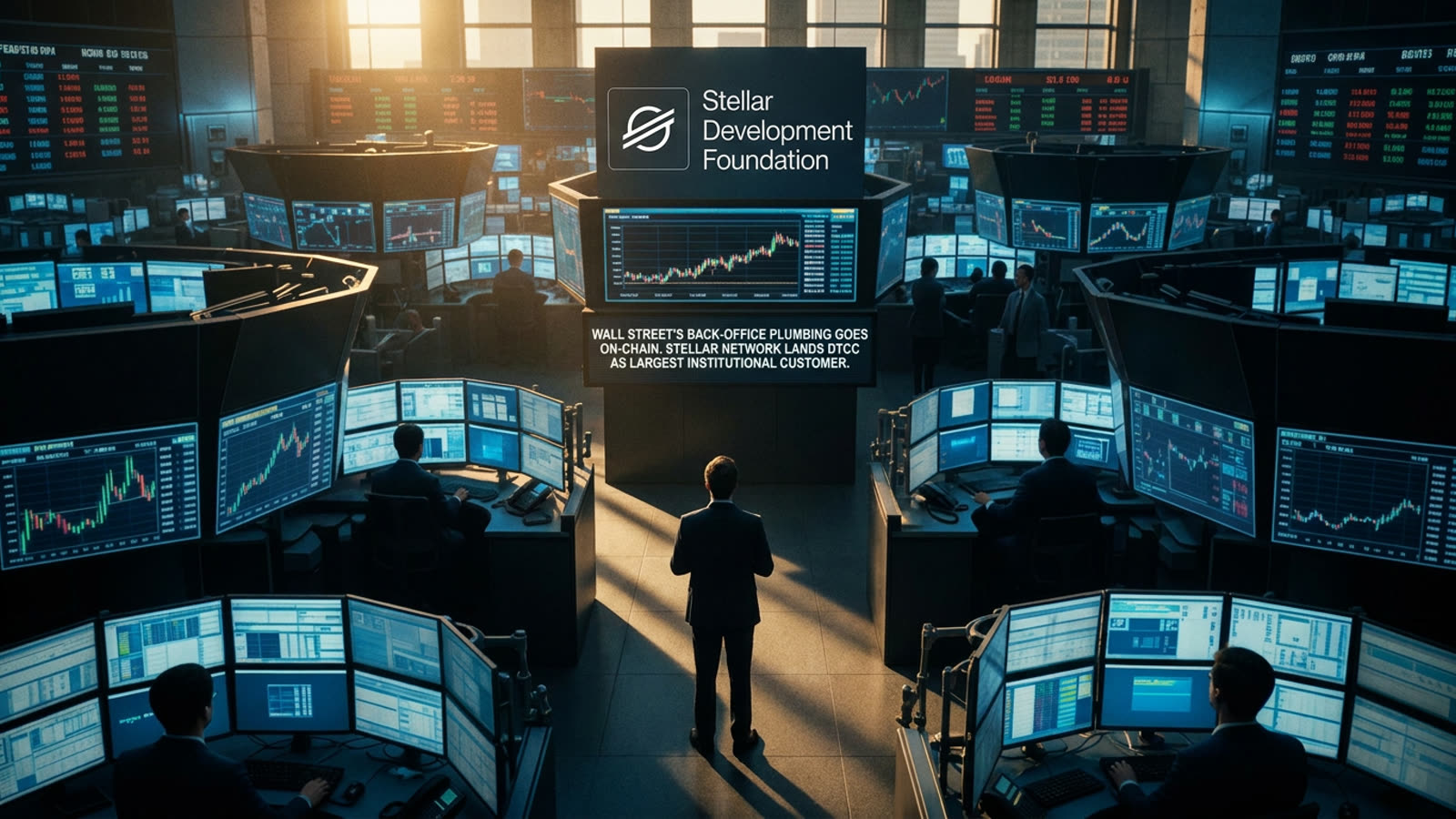
The collision between crypto rails and legacy finance has been promised for so long that the phrase "institutional adoption" became a punchline. Now the joke is on the skeptics. The DTCC — the entity that settles the vast majority of U.S. securities transactions — is preparing to move tokenized assets onto the Stellar blockchain, a development that quietly rewrites the rules of who controls the pipes through which trillions of dollars flow.
This is not a pilot program or an innovation-lab press release. The DTCC processes roughly $2.4 quadrillion in securities annually; when it commits engineering resources to a public blockchain, the signal is unmistakable. Stellar, a network designed from the outset for payments and asset issuance rather than smart-contract maximalism, has spent years cultivating precisely this kind of partnership. The bet is paying off.
Why Stellar, why now
Stellar's architecture prioritizes speed, low fees, and regulatory compatibility over the decentralization-at-all-costs ethos of Ethereum purists. For a systemically important financial institution like the DTCC, those trade-offs are features, not bugs. The network already hosts significant stablecoin volume and has built relationships with established players like MoneyGram and Franklin Templeton. Adding the DTCC to that roster transforms Stellar from a plausible enterprise chain into the default option for institutions that need to tokenize real-world assets without betting their compliance departments on unproven infrastructure.
The timing matters too. Tokenization has graduated from concept to competitive necessity. BlackRock's tokenized money-market fund on Ethereum demonstrated demand; now every major custodian and clearinghouse is racing to offer similar products. The DTCC's move suggests it would rather build on existing public rails than construct a proprietary network that might end up stranded.
What this means for crypto markets
Stellar's native token, XLM, has historically traded as a sleepy utility coin, overshadowed by flashier Layer 1 competitors. Institutional validation of this magnitude changes the narrative. If the DTCC's integration proceeds smoothly, XLM gains a durable use case disconnected from retail speculation: transaction fees and collateral requirements for tokenized securities settlement. That is the kind of demand curve that compounds quietly rather than spiking on hype.
More broadly, the announcement underscores a bifurcation in the blockchain landscape. Ethereum and its Layer 2 ecosystem remain the playground for DeFi experimentation and permissionless innovation. Stellar, Avalanche subnets, and private consortium chains are carving out the regulated institutional lane. Both can coexist, but capital allocators will increasingly need to pick which thesis they are underwriting.
Our take
The DTCC choosing Stellar is the institutional-crypto equivalent of a Fortune 500 company switching its ERP system: unsexy, consequential, and nearly impossible to reverse once the migration begins. Crypto natives may shrug at a chain that lacks Ethereum's developer mindshare or Solana's speed-demon marketing, but Stellar just demonstrated that winning the enterprise game requires different muscles. For the tokenization thesis to matter, someone has to build the on-ramps. Stellar is now pouring the concrete.