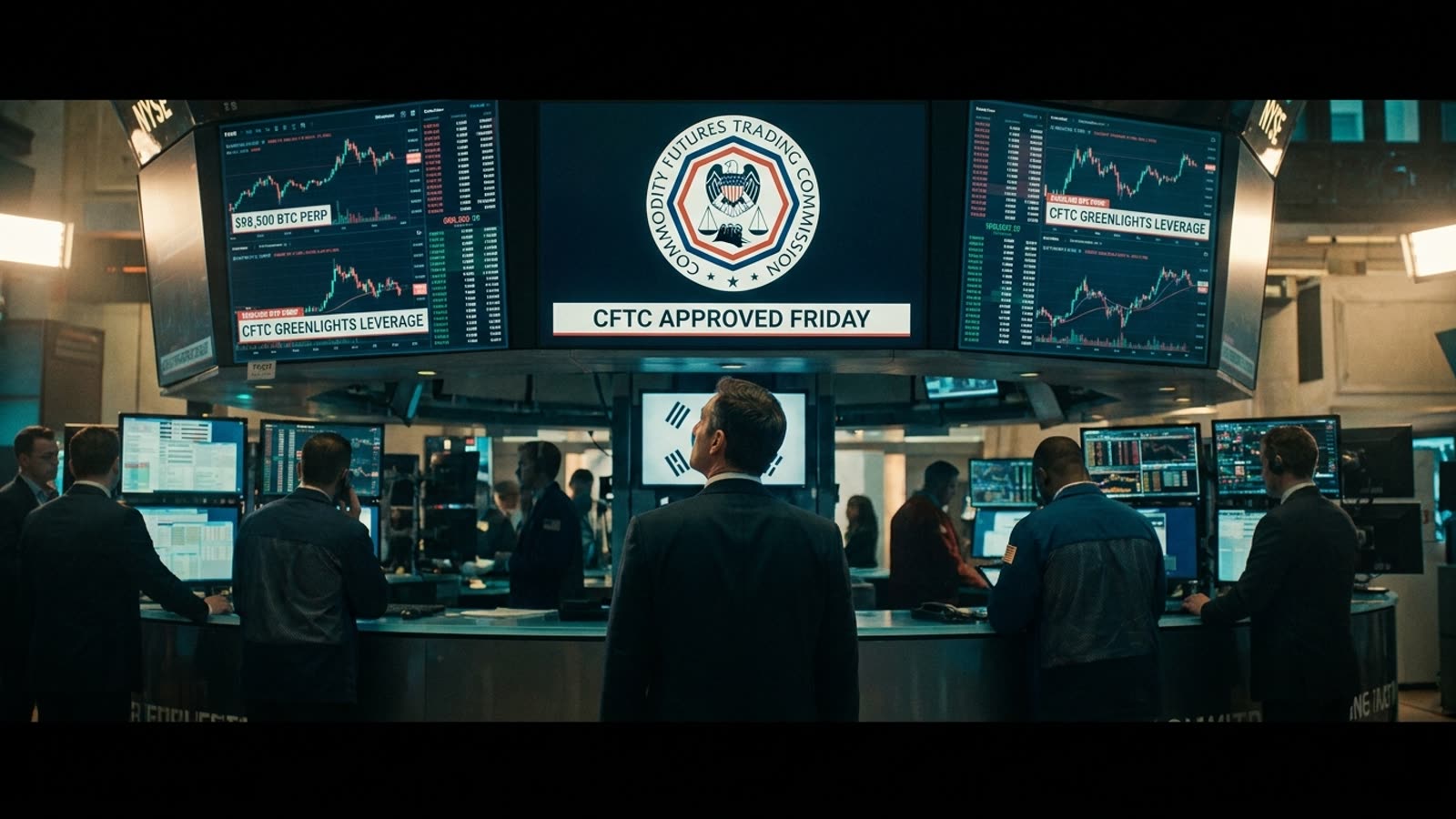
The Commodity Futures Trading Commission has granted its first approvals for cryptocurrency perpetual futures contracts to American platforms, a regulatory inflection point that will reshape how domestic retail traders access leverage in digital assets. Kalshi and Coinbase received the green light this week, ending years of regulatory ambiguity that had pushed American traders toward offshore exchanges operating beyond the reach of U.S. enforcement.
The decision represents a philosophical pivot for an agency that spent the better part of a decade treating crypto derivatives with a mixture of suspicion and studied neglect. Perpetuals—contracts that never expire and track an underlying asset through funding rate mechanisms—have long been the dominant instrument on offshore venues like Binance and Bybit, where daily volumes routinely dwarf spot markets. American traders have participated anyway, using VPNs and creative domicile claims, creating exactly the kind of regulatory arbitrage that makes enforcement officials lose sleep.
The logic of capitulation
The CFTC's reasoning appears straightforward: if Americans are going to trade these products regardless, better they do so on regulated platforms with proper customer protections, margin requirements, and audit trails. Kalshi, which has spent the past year waging legal battles to expand its prediction market offerings, now adds Bitcoin perpetuals to a product suite that already includes contracts on everything from election outcomes to weather events. Coinbase, the largest U.S. exchange, gains a tool to compete with offshore rivals that have long offered superior derivatives products.
The approvals come with the standard regulatory apparatus—position limits, segregated customer funds, regular reporting—that distinguishes American markets from the Wild West of offshore crypto. Whether these guardrails prove sufficient when retail traders inevitably discover that 10x leverage works in both directions remains to be seen.
The timing question
That this approval arrives during a period of cooling ETF demand and underperforming crypto prices relative to equities is either coincidental or calculated. Bitcoin and Ether spot ETFs have shed roughly $2 billion in late May outflows, while traditional equity indices have rallied for nine consecutive weeks. The introduction of perpetuals gives exchanges a new revenue stream precisely when spot trading volumes have softened—derivatives generate fees on both entry and exit, plus funding payments that flow through the platform.
For Kalshi specifically, the approval validates a regulatory strategy built on aggressive litigation. The company has sued multiple state regulators, including an ongoing federal case against Minnesota, arguing that prediction markets deserve the same legitimacy as traditional futures. Adding crypto perpetuals to its menu suggests the CFTC views Kalshi as a serious derivatives venue rather than a novelty betting platform.
Our take
This is the right call made for pragmatic reasons. The offshore crypto derivatives market exists, thrives, and will continue operating regardless of American regulatory posture. Bringing perpetuals onshore doesn't eliminate risk—it domesticates it. Retail traders will still blow up accounts; the difference is they'll do so on platforms that answer to U.S. regulators and maintain actual customer protections. The CFTC has essentially concluded that prohibition failed. Now begins the harder work of supervision.