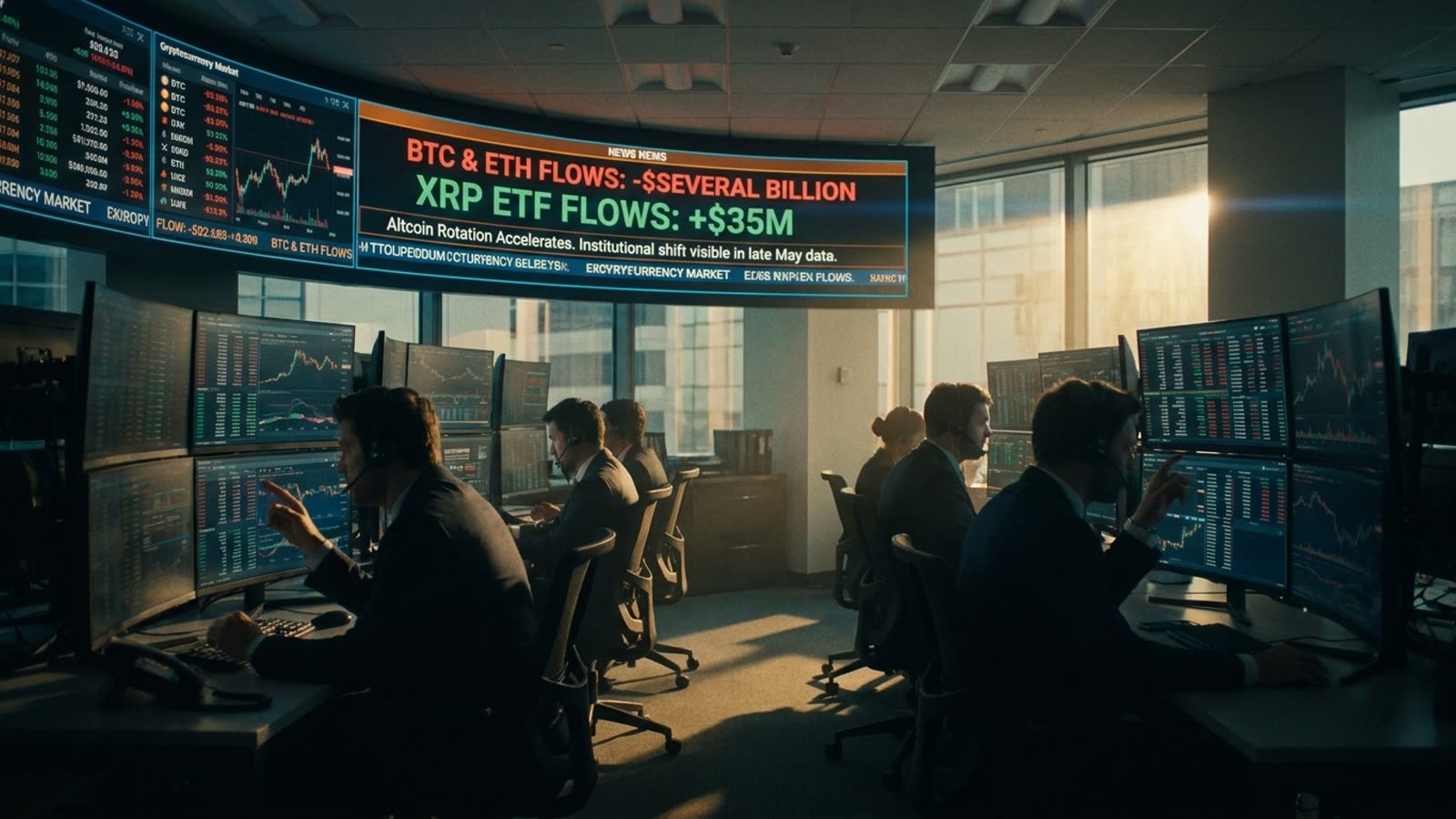
The crypto ETF market just flashed a warning sign that most investors missed. While Bitcoin and Ether exchange-traded funds hemorrhaged roughly $2 billion in the final weeks of May, XRP-focused products quietly absorbed $35 million in fresh capital. The divergence is not noise; it is the clearest evidence yet that institutional allocators are treating digital assets less like a monolithic bet on crypto and more like a differentiated asset class with distinct risk-return profiles.
This matters because ETF flows have become the dominant price signal for crypto. When BlackRock's iShares Bitcoin Trust launched in early 2024, the industry celebrated spot ETFs as the great legitimizer. Two years later, the legitimacy has arrived—but so has the ruthless capital rotation that characterizes mature markets.
The rotation thesis
Bitcoin and Ether have been range-bound for weeks, lagging a nine-week equity rally that pushed the S&P 500 to fresh highs. The underperformance has not gone unnoticed. Institutional investors, many of whom entered crypto through ETFs as a macro hedge, are now treating the majors as crowded trades. XRP, by contrast, offers something Bitcoin cannot: regulatory clarity. Ripple's long-running legal battle with the SEC concluded with a partial victory that left XRP's status as a non-security intact for most use cases. That clarity, combined with Ripple's expanding cross-border payments network, has made XRP the preferred vehicle for institutions seeking crypto exposure without existential legal risk.
What the outflows reveal
The $2 billion in Bitcoin and Ether outflows is not a panic—it is a rebalancing. Large allocators are trimming positions that have appreciated significantly since the 2024 ETF launches and rotating into smaller-cap tokens where the risk-adjusted upside appears more attractive. The pattern mirrors what happens in equity markets during sector rotations: money leaves mega-caps for mid-caps when valuations stretch and growth expectations moderate. Crypto is simply catching up to the playbook.
The timing is also telling. Late May historically sees portfolio rebalancing ahead of quarter-end, and this year is no exception. But the magnitude of the divergence—billions out of BTC and ETH, tens of millions into XRP—suggests something more structural than seasonal adjustment.
Our take
The XRP inflows are a canary, not a revolution. Thirty-five million dollars is a rounding error in the context of Bitcoin's multi-hundred-billion-dollar market cap, and XRP remains a polarizing asset with concentrated holdings and an uncertain utility narrative. But the direction of travel is clear: institutional crypto is no longer a Bitcoin-or-nothing proposition. As more altcoin ETFs receive approval—Solana and Cardano products are in the regulatory queue—expect the rotation trade to intensify. The era of crypto as a single trade is ending. The era of crypto as a portfolio is beginning.