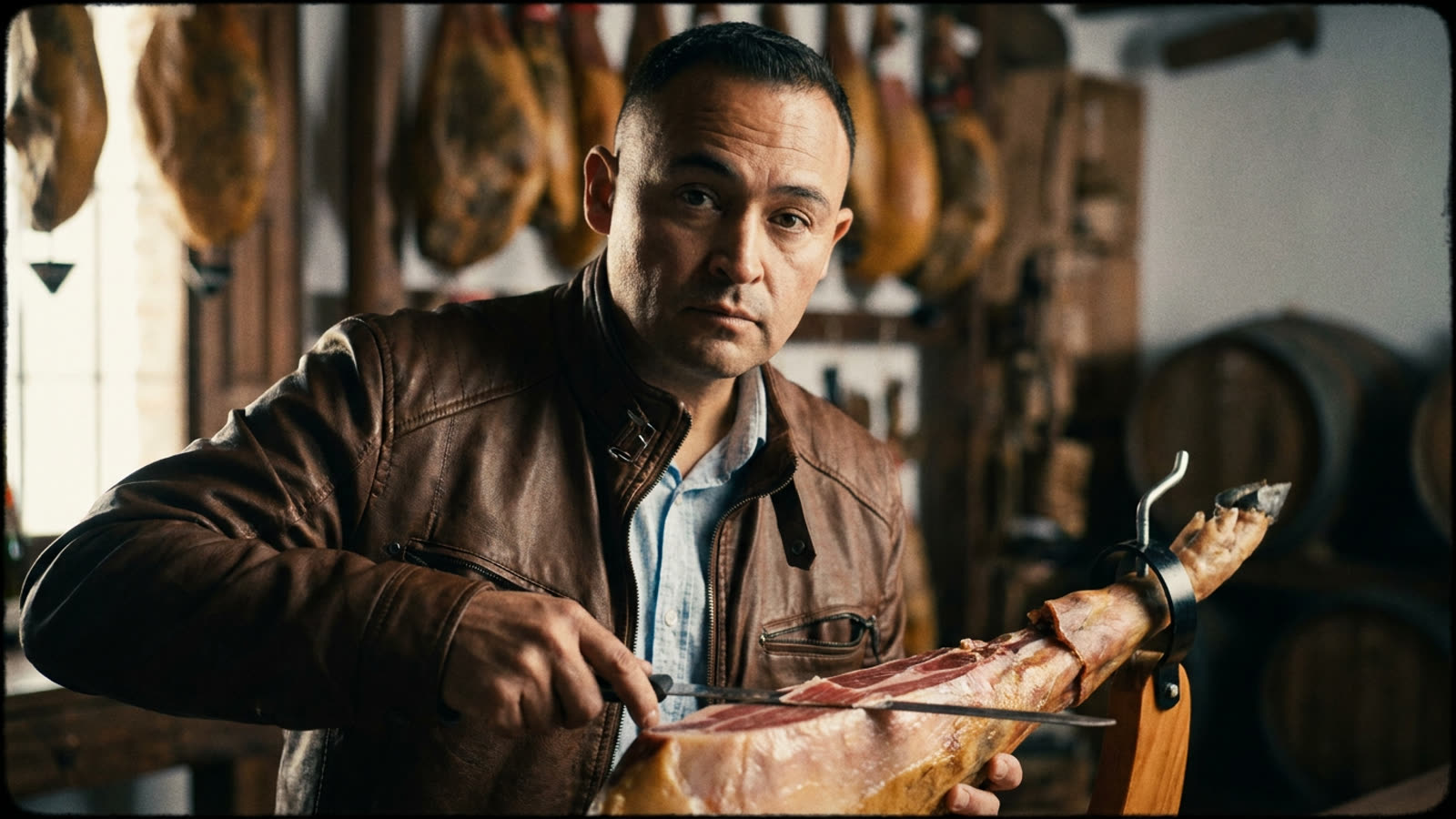
There is no machine that can replicate what Ernesto Soriano does with a knife and a leg of ibérico ham. This is not sentimentality; it is physics. The paper-thin slices he produces—translucent, glistening with intramuscular fat that has spent years developing in dehesa oak forests—require a calibration of pressure, angle, and rhythm that no algorithm has yet mastered. More importantly, no algorithm has mastered the theater of it: the focused silence, the deliberate movements, the moment when a slice is laid on a plate like an offering.
Soriano has become, improbably, one of Spain's most booked performers. Not a musician, not a chef in the conventional sense, but a cortador de jamón—a professional ham slicer whose services are requested at society weddings, corporate galas, and international sporting events including the French Open. The waiting list, reportedly, runs to months.
The economics of scarcity
A leg of top-grade jamón ibérico de bellota can cost upward of €500. But the ham is only as good as the person cutting it. Slice too thick and you lose the melt-on-tongue texture that justifies the price. Slice at the wrong angle and you waste product, hitting bone too soon, leaving meat to oxidize. A skilled cortador extracts perhaps 20 percent more edible ham from the same leg than an amateur—a difference that, at scale, represents thousands of euros. Soriano's fee, whatever it is, pays for itself.
But economics alone do not explain the phenomenon. Spain produces excellent ham in industrial quantities; supermarkets sell pre-sliced packets that are perfectly acceptable. What Soriano offers is something else: the experience of watching someone do one thing, slowly, with total commitment. In a culture that has optimized nearly everything for speed, this registers as radical.
Craft as counterculture
The revival of artisanal trades is well-documented, from Brooklyn knife-makers to Japanese denim weavers. What distinguishes the cortador is the ephemeral nature of the product. A handmade knife lasts generations; a slice of ham lasts seconds. The value is entirely in the moment—the anticipation, the execution, the consumption. It cannot be photographed meaningfully, cannot be resold, cannot be displayed. It can only be experienced and then remembered.
This may explain why Soriano's services are particularly coveted at weddings. The ceremony itself is a performance of commitment; the ham-slicing is its secular echo. Both ask guests to pause, to witness, to participate in something that cannot be replicated by an app.
Our take
Soriano's career is a quiet rebuke to the efficiency fetish that governs modern life. Not everything needs to be faster. Not everything needs to scale. Some things—perhaps the best things—are valuable precisely because they resist automation, because they require a human hand and a human eye and years of practice that cannot be compressed. The fact that people will wait months and pay handsomely for someone to cut their ham is not absurd. It is, in its way, hopeful.