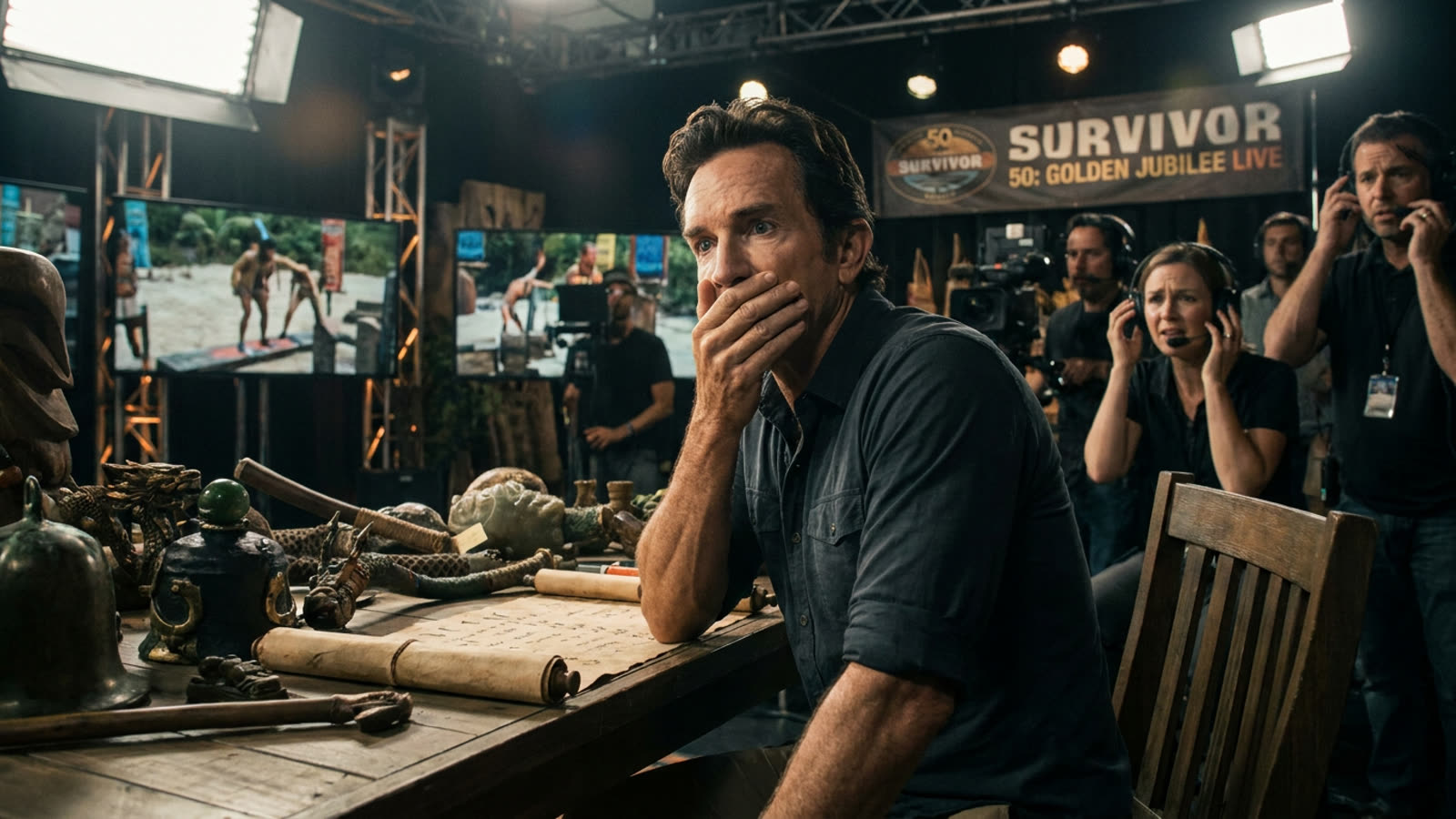
For 25 years and 50 seasons, Jeff Probst has been the unflappable center of American reality television's most enduring franchise. On Wednesday night, during Survivor's much-hyped golden anniversary live special, he became something else entirely: the man who spoiled his own show.
The moment was as swift as it was irreversible. During what CBS had billed as a historic live challenge—a first for the franchise—Probst inadvertently announced the result before the competition had concluded, revealing which tribe had secured immunity while cameras were still rolling on contestants mid-struggle. The production team scrambled. Social media erupted. And somewhere, a generation of Survivor superfans felt the particular anguish of having a twist ruined by the one person they trusted most.
The anatomy of a live-TV disaster
Live television is unforgiving by design. The same rawness that makes it compelling—the knowledge that anything could happen—is precisely what makes it treacherous. Survivor had largely avoided this gamble for its entire run, preferring the safety of pre-taped episodes where editors could smooth over stumbles and producers could craft narrative arcs with surgical precision.
The decision to go live for the 50th season was a calculated risk, a way to generate the kind of appointment-viewing urgency that streaming has steadily eroded. CBS promoted it relentlessly: watch history unfold in real time. What unfolded instead was a masterclass in why reality television prefers the illusion of spontaneity to the genuine article.
Probst, to his credit, attempted to recover in the moment, but the damage was done. The spoiler spread across social media faster than any tribal council blindside, with clips circulating before the episode had even concluded.
The Probst paradox
Here is the strange thing about Jeff Probst: he is simultaneously the most reliable and most volatile element of Survivor. His enthusiasm is genuine to the point of being almost unsettling; his commitment to the franchise borders on the religious. He has hosted every single episode, served as an executive producer, and shaped the show's evolution from tropical novelty to strategic institution.
That same intensity may have contributed to Wednesday's mishap. Probst has always narrated challenges with the breathless urgency of a sports commentator calling a photo finish. In a taped environment, this energy is an asset—it can be channeled, edited, perfected. Live, it becomes a liability. The muscle memory of declaring winners kicked in a beat too early, and no amount of post-production magic could unsay what had been said.
CBS faces an uncomfortable question
The network has not yet issued a formal statement beyond acknowledging the error occurred. But the incident forces a broader reckoning with the live-television experiment in reality programming. The genre has always existed in tension between authenticity and control—contestants are real people, but their stories are shaped by editors who decide what viewers see and when they see it.
Live episodes strip away that safety net entirely. For a show like Survivor, where challenge outcomes and elimination votes are the core currency of suspense, a single slip can deflate an entire episode's dramatic architecture. The question CBS must now answer: was the buzz generated by the live format worth the risk of exactly this kind of catastrophe?
Our take
There is something almost poetic about Survivor's 50th-season stumble. The show has spent a quarter-century perfecting the art of manufactured suspense, and the one time it surrendered to genuine unpredictability, unpredictability bit back. Probst will recover—he has weathered controversies before, and his position is as secure as any in television. But the incident is a useful reminder that live TV's magic comes from the same source as its danger. You cannot have one without accepting the other, and on Wednesday night, Survivor learned that lesson the hard way.