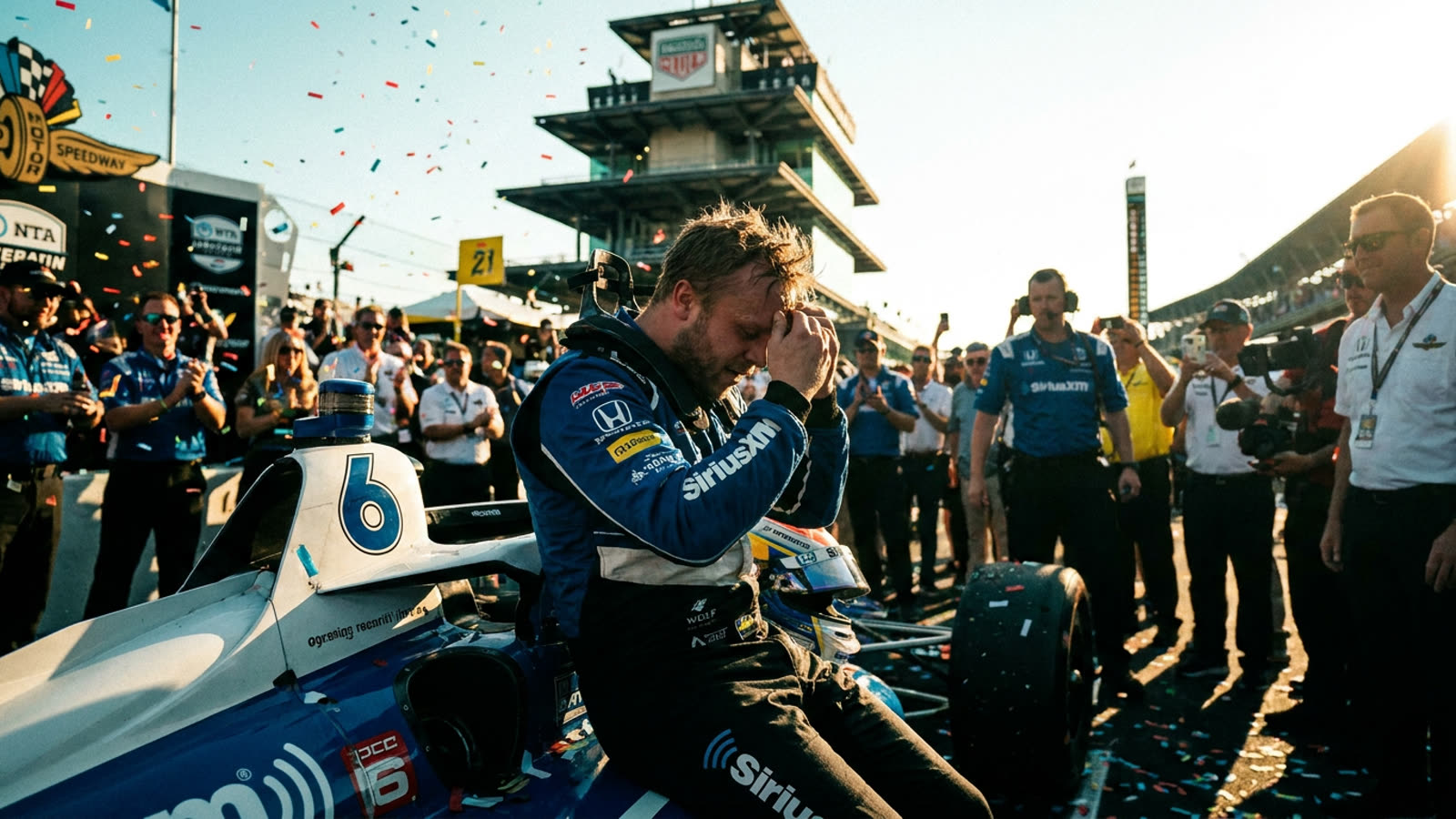
The Indianapolis 500 has always been a race measured in fractions — of time, of nerve, of mechanical tolerance. On Sunday, Felix Rosenqvist pushed that calculus to its logical extreme, winning the 110th running of the Greatest Spectacle in Racing by a margin so infinitesimal that officials needed photo verification to confirm what the naked eye could not discern.
The Swedish driver's victory represents the closest finish in the race's 115-year history, eclipsing margins that previously seemed impossibly tight. At speeds exceeding 230 mph on the final lap, the difference between immortality and runner-up status came down to measurements that would be rounding errors in any other context.
A career defined by near-misses finds its moment
Rosenqvist's path to this victory has been anything but linear. The 34-year-old Swede has spent years as one of IndyCar's most talented drivers without the results to match, a familiar archetype in motorsport where machinery, strategy, and fortune must align with skill. His previous Indy 500 attempts featured competitive runs undermined by the chaos that defines the race — pit timing gone wrong, mechanical failures, the wrong side of multi-car incidents.
That history made Sunday's finish particularly cruel for the runner-up and particularly sweet for Rosenqvist. To win by such a margin requires not just speed but the accumulated wisdom of knowing when to push and when to preserve, when to gamble on fuel strategy and when to play the percentages. Rosenqvist's final-lap approach suggested a driver who had internalized every previous disappointment.
The technology of certainty
Modern timing systems can measure gaps down to ten-thousandths of a second, a precision that would have seemed absurd to the pioneers who first circled this 2.5-mile oval in 1911. Sunday's finish tested even those capabilities. The photo verification process — a term that sounds almost quaint in an era of instant replay — reminded viewers that some moments still require human judgment to interpret what sensors capture.
The implications extend beyond one race. As cars become faster and fields become more competitive, margins will continue to shrink. IndyCar may need to consider whether current timing technology is sufficient for a future where multiple cars cross within hundredths of a second, or whether the sport will increasingly rely on the judicial review that decided Sunday's outcome.
Our take
There is something almost too perfect about the closest Indy 500 ever being won by a driver who has spent his career on the wrong side of close calls. Rosenqvist's victory is a reminder that motorsport, for all its technological sophistication, remains a fundamentally human endeavor where persistence eventually finds its reward. The margin of victory will be forgotten by most within weeks; the fact of victory will define Rosenqvist's career forever. That asymmetry — between the measurement and the meaning — is what makes the Indianapolis 500 worth caring about.