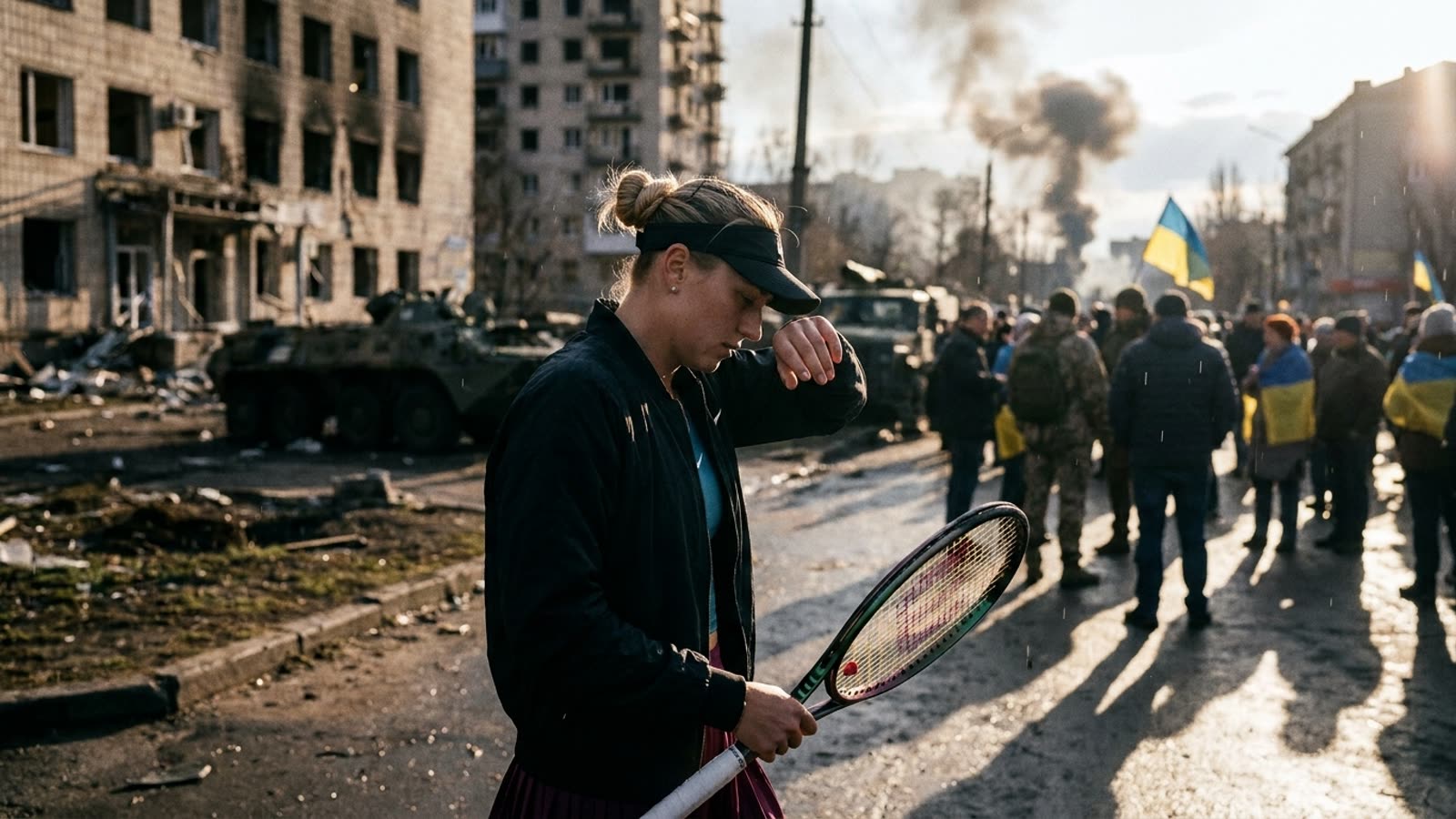
Marta Kostyuk learned this week that a missile struck near her parents' home in Kyiv, the latest in a series of Russian attacks that have turned the Ukrainian capital into a city of sirens and shelters. Her parents survived. She will compete at Roland Garros anyway. This is what Ukrainian sport looks like in 2026: excellence performed under the shadow of existential dread.
The 23-year-old, currently ranked 17th in the world, has spent the better part of three years navigating a professional circuit while her country endures invasion. She has refused to shake hands with Russian and Belarusian opponents, drawn criticism and praise in equal measure, and steadily climbed the rankings while carrying a psychological burden that no sports psychologist's toolkit was designed to address.
The impossible compartmentalization
Elite athletes are taught to block out distractions. A hostile crowd, a bad line call, a nagging injury—these are the standard obstacles of competition. But how does one compartmentalize the knowledge that one's family could be killed between sets? Kostyuk has spoken repeatedly about the mental toll, about checking her phone during changeovers not for social media but for air raid alerts. The missile strike near her parents' home is not an aberration; it is the backdrop against which she has built her career's most successful stretch.
The WTA has allowed Russian and Belarusian players to compete as neutrals since 2022, a compromise that satisfies no one fully. For Kostyuk, the handshake refusals are not gamesmanship but principle—a small, visible protest that costs her nothing but social capital in the locker room. Some have called it unsportsmanlike. Others recognize it as the bare minimum of conscience.
Sport as witness
Ukrainian athletes across disciplines have become inadvertent ambassadors, their visibility a reminder that the war continues even when it slips from front pages. Kostyuk's disclosure about the missile strike serves a dual purpose: it is both personal processing and public testimony. Every interview, every post-match press conference, becomes an opportunity to keep Ukraine in the global conversation.
The French Open begins Sunday. Kostyuk will be among the contenders, her game sharp, her serve improved, her groundstrokes carrying the controlled aggression that has defined her rise. She will also be checking her phone.
Our take
There is something almost obscene about the juxtaposition: a young woman hitting fuzzy yellow balls on Parisian clay while her homeland absorbs cruise missiles. But Kostyuk's continued presence on tour is itself a form of resistance, a refusal to let war erase normalcy entirely. She cannot stop the missiles. She can, however, keep showing up—and keep reminding the tennis world that some players carry more than a racket bag onto the court.