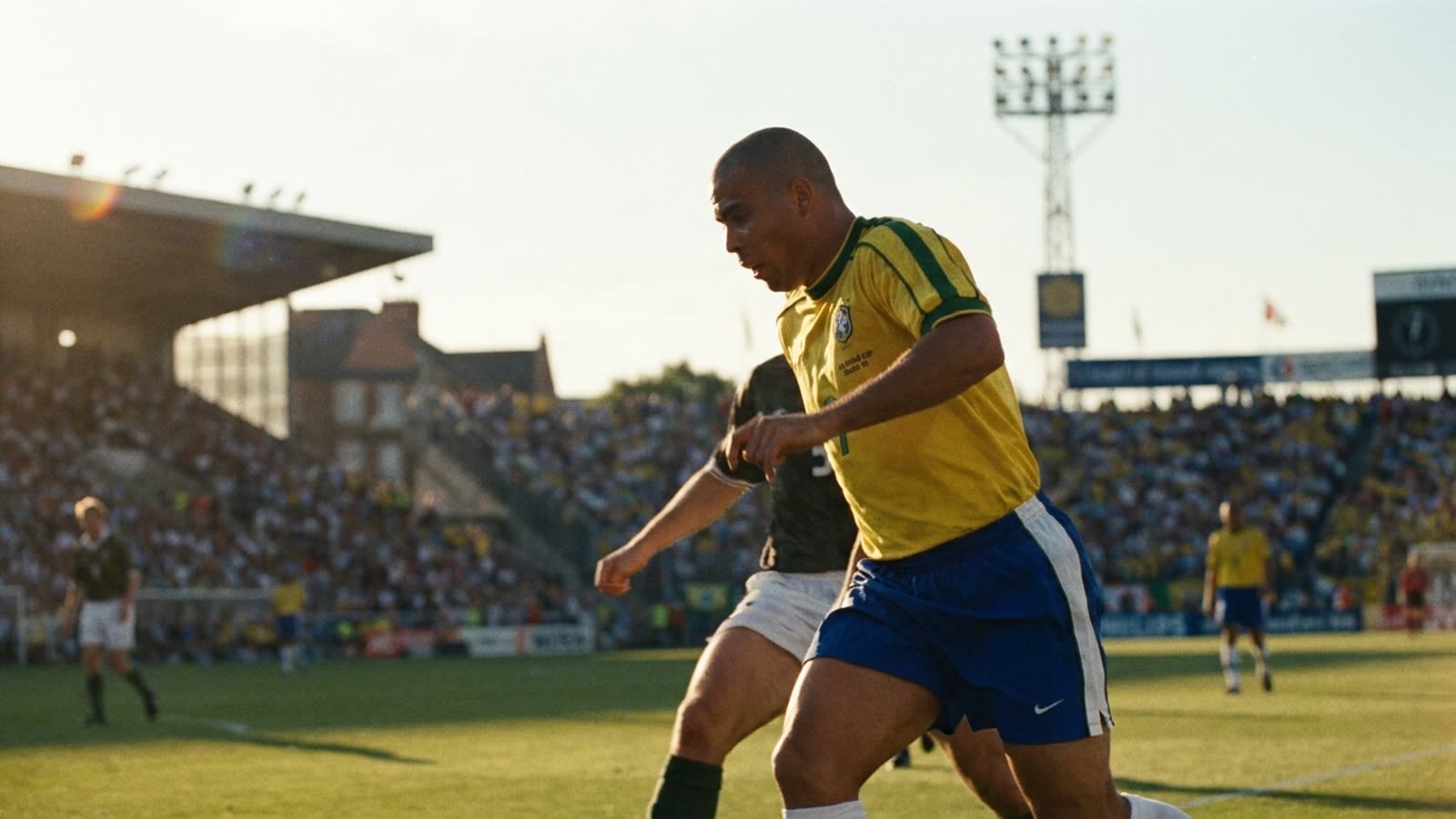
There is a particular cruelty in watching Ronaldo Luís Nazário de Lima at his best. The clips from 1996 and 1997—the PSV years, the brief Barcelona season, the early Inter period—show something that shouldn't be physically possible: a man built like a middleweight boxer moving with the acceleration of a sprinter and the close control of a futsal player. He was a glitch in the matrix, a cheat code made flesh.
The Brazilian who would come to be known simply as "O Fenômeno" arrived in European football as a teenager and immediately rendered the existing understanding of centre-forward play obsolete. Strikers before him were either powerful or quick, either clinical finishers or creative dribblers. Ronaldo was all of these things simultaneously, and he performed them at a speed that made contemporary footage look artificially accelerated.
The physics-defying package
What made Ronaldo singular was the combination of attributes that, by all logic, should not coexist in one body. At his peak, he stood over six feet tall and carried substantial muscle mass, yet he could accelerate past fullbacks from a standing start. His low centre of gravity—unusual for his height—allowed him to change direction without losing speed, a skill he deployed with almost sadistic frequency.
His finishing was equally improbable. Ronaldo could score with either foot, with his head, from distance, from tight angles, on the counter, or in traffic. He possessed the cold calculation of a penalty-box predator and the improvisational genius of a street footballer. Defenders who tried to show him onto his weaker foot discovered he didn't have one.
The stepover became his signature, but it was never mere showboating. Each feint served a purpose: to shift a defender's weight, to create a half-yard of space, to turn a blocked shooting lane into an open one. He made the difficult look routine and the impossible look merely difficult.
The body that couldn't keep pace
The knee injuries began in earnest during his Inter Milan tenure. The first major rupture came in November 1999, and when he returned nearly a year later, he lasted six minutes before the same knee gave way again. The image of Ronaldo collapsed on the San Siro pitch, clutching his leg, remains one of football's most heartbreaking frames.
That he returned at all was remarkable. That he returned to win the 2002 World Cup—scoring twice in the final against Germany, finishing the tournament with eight goals—bordered on the miraculous. But the Ronaldo of 2002 was already a diminished version: still brilliant, still decisive, but no longer capable of the sustained, physics-defying performances of his youth. The explosive acceleration had softened. The body that once seemed indestructible now required careful management.
His later years at Real Madrid produced goals and trophies, but they also produced a player visibly fighting against his own physiology. The weight fluctuated. The pace declined. The knees remained a constant concern. He retired at thirty, an age when many elite strikers are just entering their prime.
Our take
Football's endless debates about the greatest players tend to favour those blessed with longevity: the Messis and Ronaldos (the Portuguese one) who maintained elite performance across two decades. This is understandable but incomplete. Peak Ronaldo Nazário, in the narrow window before his body failed him, was doing things that neither of those players—nor anyone else—has replicated. We saw perhaps four full seasons of what he could be. The sport is still wondering what another decade might have looked like.