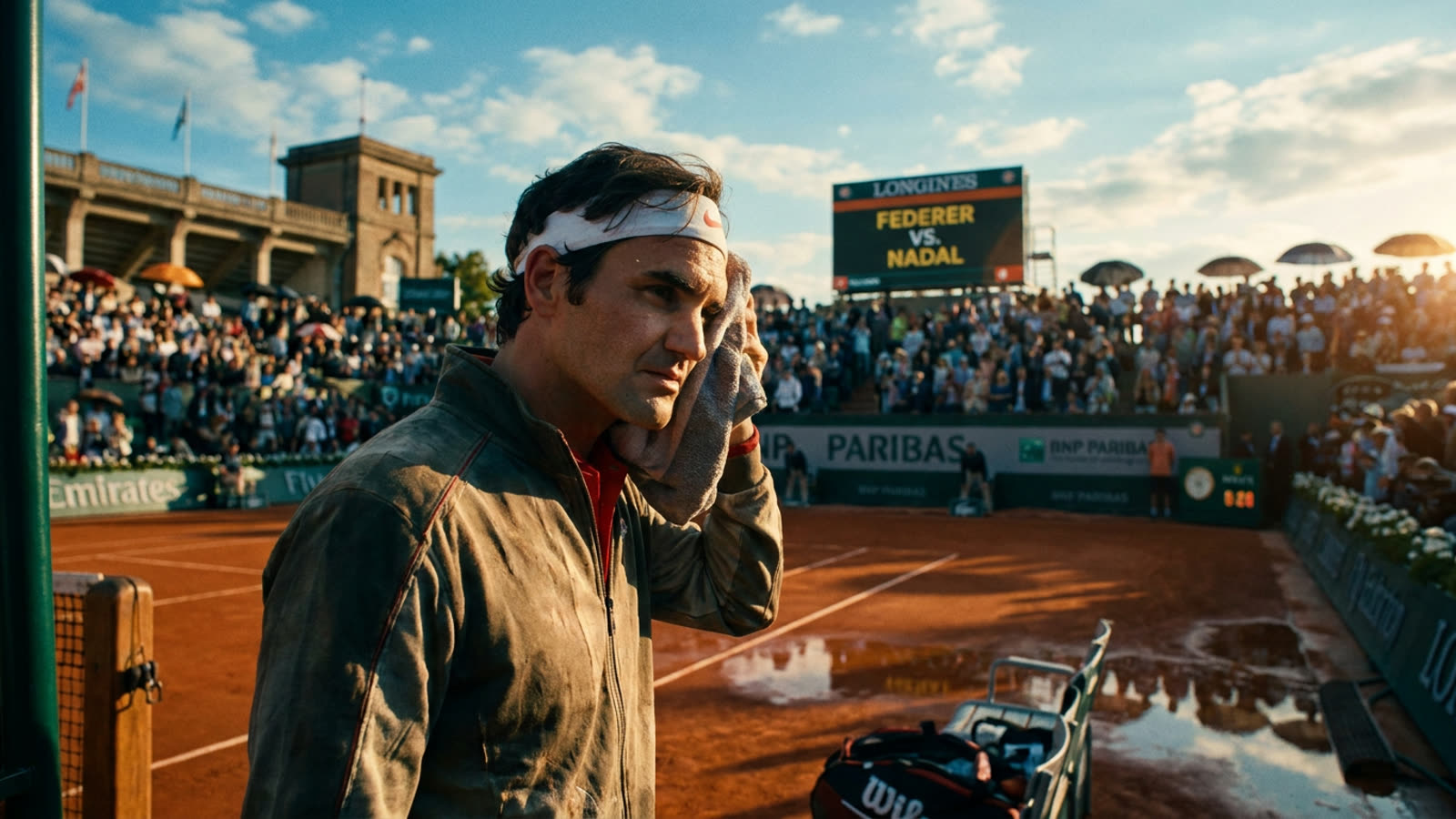
The great con of Roger Federer's career was convincing millions of spectators that tennis is a graceful pursuit. It is not. Tennis is a sport of controlled violence, of joints screaming under lateral torque, of lungs burning through five-set attrition. Federer made it look like calligraphy.
This was not an accident. The effortlessness was itself a form of aggression, a psychological weapon deployed against opponents who could see the ball coming and still couldn't solve the puzzle. While rivals grunted and sweated and visibly suffered, Federer glided. The message was unmistakable: this costs me nothing.
The architecture of ease
Watch footage of Federer's single-handed backhand in slow motion and you'll notice something peculiar. The stroke appears to have no moving parts. The racket head arrives at the ball as if summoned there by physics rather than effort. This is, of course, an illusion created by thousands of hours of repetition, by a biomechanical efficiency that eliminated wasted motion the way a master calligrapher eliminates unnecessary strokes.
His footwork told the same lie. Where other players scrambled, Federer arrived. The micro-adjustments happened so early and so subtly that by the time the ball crossed the net, he appeared to be waiting for it. Commentators reached for the word "anticipation," but that undersells it. Federer didn't anticipate the game; he seemed to be playing a slightly slower version of it than everyone else.
The burden of beauty
There is a cost to making difficult things look easy: people assume they are easy. Federer's most ardent admirers sometimes failed to appreciate the athletic brutality underneath the silk. His serve, analyzed frame by frame, reveals a kinetic chain of explosive violence — the coiling of the legs, the whip of the shoulder, the snap of the wrist — all hidden beneath a motion so fluid it resembled a shrug.
This created an odd dynamic in his rivalries. Against Rafael Nadal's visible suffering and Novak Djokovic's elastic contortions, Federer could appear almost passive, as though he were merely allowing tennis to happen to him. When he lost, it seemed like a failure of will. When he won, it seemed inevitable. Neither perception was fair, but both were consequences of his own aesthetic choices.
The legacy of looking easy
Federer's influence extends beyond his trophy case. He changed the visual grammar of tennis broadcasting. Directors learned to hold shots longer on his rallies, to trust that the elegance would carry the moment. A generation of coaches began emphasizing economy of motion, teaching young players that efficiency isn't just tactically sound — it's psychologically devastating.
More subtly, Federer expanded the sport's audience by making it legible to casual viewers. You didn't need to understand topspin margins or court geometry to appreciate what he was doing. The beauty was self-evident. This was tennis as performance art, and it drew millions who might otherwise have found the sport's technical details impenetrable.
Our take
The effortless athlete is always a kind of liar, and Federer was the most elegant liar the sport has produced. His gift was not merely physical but theatrical — the ability to hide the machinery while displaying the magic. Future champions will win more titles and break more records, but none will make the impossible look quite so simple. That trick, once performed, cannot be repeated. We will spend decades watching tennis players try.