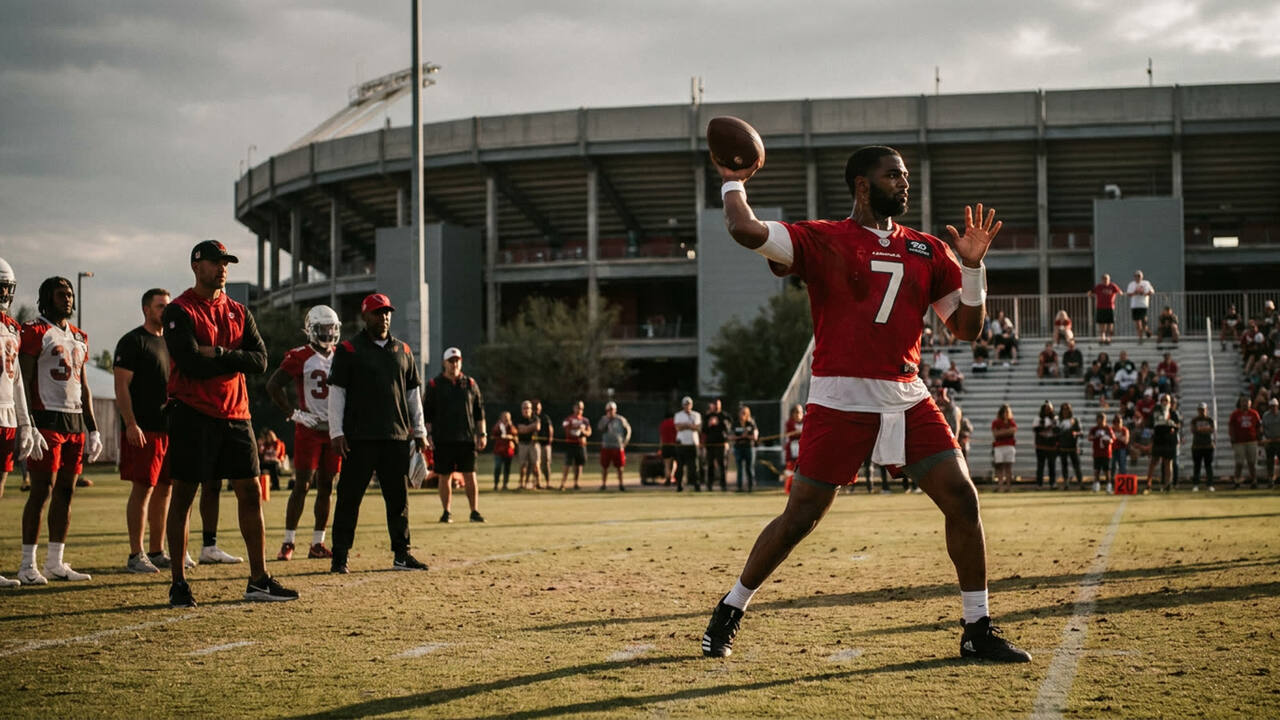
The Arizona Cardinals have made a career out of quarterback carousel management, and Jacoby Brissett's agreement to report for minicamp this week represents the latest spin. Per sources, the veteran signal-caller will join the team's organized activities, positioning himself as the presumptive starter for a franchise that finished 6-11 last season and has lacked stable quarterback play since trading Kyler Murray to Atlanta in 2024.
Brissett, now 33, has become the NFL's most reliable emergency option—a quarterback whose entire value proposition rests on competence rather than ceiling. He has started meaningful games for the Colts, Dolphins, Browns, Commanders, Patriots, and now Cardinals, compiling a career record that hovers stubbornly around .500. He has never been anyone's long-term answer, but he has also never been anyone's disaster.
The Cardinals' quarterback calculus
Arizona's decision to bring in Brissett reflects a front office that has apparently abandoned the high-upside gamble. After Murray's acrimonious exit, the Cardinals tried the draft route with a fourth-round pick who never developed, then cycled through bridge options that bridged nothing. General Manager Monti Ossenfort has now seemingly concluded that stability—even unglamorous stability—beats volatility.
The minicamp invitation suggests Brissett will compete with incumbent Clayton Tune, who showed flashes last season but also threw 17 interceptions. The competition may be less about who wins the job than about establishing a veteran presence that can mentor Tune while keeping the offense functional.
What Brissett actually provides
Brissett's appeal has always been his floor rather than his ceiling. He processes defenses adequately, protects the football reasonably well, and commands enough respect in the huddle to keep a locker room from fracturing. His arm talent is modest, his mobility has declined, and his ceiling is probably 8-9 wins with a good defense. But in a league where bad quarterback play can crater a season before October, that floor has genuine value.
The Cardinals' offensive infrastructure—featuring receiver Marvin Harrison Jr. and a rebuilt offensive line—could theoretically elevate Brissett's production. He has historically performed better with quality supporting casts, which Arizona now possesses.
Our take
Brissett to Arizona is the NFL equivalent of a mutual fund: boring, predictable, unlikely to make anyone rich but also unlikely to go bankrupt. The Cardinals have spent two years chasing upside at quarterback and have nothing to show for it. Bringing in a 33-year-old journeyman feels like surrender, but it might actually be wisdom. Sometimes the smartest move is admitting you cannot solve a problem and simply managing around it. Brissett will not lead Arizona to a Super Bowl, but he might lead them to respectability—and for this franchise, that would qualify as progress.