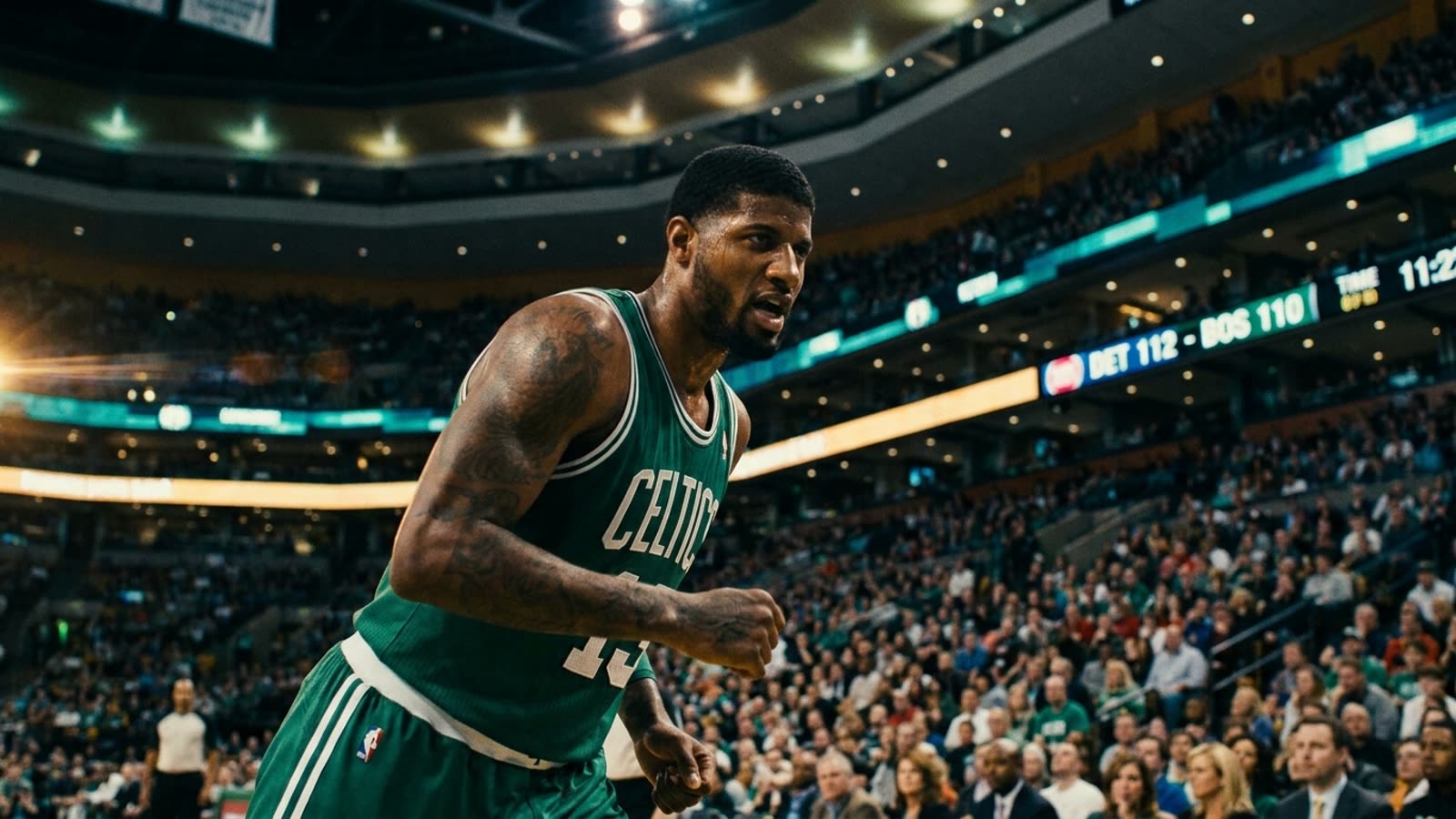
Paul George wanted to make one thing clear after his 38-point Celtics debut: he is not a moral victory guy. Fair enough. Moral victories do not hang banners, and Boston did not trade for a 36-year-old future Hall of Famer to admire box scores in October losses. But Tuesday's 121-113 defeat to Detroit — a game in which the Celtics led by 22 before surrendering the largest opening-night comeback in the play-by-play era — was not just a loss. It was a diagnostic.
George's 38 points were the most by any Celtic in his franchise debut, a mark that speaks to both his enduring skill and the desperation Boston felt to add a third star after falling short in last season's Finals. He shot efficiently, moved without the ball, and looked every bit the offensive weapon general manager Brad Stevens promised when he inked George to a two-year, $87 million deal in July. The problem was not George. The problem was everyone else.
The collapse
Boston led 71-49 midway through the third quarter, dominating Detroit with the kind of execution that suggested the Celtics had solved their late-game fragility. Then the Pistons, led by Cade Cunningham's 29 points and 10 assists, went on a 41-16 run to close the game. Boston's defense — already a question mark after ranking 18th in the league last season — disintegrated. Cunningham carved up switches, Detroit's role players found open threes, and the Celtics' vaunted offense stalled under pressure. It was the same script that cost them the 2026 Finals against the Knicks, only this time it happened in Game 1.
Head coach Joe Mazzulla called it "unacceptable" and "a reminder that nothing is given." George was more direct: "I'm not here to feel good about 38. I'm here to win." The sentiment is correct, but the underlying issue is structural. Boston added George to address its offensive inconsistency, but the team's real weakness — an inability to defend in crunch time — remains unresolved. George is not a defensive savior at this stage of his career, and asking him to be one is a category error.
The gamble
Boston's front office made a calculated bet this summer: that George's offensive firepower would outweigh his defensive decline and injury history. The first half of Tuesday's game suggested the bet might pay off. The second half suggested it might not. George's 38 points were the fifth-most by any player in his debut with a new franchise, trailing only Wilt Chamberlain (43 for the Warriors in 1959), Elgin Baylor (55 for the Lakers in 1958), Walt Bellamy (39 for the Bullets in 1961), and Kareem Abdul-Jabbar (39 for the Bucks in 1969). That is rarefied air. But none of those players lost their debut by eight after leading by 22.
The Celtics' championship window is now, and it is narrow. Jayson Tatum is 28, Jaylen Brown is 30, and George will be 37 by the time his contract expires. Boston does not have time to grow into this roster. They need to win immediately, and Tuesday's collapse — against a Pistons team that won 34 games last season — does not inspire confidence.
Our take
Paul George is right to reject moral victories, but Boston's front office should be worried that his debut produced one anyway. The Celtics did not need another scorer; they needed a closer and a defensive anchor. George provided the former and cannot provide the latter. If Boston's season ends the way Tuesday's game did — with a late collapse and a box score full of empty points — Stevens will have a lot of explaining to do. The East is wide open, but so is the gap between Boston's talent and its execution.