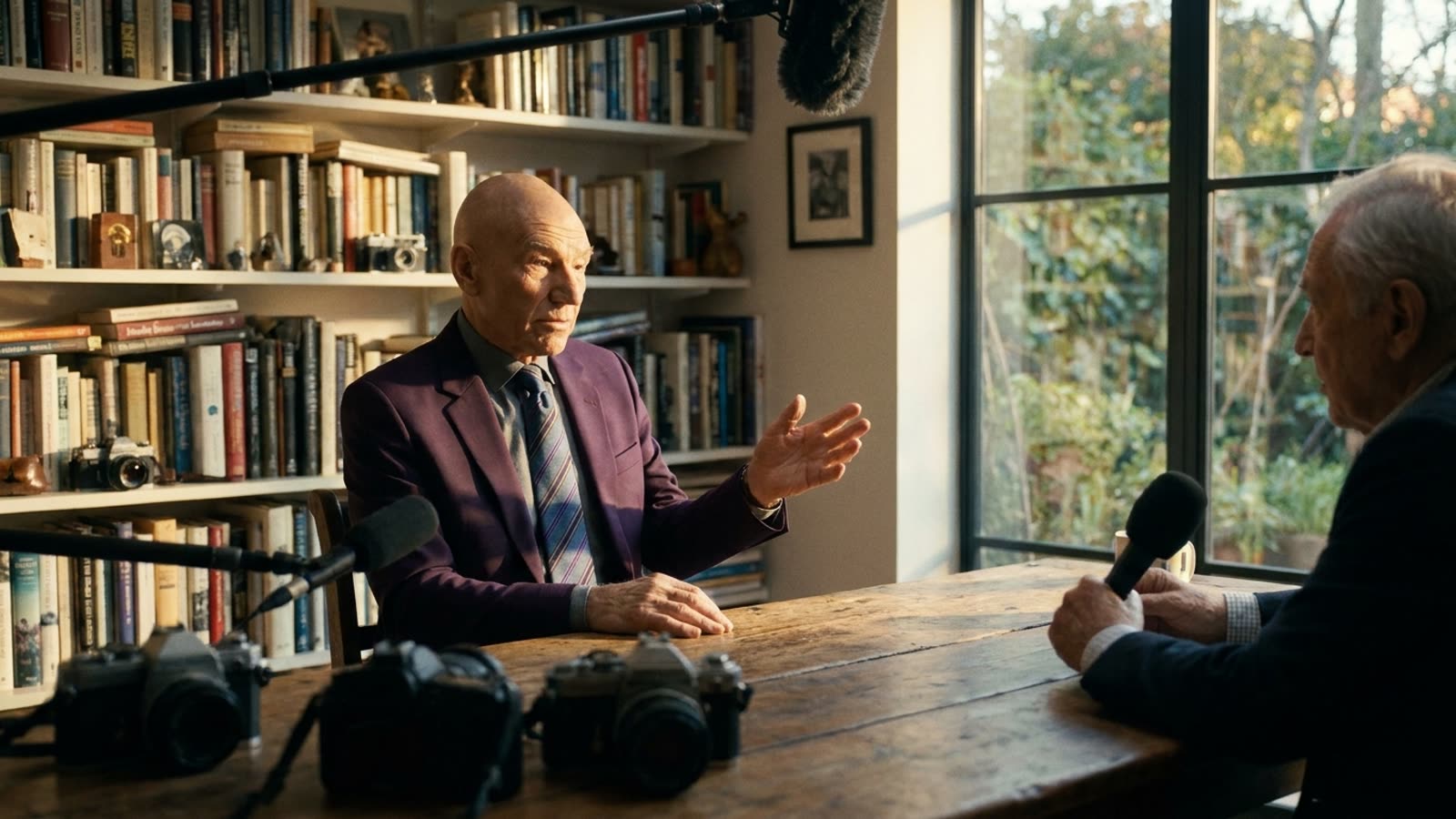
Hours before the world learned that Patrick Stewart had died at his Los Angeles home following a battle with Alzheimer's disease and Lewy body dementia, his final interview surfaced—a document of such stubborn defiance that it threatens to overshadow the obituaries already being written. "I'll always and forever be an actor," he told his interviewer, a statement that reads less like professional identity and more like a dare aimed at mortality itself.
Stewart's publicist, Kelly Bush Novak, described his decline as "a brief and poignant journey," language that suggests the 86-year-old kept his diagnosis private until the very end. This was characteristic. The man who spent decades playing commanders—Jean-Luc Picard on Star Trek: The Next Generation, Professor Charles Xavier in the X-Men franchise—understood that authority is partly performance, and that performance requires control of the narrative.
The second act that became the main event
Stewart was 47 when he was cast as Picard in 1987, already a respected Shakespearean actor but hardly a household name. What followed was one of the stranger career trajectories in entertainment history: a classically trained British stage actor becoming the moral center of American science fiction, then leveraging that into a comic-book franchise that would span two decades. He returned to Picard in 2020 for a streaming revival that ran three seasons, a decision that seemed less about money than about the character's unfinished business—and perhaps his own.
The final interview's insistence on perpetual acting takes on different weight when you consider the diseases involved. Lewy body dementia, in particular, is notorious for its fluctuating cognitive states, its visual hallucinations, its assault on the very faculties an actor depends upon. To declare yourself "forever" an actor while that condition advances is not denial; it is a philosophical position about what constitutes the self.
The Yorkshire steel beneath the velvet voice
Stewart grew up in Mirfield, West Yorkshire, the son of a violent, alcoholic father—a biography he discussed with increasing candor in later years, becoming an advocate for domestic violence awareness. That background perhaps explains the particular quality of his screen presence: the sense that the calm was earned, not inherited. His Picard was authoritative because you believed the authority had been tested. His Xavier was wise because you believed the wisdom had cost something.
Hollywood will now cycle through the requisite tributes, and they will be deserved. But the more interesting legacy may be the final interview itself—a man staring down cognitive collapse and choosing to define himself by what he could still do rather than what was being taken from him.
Our take
There is something almost unbearably moving about an actor insisting on his craft as identity while his brain betrays him. Stewart spent his career playing men who held the line—against the Borg, against Magneto, against the entropy of the universe. In the end, he held his own line. The diseases got his body; they did not get to write his ending. He did that himself, in an interview he surely knew would become his epitaph. Make it so, indeed.