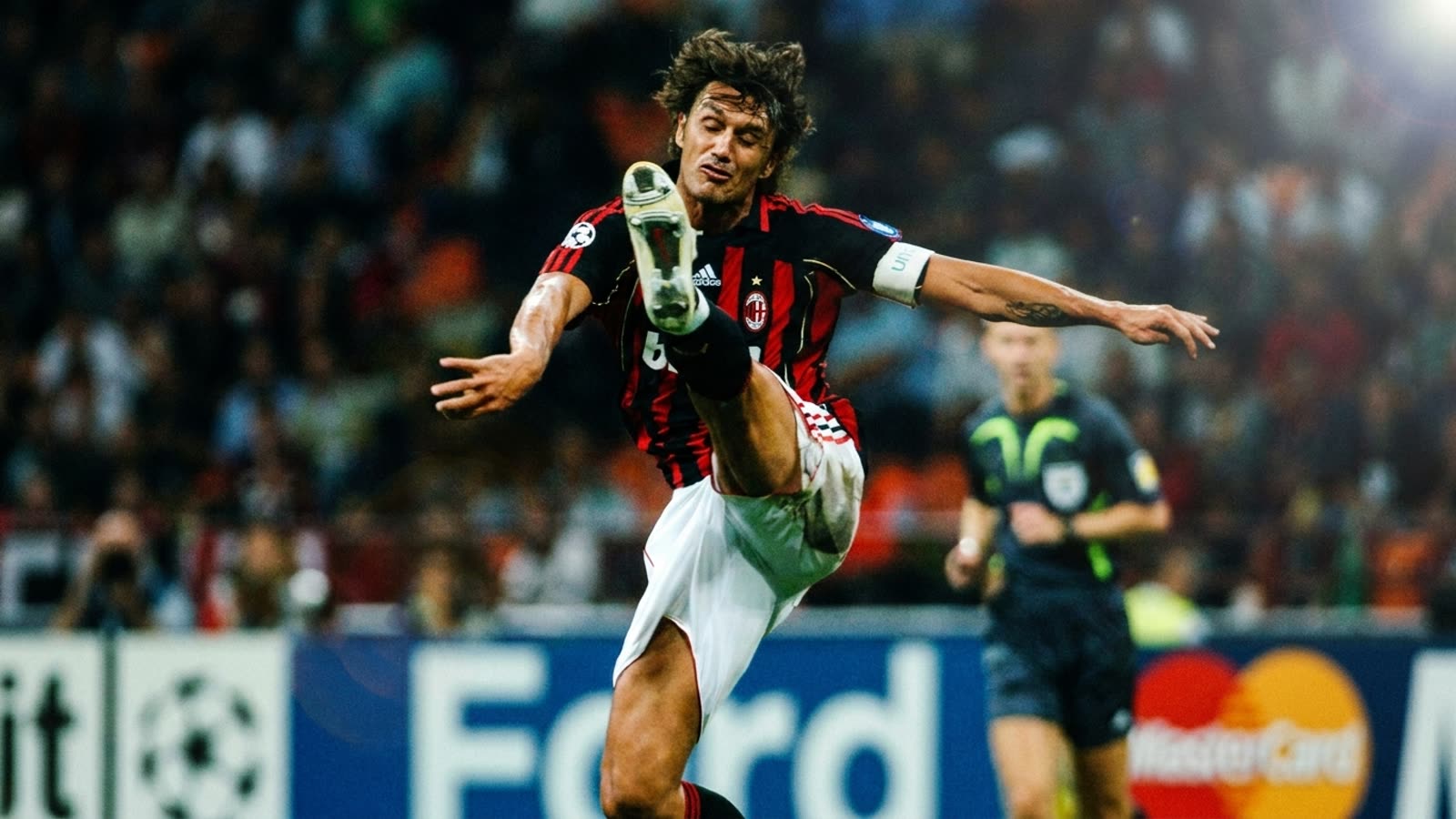
The greatest defenders are remembered for what did not happen. No goals conceded, no chances created, no moments of panic — just the quiet erasure of threat before it could materialise. Paolo Maldini spent twenty-five seasons at AC Milan perfecting this art of negation, and the game has struggled to properly honour his kind ever since.
Maldini's career spanned from the tail end of catenaccio's dominance through the total-football hybrids of Arrigo Sacchi and into the modern era of pressing and possession. He adapted to each evolution without ever abandoning the fundamental truth of his position: defending is about reading what will happen, not reacting to what has. His anticipation was so refined that he rarely needed to tackle, which he considered a failure of positioning. The ball simply never arrived where he stood, because he had already closed the space that mattered.
The inheritance and the invention
His father Cesare captained Milan to their first European Cup in 1963, but Paolo was never merely a beneficiary of footballing aristocracy. He transformed the left-back position from a specialist role into something more expansive, overlapping with purpose decades before fullbacks were expected to function as auxiliary wingers. Yet his attacking contributions always served the defensive structure rather than undermining it. He understood that a well-timed forward run could prevent a counterattack before it began.
Five Champions League finals tell part of the story. The other part lives in the countless moments that cameras barely noticed — the subtle body feints that shepherded attackers into dead ends, the imperceptible adjustments that turned promising crosses into harmless floaters. Statistics capture almost none of this. Modern analytics obsess over expected goals and progressive carries, metrics that illuminate attacking contribution but render defensive excellence nearly invisible.
Why the Ballon d'Or never came
Maldini never won the Ballon d'Or, finishing in the top five on multiple occasions but always behind forwards and midfielders whose contributions were easier to count. This is not an injustice unique to him — Baresi never won it either, nor did most of history's finest defenders. The award's structure reflects a broader bias in how football values its participants. Goals are discrete events; great defending is a continuous state.
The modern game has accelerated this imbalance. Transfer fees for centre-backs lag far behind those for attackers. Youth academies prioritise ball-playing ability over positional intelligence. Highlight reels celebrate last-ditch tackles — the spectacular recovery — rather than the superior reading that makes such desperation unnecessary. Maldini would have found this perverse.
Our take
Football's obsession with the measurable has impoverished its appreciation of the essential. Maldini's career offers a corrective: the reminder that the highest form of defensive mastery is the creation of nothing at all. No drama, no scrambling, no heroic interventions — just the serene management of space and time that makes attacking seem futile. The game produces fewer players like him now, partly because it has forgotten how to see them.