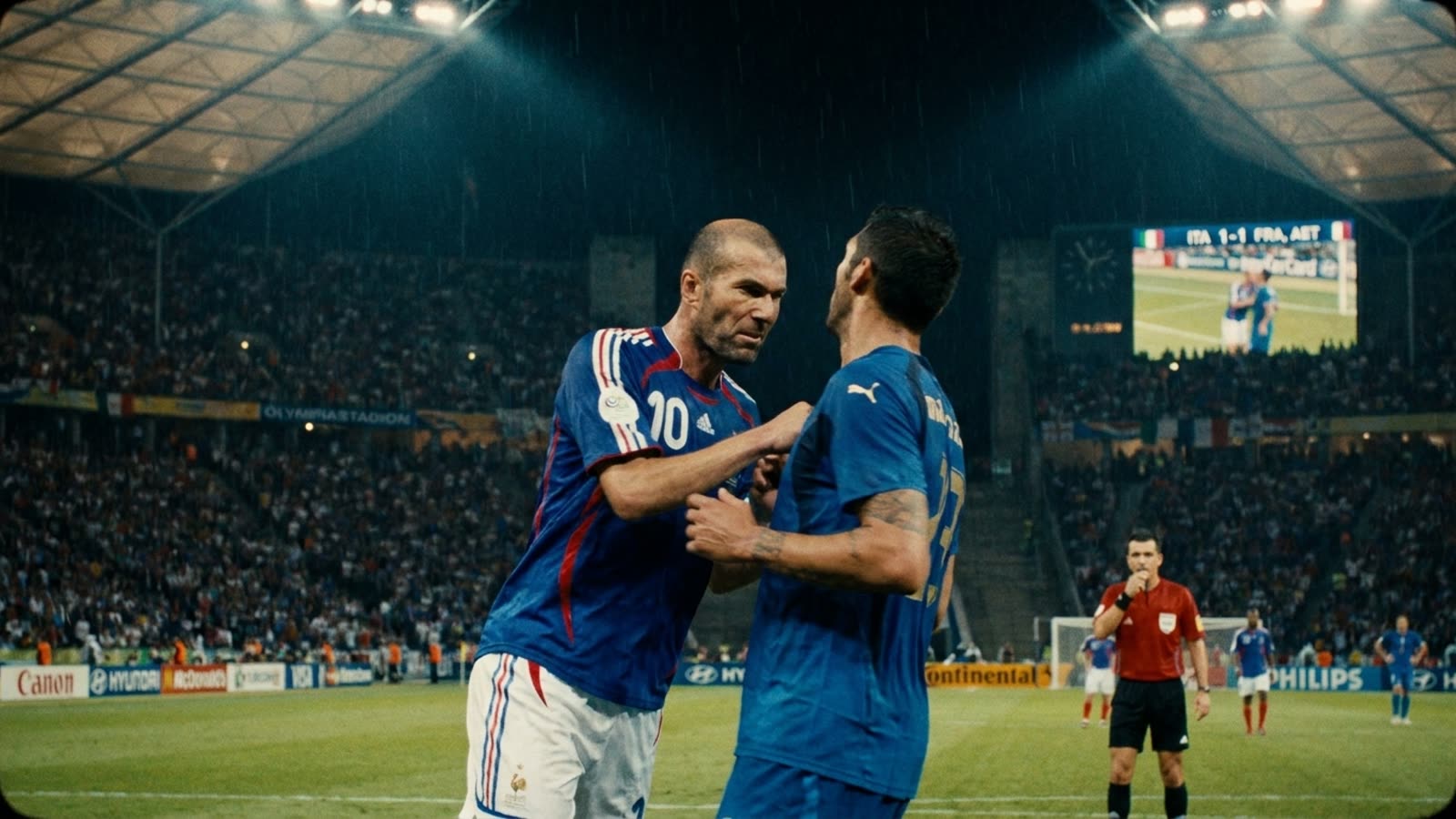
In the 110th minute of his final professional match, with the World Cup trophy minutes away and a billion people watching, Zinedine Zidane walked calmly toward Marco Materazzi and drove his forehead into the Italian defender's chest. It was not a moment of explosive rage but something stranger and more deliberate — a man choosing, with apparent clarity, to end his career in disgrace rather than let an insult pass.
The red card followed. Italy won on penalties. Zidane, widely considered the tournament's best player and one of football's supreme artists, walked past the trophy without glancing at it, down the tunnel, and into a retirement that began with a sending-off. It should have been a tragedy. Instead, it became something more complicated: an indelible image that has somehow enhanced rather than diminished his legend.
The provocation and its aftermath
Materazzi later admitted to insulting Zidane's sister, though the precise words remain disputed. Lip-readers, amateur investigators, and eventually Materazzi himself offered varying accounts. What matters is that Zidane, a man celebrated for his preternatural composure, his ability to slow time in the penalty area, chose violence over victory. He knew the cameras were everywhere. He knew the stakes. He did it anyway.
The football establishment's response was predictably muddled. FIFA handed Zidane a three-match ban he would never serve and fined Materazzi for provocation. The message was unclear: verbal abuse is wrong, but responding to it physically is worse, except when the perpetrator is a beloved icon, in which case we will all quietly agree to focus on his earlier penalty kick and those extraordinary performances against Brazil and Spain.
Why the image persists
Great athletes are supposed to deliver in decisive moments. Zidane had done exactly that throughout his career — the volley against Leverkusen, the brace against Brazil in 1998, the audacious Panenka earlier in that same 2006 final. The headbutt should have overwritten all of it. Instead, it exists alongside those moments, somehow part of the same mythology.
Part of the explanation is aesthetic. The headbutt was, in its awful way, distinctive. Not a punch thrown in fury but a strange, almost formal gesture, delivered with the same economy of movement Zidane brought to a roulette turn. It looked like him. The other part is narrative: we prefer our heroes flawed, and Zidane's flaw arrived at the exact moment when it could do maximum damage to himself. There is something almost sacrificial about it, a refusal to accept humiliation even at the cost of everything.
The selective memory of greatness
Football history is generous to winners and brutal to losers, except when it is not. Zidane's France lost that final. He was sent off in the knockout rounds of a World Cup for the second time in his career. By any rational accounting, his tournament record is checkered. Yet he remains the defining figure of early 21st-century football, and the headbutt is inseparable from that status.
This says something uncomfortable about how we construct sporting legacy. We claim to value sportsmanship, composure, and grace under pressure. We build statues to players who embody those virtues. But we reserve our deepest fascination for moments when the mask slips, when the superhuman reveals himself as merely human, subject to the same provocations and failures of self-control as the rest of us.
Our take
The headbutt was indefensible and unforgettable, which is precisely why it endures. Zidane could have walked away, won the trophy, and retired as the man who delivered when it mattered most. Instead, he gave us something more honest: proof that even transcendent talent cannot insulate a person from their own worst impulses. We say we want our athletes to be role models. What we actually want is for them to be interesting. Zidane, in that terrible final moment, was both.