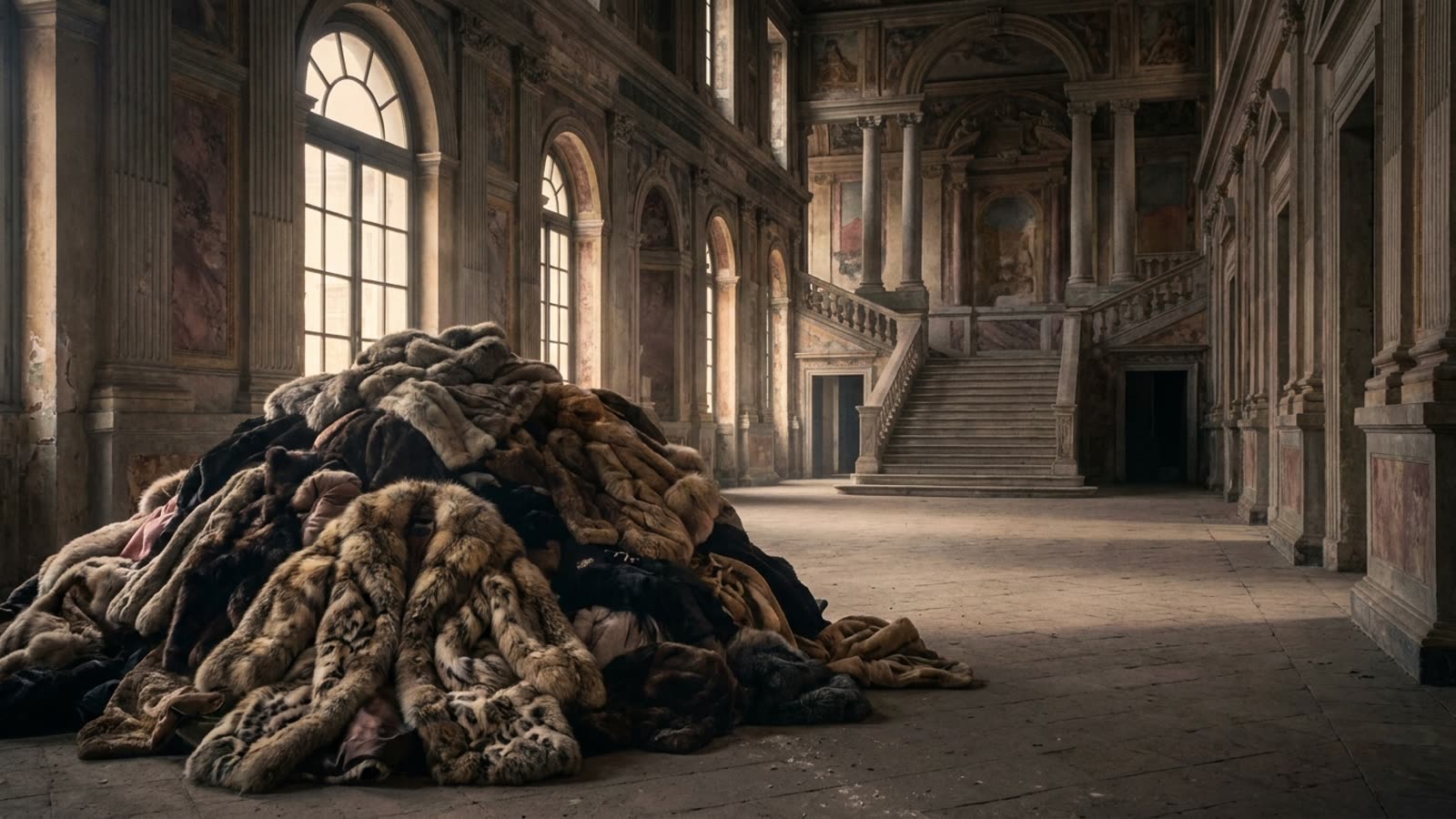
The Camera Nazionale della Moda Italiana has done something unusual for a trade body that represents an industry built on aspiration and discretion: it has taken a moral stance. CNMI, the organization that orchestrates Milan Fashion Week, is now formally encouraging member brands to phase out animal fur—a material that once defined European luxury but has become a liability in an era of climate-conscious consumers and activist shareholders.
The timing is deliberate. Brussels is weighing a comprehensive EU ban on fur farming and imports, a measure that would affect not just fashion houses but also the agricultural economies of Finland, Poland, and Denmark. Milan's declaration gives that legislative push a powerful endorsement from within the industry itself, making it harder for skeptics to dismiss the ban as external moralizing imposed on an unwilling trade.
The economics of abandonment
Fur's decline has been a slow-motion collapse rather than a sudden fall. Gucci dropped it in 2017, Prada in 2019, and Kering group-wide in 2022. Moncler, whose down jackets once featured fur-trimmed hoods as standard, completed its phase-out last year. What remains is a rump of heritage houses—primarily in the outerwear and accessories segments—and a handful of emerging designers who view fur as a provocation.
The financial calculus has shifted accordingly. Kopenhagen Fur, once the world's largest auction house for mink pelts, filed for bankruptcy in 2023 after Denmark culled its entire farmed mink population during the pandemic. Remaining supply chains are fragmented, prices volatile, and reputational risk acute. For most brands, the question is no longer whether to exit fur but how to narrate the exit as a choice rather than a concession.
What an EU ban would actually do
A continent-wide prohibition would accomplish what voluntary pledges cannot: it would remove the arbitrage opportunity for brands that quietly source fur through subsidiaries or licensees while publicly claiming sustainability credentials. It would also standardize labeling requirements, closing the loophole that allows real fur to be sold as faux in certain contexts.
Critics, including some within CNMI, argue that a ban would simply offshore production to China and Russia, where animal welfare standards are lower and enforcement nonexistent. This is the familiar displacement objection, and it carries weight. But proponents counter that Europe's role as the global arbiter of luxury taste means that a ban here would delegitimize fur everywhere, even if it cannot eliminate it.
Our take
Milan's announcement is less a revolution than a ratification. The industry has already voted with its collections, and CNMI is merely formalizing the consensus. The more interesting question is whether the EU will follow through—and whether a ban will accelerate the development of convincing bio-fabricated alternatives or simply leave a gap that no material quite fills. For now, the message from Italy is clear: fur is no longer a signifier of opulence. It is a signifier of yesterday.