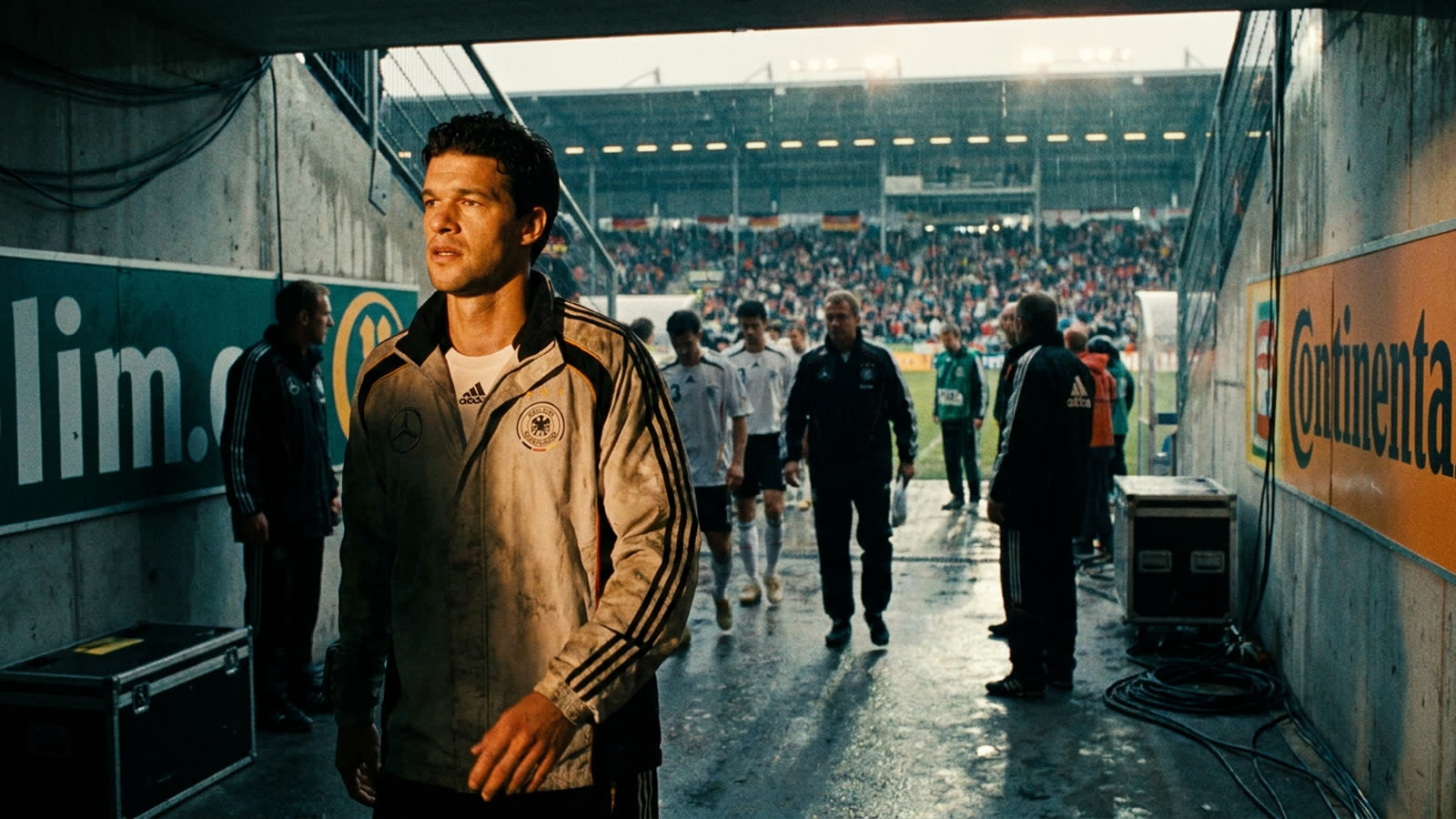
There is a particular cruelty reserved for players who are good enough to carry their teams to finals but not quite blessed enough to win them. Michael Ballack collected runner-up medals the way others collect trophies, and the consistency of his near-misses suggests something beyond bad luck—a kind of cosmic joke at the expense of German football's most complete midfielder of his generation.
Ballack could score from distance, head the ball like a center-forward, tackle like a destroyer, and orchestrate play like a number ten. He was six-foot-two and moved like someone smaller. In an era that produced Zidane's artistry and Gerrard's fury, Ballack offered something rarer: the sense that he could do literally any job on the pitch and do it well.
The 2002 template
The World Cup in South Korea and Japan established the pattern. Ballack dragged an ordinary Germany squad to the final through sheer force of will, scoring crucial goals against the United States and South Korea. In the semifinal, he committed the tactical foul that earned him a yellow card and suspension from the final against Brazil. Germany lost 2-0, and Ballack watched from the stands in his suit, the image of impotent excellence.
This became his signature: the brilliant campaign undone at the last moment, often by his own sacrifice. The yellow card against South Korea was correct—he stopped a certain goal. But correctness is cold comfort when Ronaldo is lifting the trophy.
The club parallel
What makes Ballack's case genuinely strange is that the pattern repeated at club level with eerie precision. With Bayer Leverkusen in 2002, he finished second in the Bundesliga, second in the German Cup, and second in the Champions League—all in the same season. The Germans have a word for Leverkusen now: Vizekusen, the eternal runner-up. Ballack was their avatar.
At Chelsea, he won trophies but missed the biggest ones. The 2008 Champions League final against Manchester United went to penalties; Chelsea lost. Ballack wasn't on the pitch for the decisive kicks—he'd been substituted. In 2010, an injury sustained in the FA Cup final kept him out of the World Cup entirely. Germany, suddenly young and fast without him, finished third.
The talent question
The easy reading is that Ballack was simply not quite at the level of the true greats—that the finals losses revealed a ceiling. This is unconvincing. Watch him play and you see a midfielder who could genuinely do everything, who elevated teammates and terrified opponents, who showed up in big moments with metronomic reliability.
The harder reading is that football, unlike tennis or golf, is irreducibly collective, and individual excellence cannot always overcome institutional mediocrity or simple variance. Ballack's Germany teams were functional but limited. His Leverkusen side overachieved to reach those finals. His Chelsea teams were good but faced a Barcelona entering its greatest era and a Manchester United at its peak.
Our take
Ballack's career is a useful corrective to the trophy-counting that dominates football discourse. The man was magnificent, and the record books will never quite capture it. Sometimes the best player on the pitch loses, and sometimes he loses repeatedly, and sometimes that tells you nothing about his quality and everything about the sport's brutal randomness. Ballack deserved better. Football, characteristically, did not care.