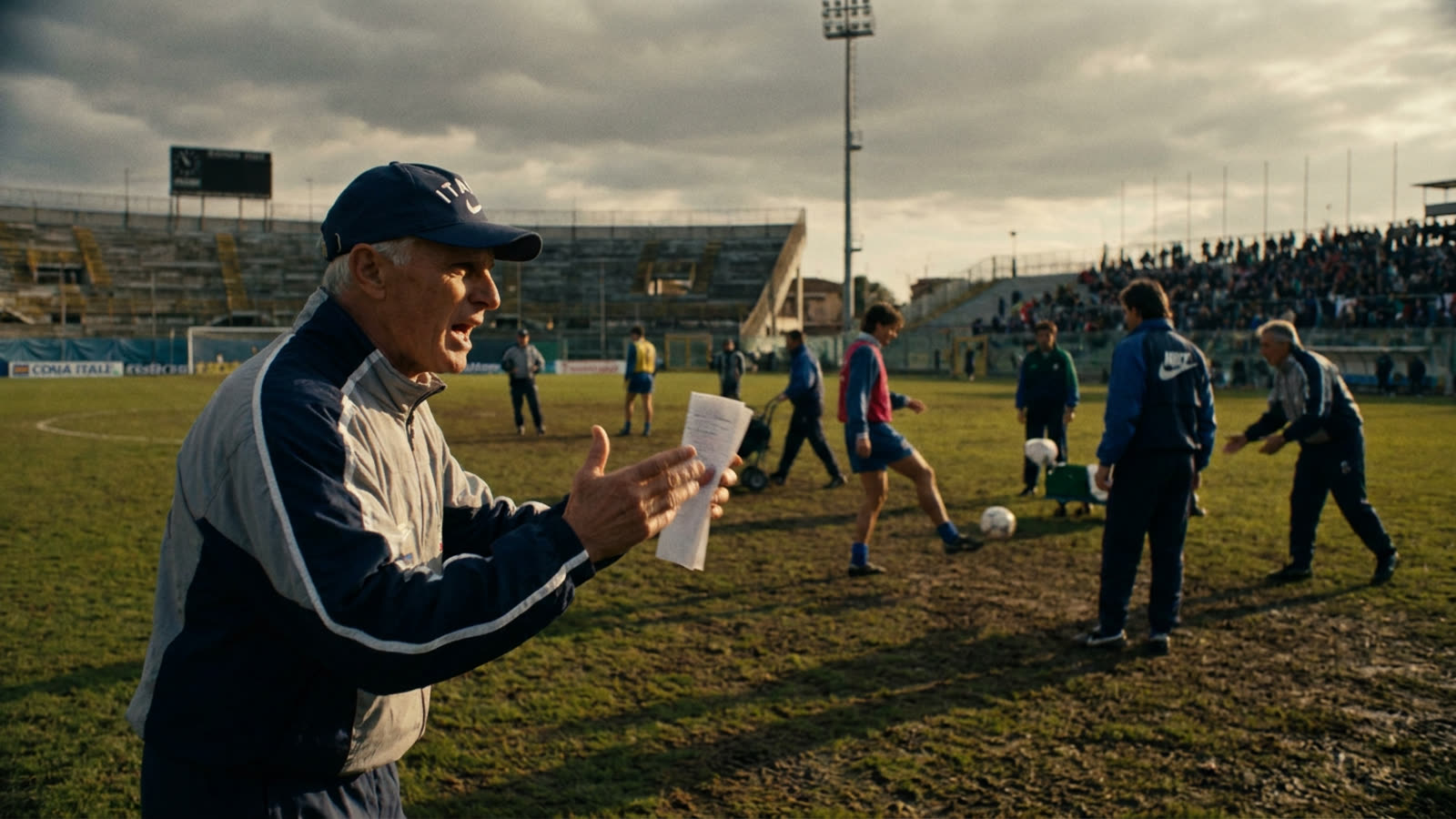
Before Arrigo Sacchi arrived at AC Milan in 1987, the prevailing wisdom in Italian football was immutable: defenders defend, attackers attack, and the man in charge had better have played the game at the highest level. Sacchi had done none of these things in the traditional sense. He sold shoes. He coached in the lower divisions. He had never kicked a ball professionally. When asked about his lack of playing credentials, he offered a response that would become football's most quoted rejoinder: "I never realized that to be a jockey you had to be a horse first."
What Sacchi built at Milan between 1987 and 1991 — two consecutive European Cups, a league title, and a style of play that terrorized opponents — was not merely successful. It was paradigm-shifting. Football before Sacchi and football after him are recognizably different sports.
The geometry of suffocation
Sacchi's innovation was conceptually simple and executionally brutal: the entire team moves as a single organism. His Milan side pressed in coordinated waves, with the back four pushing absurdly high — sometimes to the halfway line — while midfielders and forwards collapsed space around the ball. The distances between players were obsessively maintained. In training, Sacchi would stop sessions to measure the gaps between his defenders with rope.
This was heresy in Serie A, where catenaccio — defensive depth, patient counterattacking — had dominated for decades. Italian football valued individual defensive excellence: the sweeper reading danger, the marking defender winning duels. Sacchi wanted something else entirely. He wanted the system to do the defending, the geometry itself to suffocate opponents before they could create.
The results were spectacular. In the 1989 European Cup semifinal, Milan demolished Real Madrid 5-0 at the Bernabéu, a scoreline so improbable that Spanish newspapers initially assumed a printing error. The final against Steaua Bucharest was 4-0. The following year, Milan retained the trophy.
The disciples and the doctrine
Sacchi's direct influence is traceable through coaching genealogies. Carlo Ancelotti played in that Milan midfield and absorbed the principles before becoming one of the most decorated managers in history. Fabio Capello succeeded Sacchi at Milan and won four Serie A titles. But the deeper legacy runs through those who never worked with him directly yet built upon his foundation.
Pep Guardiola has cited Sacchi as the single greatest influence on his football philosophy. The Barcelona side that won fourteen trophies in four years — the team widely considered the finest club side ever assembled — played a version of Sacchi's principles with the ball rather than against it. Jürgen Klopp's gegenpressing at Borussia Dortmund and Liverpool is Sacchi's coordinated pressing translated into German intensity. When modern analysts discuss "compactness" or "defensive transitions" or "pressing triggers," they are speaking a language Sacchi largely invented.
Our take
The beautiful irony of Sacchi's career is that the football establishment's gatekeeping — the insistence that only former players could understand the game — was proved catastrophically wrong by someone who understood it better than almost anyone who had played it. His Milan teams were not just effective; they were correct in a way that took the sport decades to fully appreciate. Every time a manager speaks of "the team defending as eleven" or drills positional compactness, they are paying unconscious tribute to a shoe salesman from Fusignano who saw football not as a collection of individuals but as a system waiting to be optimized.