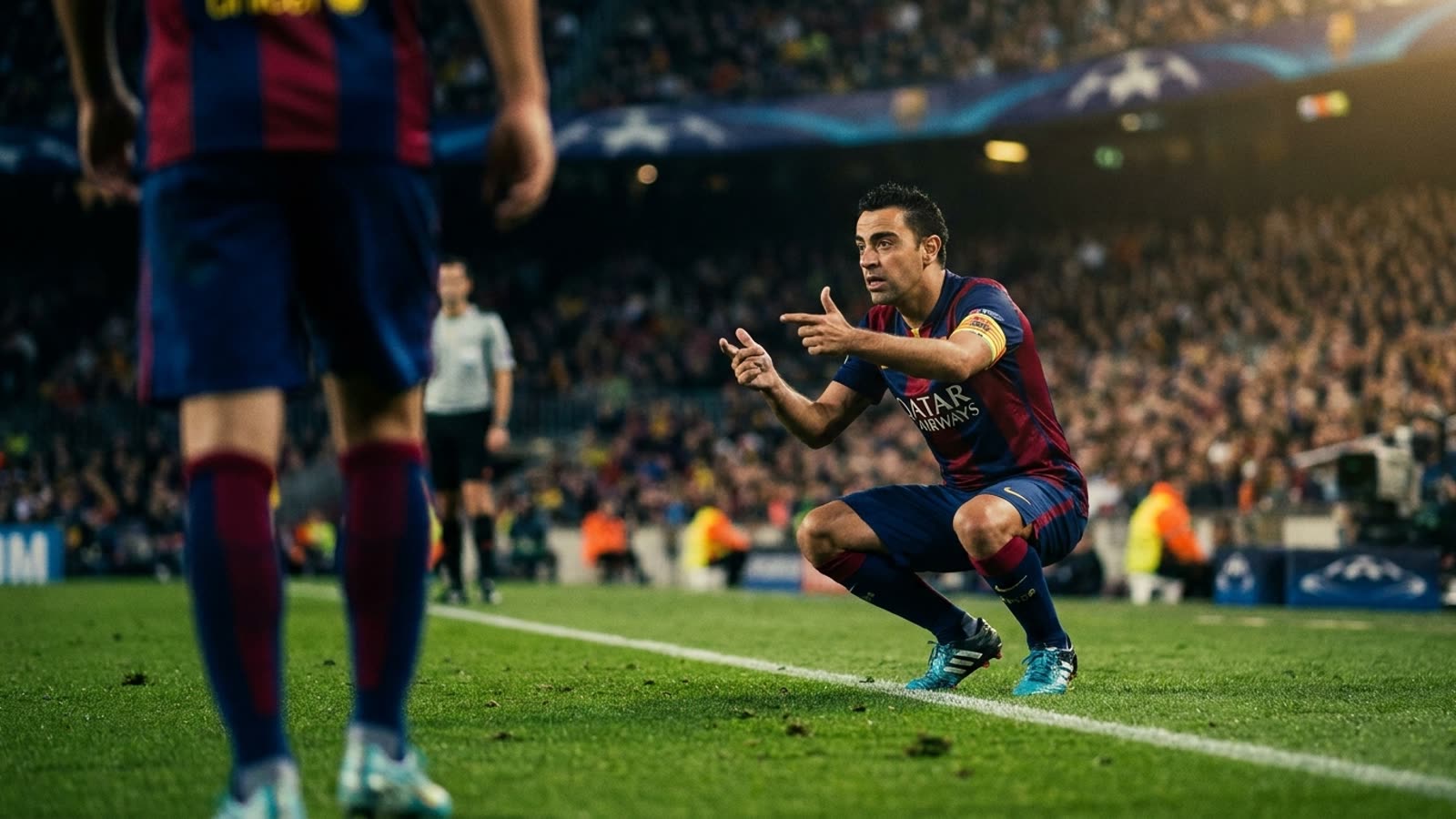
There is a particular kind of genius that looks, to the untrained eye, like nothing at all. Xavi Hernández Creus spent nearly two decades making football appear simple, threading passes into spaces that seemed to exist only in his imagination, always one thought ahead of everyone else on the pitch. He was not fast. He was not powerful. He was not tall. What he possessed instead was something rarer: a cognitive map of the game so complete that he could manipulate time itself, slowing matches down when Barcelona needed control and accelerating them the moment a gap appeared.
The metronome principle
Watch any Barcelona match from the Guardiola era and you will notice something peculiar about Xavi's positioning. He never seemed to be where the action was, yet every attack flowed through him. This was not coincidence but calculation. Xavi's game was built on what he called "looking before receiving" — scanning the pitch obsessively, sometimes dozens of times before the ball arrived at his feet, so that by the time it did, the decision was already made. Studies of his playing style found he completed passes at rates that seemed statistically implausible, often exceeding ninety percent in matches against elite opposition. His secret was not technical perfection, though he had that too, but rather the elimination of uncertainty. By the time defenders closed him down, the ball was already gone.
Spain's World Cup metamorphosis
Before Xavi's generation, Spain was famous for underperforming at major tournaments — talented squads that wilted when pressure arrived. The 2010 World Cup in South Africa changed that narrative permanently. With Xavi conducting from midfield alongside Andrés Iniesta, Spain won the tournament playing a style so possession-dominant that opponents sometimes went entire halves barely touching the ball. The approach was not merely effective but philosophically distinct: rather than defending by positioning players behind the ball, Spain defended by keeping the ball. Xavi was the engine of this philosophy, treating possession as both sword and shield. The victory represented more than a trophy; it was a proof of concept that a team could win football's greatest prize through control rather than chaos.
The inheritance problem
Every great player leaves behind imitators, but Xavi's legacy presents a particular challenge. His style required not just technical skill but a specific kind of football intelligence that cannot be easily coached. Barcelona and Spain have spent years searching for his successor, cycling through talented midfielders who can pass but cannot see, or who can see but cannot execute under pressure. The difficulty is that Xavi's game depended on an entire system — the positional play, the pressing triggers, the collective understanding — that made his individual brilliance possible. Isolate his qualities and they become merely good; embedded in the right structure, they became transformative. This is perhaps his most lasting contribution: the demonstration that football's highest level is not about individuals but about how individuals think together.
Our take
Xavi's career is a rebuke to the cult of athleticism that dominates modern football discourse. In an era obsessed with speed, power, and physical metrics, he proved that the mind remains the most important muscle. His retirement from playing has not diminished his influence; if anything, the struggles of teams trying to replicate his approach have only clarified how singular he was. Football will continue producing fast wingers and powerful strikers, but players who can think at Xavi's level remain vanishingly rare. He did not change the game through spectacle. He changed it through understanding.