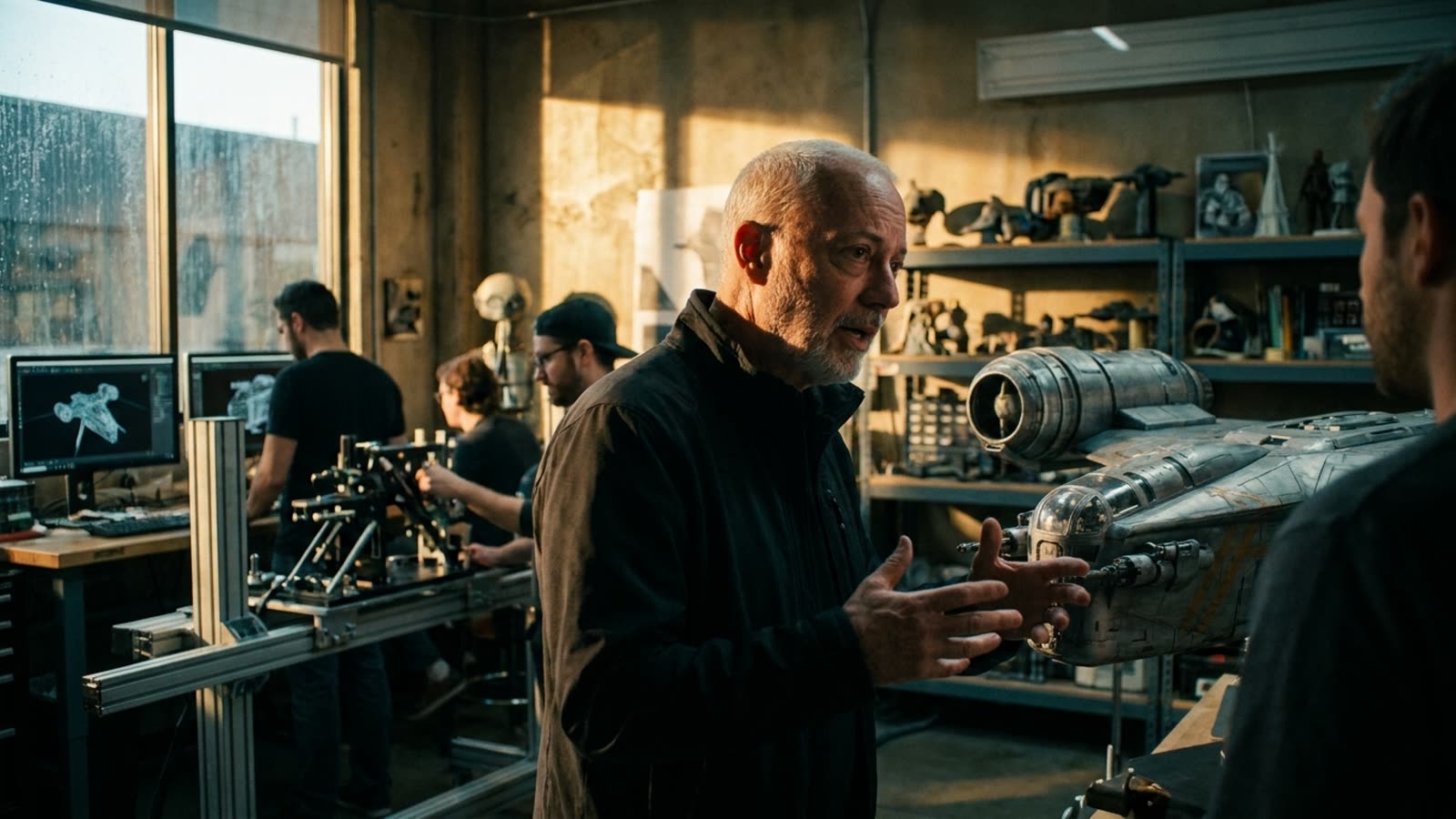
When Hal Hickel sits down to animate a scene for Jon Favreau, he doesn't consult the latest neural-network upscaling tool or pore over mocap data. He asks himself what Phil Tippett—the stop-motion maestro who gave the original trilogy its tactile soul—would have done with a puppet and a camera. It's a deliberately anachronistic question for a film reportedly north of $300 million, and that's precisely the point.
Hickel, Industrial Light & Magic's animation supervisor on The Mandalorian and Grogu, has spent decades bridging the analog and digital eras of creature work. His latest interview with Variety offers a rare window into how the franchise's first theatrical outing since 2019 is trying to recapture a quality that CGI spectacle often obliterates: weight. The Rotta redesign—Jabba the Hutt's son, last seen as an infant in the much-maligned Clone Wars film—exemplifies the approach. Rather than smoothing every wrinkle into photorealism, Hickel's team leaned into the rubbery, slightly awkward physicality of the original Hutt puppet, trusting that audiences respond to imperfection.
Favreau's anti-slick directive
The director's mandate, per Hickel, was blunt: "Less James Bond, more Jackass." Translation: no frictionless action, no weightless acrobatics, no heroes who never stumble. Favreau wants Din Djarin to feel like a guy in heavy armor, not a superhero in a helmet. The philosophy extends to Grogu, whose movements still reference the practical puppet used on set even when digital augmentation takes over. The goal is continuity of texture—making the audience forget they're watching a $300 million movie.
The Tippett inheritance
Tippett's influence on modern blockbuster VFX is difficult to overstate. His go-motion technique on The Empire Strikes Back and Return of the Jedi gave creatures like the tauntaun and the rancor a heft that pure animation couldn't replicate. Hickel worked under Tippett early in his career and absorbed a core lesson: the camera should feel like it's struggling to keep up with something real, not effortlessly tracking a digital asset. In an era when AI-assisted animation can generate smooth, plausible movement in hours, that roughness has become a stylistic choice rather than a technical limitation—and, Hickel argues, a more emotionally resonant one.
Why it matters for Star Wars
Disney's galaxy far, far away has spent the past decade oscillating between reverence and reinvention, often satisfying neither camp. The Mandalorian television series succeeded partly because it felt handmade—Volume technology notwithstanding—in a franchise that had grown slick to the point of sterility. Translating that ethos to IMAX screens, where every seam is magnified, is the film's central gamble. Hickel's comments suggest the production is betting that tactility will scale better than spectacle.
Our take
Hollywood's VFX discourse has calcified into a binary: soulless CGI versus noble practical effects. Hickel's Tippett invocation is a reminder that the real divide is philosophical, not technological. You can render a creature in ones and zeros and still make it feel like it has mass, breath, and a bad knee. Whether The Mandalorian and Grogu pulls that off won't be clear until May, but the intention—treating imperfection as a feature, not a bug—is the most encouraging thing to come out of Lucasfilm's publicity machine in years.